

Crypto Asset Market Analysis (November 3)
0
【Crypto Asset Market Report: Summary of market conditions and major news as of November 3, 2026】
We comprehensively organize and explain the status of major crypto asset (virtual currency) markets as of November 3, 2026. Overall, the market trend is on a slight decline to a flat movement, andthe continued weak price action from the latter half of last week remains unresolved.
■ Today's price movements and main market factors
The individual movements of major assets are as follows.
Bitcoin (BTC) is hovering around about $77,200. In the past 24 hours, the volatility has been a decline of roughly 0.5% to 1.5%, with a brief dip to around $76,300, but subsequently there has been a slight rebound with some dip-buying coming in.However, on a weekly basis, it has fallen by about 4%, indicating a notable resistance to upside.
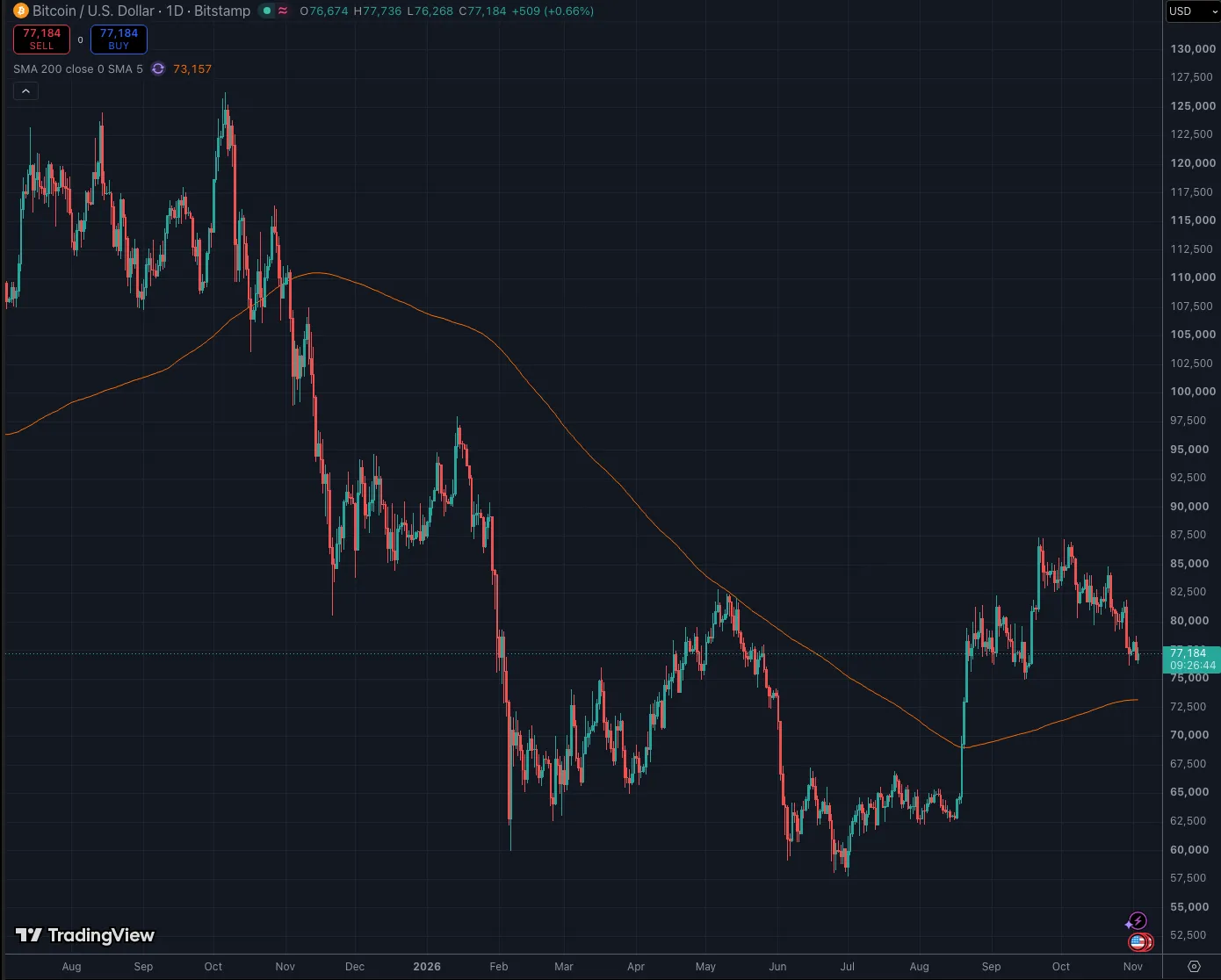
Bitcoin daily chart
Ethereum (ETH) is trading in a range from about $2,250 to $2,280, showing largely flat movement with a slight decline over the past 24 hours (with minor increases in some phases). Compared to Bitcoin, volatility is relatively lower and the trend is more stable.
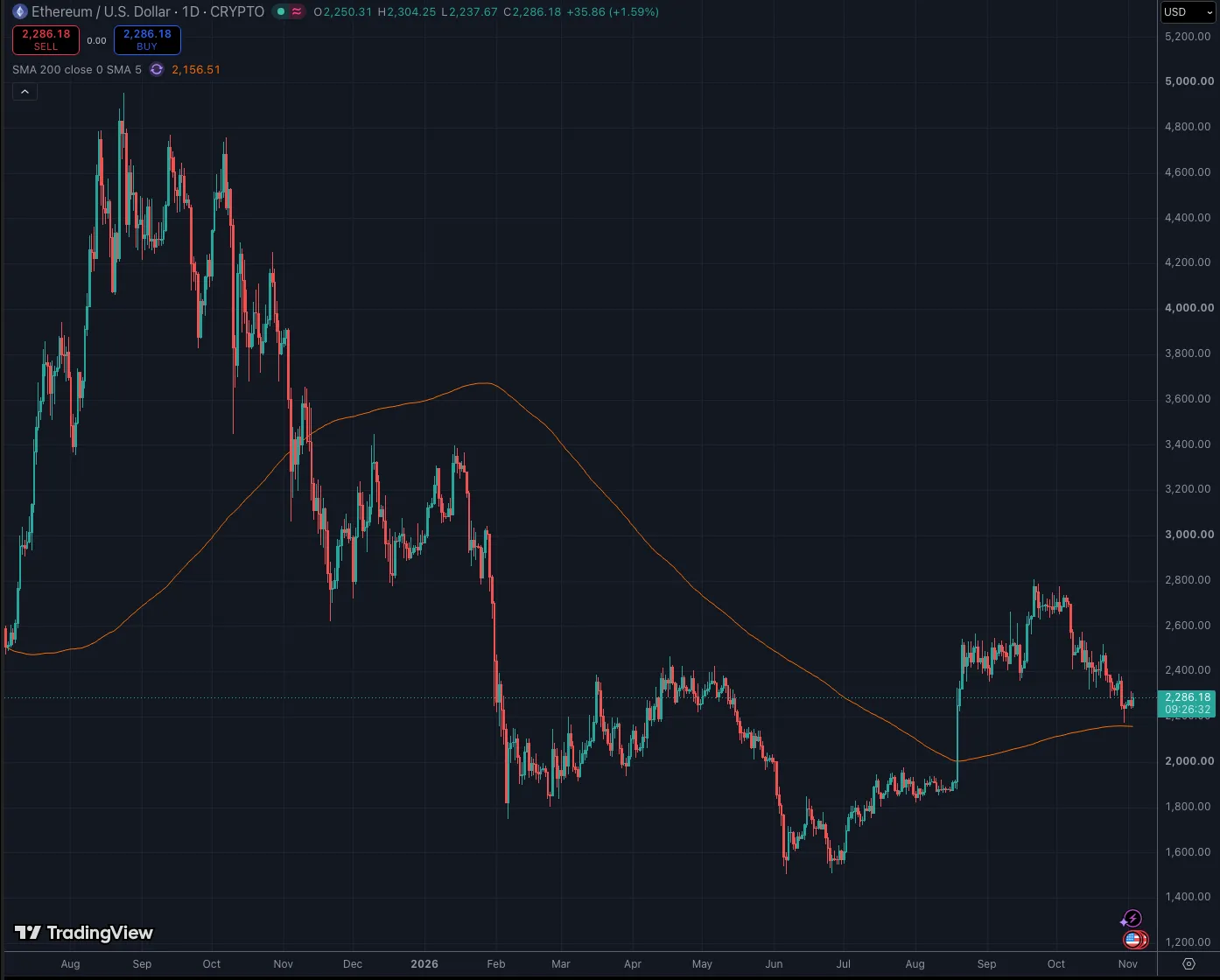
Ethereum daily chart
The total market capitalization of crypto assets has slightly decreased from about $2.57 trillion to about $2.58 trillion. Also,the Fear & Greed Index, a representative indicator of investor sentiment, is in the Fear range around 26 to 33, indicating a subdued moodand market participants are highly cautious and risk-off.This index moved from 68 to 51 before the hacking incident, but deteriorated sharply after the incidentand fell well below the 30-day moving average of 56. CryptoQuant, a data analytics firm, also cautions that “sentiment and price have not clearly reversed or recovered, so a true bottom cannot be said yet.”
The main factors weighing on the market can be summarized as follows:
Continued outflows from BTC spot ETFs On Monday, November 2, there was a net outflow of about $399 million from the entire U.S. Bitcoin spot ETF market. In particular, a large outflow of about $405 million from BlackRock’s IBIT led the overall outflow. A large outflow of about $643 million was confirmed on October 30 as well, indicating a notable decline in demand and selling pressure from institutional investors in the short term.
Aftereffects of a major hacking incident at Binance
Around October 29, Binance suffered the largest hacking loss in history, about $6.3 billion (roughly 1 trillion yen). Through internal investigations and authorities’ inquiries, it was determined that the operation engineer’s PC was the entry point, and the involvement of a North Korea-linked hacker group is highly likely.Binance stated that it would “fully compensate customer funds with its own funds” and resumed withdrawals that had been paused. However, since the incident, net outflows from customer accounts reached roughly $4.7 billion, and restoring market trust is taking time. Additionally, security incidents around Mercado Bitcoin and other related platforms occurred around the same time, further heightening market anxiety.Macroeconomic uncertainty accompanying the U.S. midterm elections Today (Nov 3) is the voting day for the U.S. midterm electionsand financial markets are tense. Although not a presidential election,which party controls the Senate and House of Representatives will heavily influence future crypto asset regulations, fiscal policies, and investor risk sentiment.Note that predictive markets increasingly expect Democrats to control the House (94%) and Senate (71%). Historically, the bottom prices in Bitcoin’s last three cycles occurred after midterm elections, which is notable.Other layered downward factors include the softening US tech stocks, global risk-off mood in financial markets, and a de-leveraging of the derivatives markets, all of which weigh on crypto asset prices.■ Price trends since last week and market backgroundBitcoin was in a relatively high range of around $80,000 to $81,000 in the latter half of October, but from October 29 to 30, the Binance hacking shock news forced a sharp decline.The rebound after the plunge has been very weak, and it is now trading in the $76,000 to $78,000 range, with a weekly decline of about 3% to 4%. Ethereum likewise remains soft, testing an important technical support around $2,200 with cautious moves.Overall, the market can be characterized as a “correction and stagnation driven by ongoing loss of market confidence after the historic hacking incident, combined with outflows from spot ETFs and macro uncertainty from politics and the economy.”■ Net fund flow status of Bitcoin spot ETFs (last about 1 week)Net inflows/outflows of Bitcoin spot ETFs on the latest business days (approximate) are as follows.Oct 26: +$110 million (inflow) Oct 27: +$176 million (inflow) Oct 28: +$137 million (inflow) Oct 29: +$17 million (inflow) Oct 30: -$643 million (large outflow) Nov 2: -$399 million (large outflow)In the first half of the week (Oct 26-29), there was a total net inflow of about $440 million, appearing solid, but in the latter half of the week, only two trading days saw outflows exceeding $1 billion. As a result, the net outflow over the last five business days totaled about $712 million, entirely erasing the early inflows.However, the cumulative net inflow since ETF inception remains about $56.6 billion, and total assets under management (AUM) stay around $980 billion, indicating very high levels. The mid-to-long-term institutional investor base remains intact, but in the short term, net outflows act as a significant hurdle to price gains.■ notable moves in the altcoin marketThe market overall is bearish, but individual factors and sector-specific dynamics show divergence among coins.Major upswings: ALEO surged roughly 13% to 14% in a sharp rebound; TRON (TRX) held around +2% and remained firm. Privacy-focused coins Monero (XMR), cross-chain protocol LayerZero (ZRO), PIEVERSE, etc., also stayed in positive territory.Major declines: NEAR Protocol (NEAR) fell by about 5% to 10% and Zcash (ZEC) followed with around -6%. Additionally, assets like Ethena (ENA) and Lisk (LSK) showed weak price movements.Solana (SOL) and BNB, representative altcoins, also declined only modestly, overall moving in tandem with Bitcoin’s weakness. On the other hand, projects related to RWA (Real World Assets) are relatively well bid, suggesting demand amid broader risk-off sentiment.In summary, the current crypto asset market is facing a three-front strain: the Binance hacking shock, net outflows from spot ETFs, and macro uncertainty from the U.S. midterm elections, leading to cooled investor sentiment. Bitcoin is testing the $76,000 support, and a clear break below could raise concerns about further downside.■ Key topics and news in crypto assets and blockchain◯ US monetary policy and macroeconomic trends The Federal Reserve decided to hold the policy rate in the range of 3.75%–4.00}.The Fed’s Waller stated that inflation has remained above target for nearly six years and is still too high. In the decision, two participants advocated further rate hikes, resulting in an unusual 10-2 vote. The hawkish stance of “higher for longer” was maintained, andno rate cut was signaled for the December meeting.◯ Details of the Binance hacking incident and its implications for international politics The approximately $6.3 billion outflow from Binance revealed the full picture of funds laundering through 11 blockchains, over 12,000 wallets, and more than 40,000 complex transactions. About 44% of the outflow (roughly $2.85 billion, including around $970 million in USDT) was frozen by authorities and issuers, but more than $3.2 billion remains under the criminals’ control. Some transfer routes were found to be the same as in the BitGet hacking incident, highlighting the scale of state-sponsored cybercrime.In response to this,President Trump stated at a Halloween party press briefing that “the FBI is investigating, and if North Korea’s involvement is confirmed, we will engage directly with the authorities.”Kim Yo-jong of North Korea countered that “international cybercrime is always blamed on North Korea,” denying involvement; she suggested that revealing who ultimately gets seized funds would expose the true mastermind.Data shows that North Korea–linked hacker groups have stolen crypto assets totaling about $12.8 billion since 2017 (roughly 45% of the country’s GDP), illustrating the scale of state-level financing. Moreover, the total hacking damages in October alone reached $648 million, a 745% month-over-month surge. The top 10 thefts accounted for 92.3% of all damages, indicating a trend toward targeting large exchanges and services.CFTC Chairman noted that offshore exchanges lack the same safety standards as U.S. exchanges and advocated mandatory federal registration and stronger cybersecurity standards.◯ Ripple has announced a partnership with Coinbase to expand the rollout of the USD-pegged stablecoin RLUSD. Following a partnership with Robinhood, this supports strengthening financial infrastructure in the United States.◯ Google announced a cryptocurrency custody system using MPC (multi-party computation) technology for large banks. By distributing the management of private keys, it enables secure storage and transfers of crypto assets, and several traditional financial institutions are already testing it.◯ Bitcoin-related newsBitcoin-related topics Since Satoshi Nakamoto published “Bitcoin: A Peer-to-Peer Electronic Cash System,” October 31 marked the 18th anniversary.MicroStrategy, which pursues corporate Bitcoin holdings, announced an additional purchase of 810 BTC (about $63 million). Last week focused on share repurchases of preferred stock, but they are returning to increasing Bitcoin holdings.【Premium subscription information】In the premium subscription area, we offer deeper, valuable analysis of individual coins.“Bitcoin and Ethereum are not the end; I want to invest in the next big winning token.”“I want to understand the authentic flows and future of the crypto market and surely ride that wave.”If you think this way, please consider subscribing. Continuous high-quality research is the key to great success.(This report has been delivering the forefront of the market since its launch in 2016)
Macroeconomic uncertainty accompanying the U.S. midterm elections Today (Nov 3) is the voting day for the U.S. midterm electionsand financial markets are tense. Although not a presidential election,which party controls the Senate and House of Representatives will heavily influence future crypto asset regulations, fiscal policies, and investor risk sentiment.
Note that predictive markets increasingly expect Democrats to control the House (94%) and Senate (71%). Historically, the bottom prices in Bitcoin’s last three cycles occurred after midterm elections, which is notable.
Other layered downward factors include the softening US tech stocks, global risk-off mood in financial markets, and a de-leveraging of the derivatives markets, all of which weigh on crypto asset prices.
■ Price trends since last week and market background
Bitcoin was in a relatively high range of around $80,000 to $81,000 in the latter half of October, but from October 29 to 30, the Binance hacking shock news forced a sharp decline.The rebound after the plunge has been very weak, and it is now trading in the $76,000 to $78,000 range, with a weekly decline of about 3% to 4%.
Ethereum likewise remains soft, testing an important technical support around $2,200 with cautious moves.
Overall, the market can be characterized as a “correction and stagnation driven by ongoing loss of market confidence after the historic hacking incident, combined with outflows from spot ETFs and macro uncertainty from politics and the economy.”
■ Net fund flow status of Bitcoin spot ETFs (last about 1 week)
Net inflows/outflows of Bitcoin spot ETFs on the latest business days (approximate) are as follows.
Oct 26: +$110 million (inflow) Oct 27: +$176 million (inflow) Oct 28: +$137 million (inflow) Oct 29: +$17 million (inflow) Oct 30: -$643 million (large outflow) Nov 2: -$399 million (large outflow)
In the first half of the week (Oct 26-29), there was a total net inflow of about $440 million, appearing solid, but in the latter half of the week, only two trading days saw outflows exceeding $1 billion. As a result, the net outflow over the last five business days totaled about $712 million, entirely erasing the early inflows.
However, the cumulative net inflow since ETF inception remains about $56.6 billion, and total assets under management (AUM) stay around $980 billion, indicating very high levels. The mid-to-long-term institutional investor base remains intact, but in the short term, net outflows act as a significant hurdle to price gains.
■ notable moves in the altcoin market
The market overall is bearish, but individual factors and sector-specific dynamics show divergence among coins.
Major upswings: ALEO surged roughly 13% to 14% in a sharp rebound; TRON (TRX) held around +2% and remained firm. Privacy-focused coins Monero (XMR), cross-chain protocol LayerZero (ZRO), PIEVERSE, etc., also stayed in positive territory.
Major declines: NEAR Protocol (NEAR) fell by about 5% to 10% and Zcash (ZEC) followed with around -6%. Additionally, assets like Ethena (ENA) and Lisk (LSK) showed weak price movements.
Solana (SOL) and BNB, representative altcoins, also declined only modestly, overall moving in tandem with Bitcoin’s weakness. On the other hand, projects related to RWA (Real World Assets) are relatively well bid, suggesting demand amid broader risk-off sentiment.
In summary, the current crypto asset market is facing a three-front strain: the Binance hacking shock, net outflows from spot ETFs, and macro uncertainty from the U.S. midterm elections, leading to cooled investor sentiment. Bitcoin is testing the $76,000 support, and a clear break below could raise concerns about further downside.
■ Key topics and news in crypto assets and blockchain
◯ US monetary policy and macroeconomic trends The Federal Reserve decided to hold the policy rate in the range of 3.75%–4.00}.The Fed’s Waller stated that inflation has remained above target for nearly six years and is still too high. In the decision, two participants advocated further rate hikes, resulting in an unusual 10-2 vote. The hawkish stance of “higher for longer” was maintained, andno rate cut was signaled for the December meeting.
◯ Details of the Binance hacking incident and its implications for international politics The approximately $6.3 billion outflow from Binance revealed the full picture of funds laundering through 11 blockchains, over 12,000 wallets, and more than 40,000 complex transactions. About 44% of the outflow (roughly $2.85 billion, including around $970 million in USDT) was frozen by authorities and issuers, but more than $3.2 billion remains under the criminals’ control. Some transfer routes were found to be the same as in the BitGet hacking incident, highlighting the scale of state-sponsored cybercrime.
In response to this,President Trump stated at a Halloween party press briefing that “the FBI is investigating, and if North Korea’s involvement is confirmed, we will engage directly with the authorities.”Kim Yo-jong of North Korea countered that “international cybercrime is always blamed on North Korea,” denying involvement; she suggested that revealing who ultimately gets seized funds would expose the true mastermind.
Data shows that North Korea–linked hacker groups have stolen crypto assets totaling about $12.8 billion since 2017 (roughly 45% of the country’s GDP), illustrating the scale of state-level financing. Moreover, the total hacking damages in October alone reached $648 million, a 745% month-over-month surge. The top 10 thefts accounted for 92.3% of all damages, indicating a trend toward targeting large exchanges and services.
CFTC Chairman noted that offshore exchanges lack the same safety standards as U.S. exchanges and advocated mandatory federal registration and stronger cybersecurity standards.
◯ Ripple has announced a partnership with Coinbase to expand the rollout of the USD-pegged stablecoin RLUSD. Following a partnership with Robinhood, this supports strengthening financial infrastructure in the United States.
◯ Google announced a cryptocurrency custody system using MPC (multi-party computation) technology for large banks. By distributing the management of private keys, it enables secure storage and transfers of crypto assets, and several traditional financial institutions are already testing it.
◯ Bitcoin-related news
Bitcoin-related topics Since Satoshi Nakamoto published “Bitcoin: A Peer-to-Peer Electronic Cash System,” October 31 marked the 18th anniversary.
MicroStrategy, which pursues corporate Bitcoin holdings, announced an additional purchase of 810 BTC (about $63 million). Last week focused on share repurchases of preferred stock, but they are returning to increasing Bitcoin holdings.
【Premium subscription information】
In the premium subscription area, we offer deeper, valuable analysis of individual coins.
“Bitcoin and Ethereum are not the end; I want to invest in the next big winning token.”
“I want to understand the authentic flows and future of the crypto market and surely ride that wave.”
If you think this way, please consider subscribing. Continuous high-quality research is the key to great success.
(This report has been delivering the forefront of the market since its launch in 2016)
× ![]()