
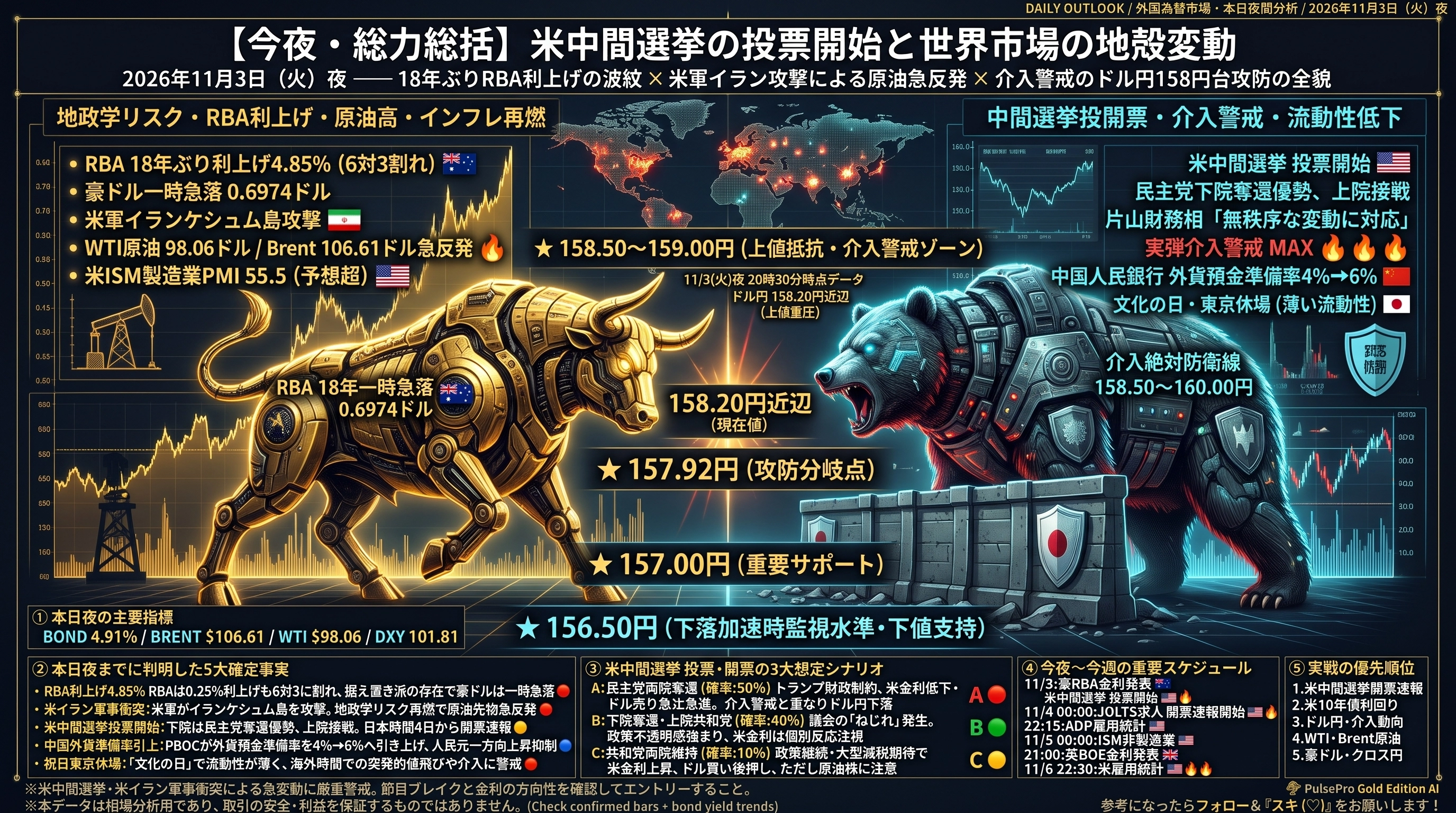
【Global Financial Markets Review】Voting for the U.S. midterm elections begins・RBA at highest level in 18 years, sharp drop after rate hike・U.S.-Iran military clash and crude rebound――The full picture of the dramatic changes that struck on the night of Nov
On the night of Tuesday, November 3, 2026, global currency and financial markets are enveloped in extreme tension as a massive political and financial event with potential history-making turning points coincides.
Today is the voting day for the US midterm elections held on November 3, US time, while at the same time the Reserve Bank of Australia (RBA) raised its policy rate to 4.85%, the highest in 18 years. Furthermore, in the Middle East, reports emerged that the United States attacked Iran’s Kish Island for defensive purposes, causing crude oil prices, which had fallen more than 7% the previous day on diplomatic expectations, to sharply rebound. This reflects multifaceted risks exploding simultaneously.
While Japan observes Culture Day as a holiday and its markets are closed, the dollar-yen moves in a market-led fashion around 158.20 yen. While Foreign Exchange Intervention warnings from Finance Minister Shunichi Suzuki and the policy alignment with the US restrain upside, strong US economic indicators (October ISM Manufacturing PMI 55.5) and the trajectory of US long-term interest rates intricately interact.
Based on confirmed facts and official data as of 20:30 on November 3, this article logically explains the full picture of today's financial markets and practical points of attention.
Chapter 1: The 7 Major Points that Shake Tonight
A summary of the key macro factors currently dominating the market.
RBA rate hike (4.85%):A 0.25 percentage point increase brings the rate to the highest in 18 years, but the vote was 6–3, dampening expectations for further hikes and causing the Australian dollar to drop sharply at one point.
Start of voting in the US midterms:House of Representatives leans toward Democrats retaking control, Senate is in a tight race. The main focus is on live vote tallies from November 4 to 5 Japan time.
Resurgence of US–Iran military confrontation:The US attacked Kish Island in Iran. With Middle East risk flaring up again, WTI crude rose back to the 98-dollar area and Brent to the 106-dollar area.
China’s yuan reserve requirement hike:The People's Bank of China (PBOC) raised foreign currency reserve requirements from 4% to 6%, aimed at curbing excessive yuan appreciation.
Japan holiday closure:With Tokyo markets closed, there is caution about overseas market-driven rapid moves during low-liquidity periods.
Strength in US ISM Manufacturing:October ISM Manufacturing PMI at 55.5 exceeded expectations, signaling underlying strength of the US economy.
Continued vigilance on AI-related stocks:Profit-taking and capital expenditure concerns for tech shares suppress global risk appetite.
Chapter 2: Domestic Factors in Japan — Holiday Closure, FX Intervention, and the BOJ’s Position
While the Tokyo market is closed for Culture Day, the dollar-yen is around 158.20 yen.
1. Holiday-Specific Liquidity and Intervention Vigilance
On holidays when actual demand and domestic financial institutions’ activity thin, headlines can move prices sharply. The reiterated stance by Finance Minister Satsuki Katayama to respond to disorderly FX moves and the plan for close US–Japan FX policy cooperation remain a restraint on dollar-yen rising toward the mid-to-upper 157s and 158s. The government has not specified a defense level, but if speculative selling of the yen accelerates, a rapid rebound in the yen could occur, requiring caution.
2. BOJ Policy and Inflation Pressure
Assuming the 1.25% hold at the October meeting, key variables for judging the timing of future rate hikes include imported price trends and sustained oil prices from Middle East tensions. If crude oil surges again, domestic inflation pressure will directly impact BOJ policy decisions, keeping a structure of FX intervention vigilance and tightening expectations high.
Chapter 3: The Day’s Biggest Political Event — Structure and Market Impact of the US Midterms
The US midterms that began voting on November 3 US time represent the greatest fork in policy direction for the remaining two years of the Trump administration.
[Scenario estimates by UBS and others on Congressional makeup]
- Democrats retake both chambers (probability 50%)
- Democrats win the House, Republicans win the Senate (probability 40%)
- Republicans retain both chambers (probability 10%)
Note: currently Democrats lead in the House, with the Senate in a tight race.
Market Impacts of Election Results on Monetary Policy and Markets
Scenario A (Democrats retake both chambers):
Tighter constraints on large fiscal policies and additional tax cuts during the Trump era. Diminished debt issuance concerns could lead to lower US long-term rates and a weaker dollar, potentially pressuring USD/JPY lower.
Scenario B (Democrats win the House, Republicans keep the Senate):
Policy gridlock may intensify fiscal negotiations and policy ambiguity. Markets would closely watch US rate reaction on a per-country basis.
Scenario C (Republicans hold both chambers):
Policy continuity could raise expectations for tax cuts and fiscal policy, potentially supporting US rates and USD appreciation (USD/JPY higher). However, if Middle East conflict triggers stock declines and oil rises, simple USD/JPY up-move may be limited.
From Wednesday, November 4 to the 5th, the live vote tallies will be a major driver for not only USD/JPY but also US Treasuries and the broader stock market volatility.
Chapter 4: RBA Rate Hike — Why Did the AUD Decline?
Today, November 3, the Reserve Bank of Australia (RBA) raised its policy rate by 0.25 percentage points as expected, to 4.85%. This is the highest level in about 18 years since late 2008 and marks the fifth rate hike of 2026.
[RBA Board Decision Summary]
- Policy rate: 4.60% ➜ 4.85% (+0.25%)
- Vote: 6–3 (hiking majority 6, hold 3)
- Background: September inflation accelerated to 4.3% year-on-year; Middle East conflict boosted fuel costs; AI
- High costs of tech-related capital expenditures.
Why did the AUD fall despite hikes?
After the rate hike, AUD/USD briefly fell to 0.6974.
The rate increase was already fully priced in by the market.
The vote was split 6–3, with 3 members supporting hold.
From Governor Michelle Bullock’s explanation, the market interpreted the hike as nearing the end of tightening.
This phenomenon shows that a rate increase does not automatically guarantee currency appreciation. When trading AUD/JPY, do not rely solely on the RBA decision; calmly assess future rate-hike pace, China’s economy, and global risk sentiment for potential directional changes.
Chapter 5: Reignition of US–Iran Military Clash and Oil Price Decline and Rise
Middle East tensions have surged to a peak, reversing the prior diplomatic optimism with heightened military risk.
1. US Attack on Kish Island
According to Reuters, the United States carried out a defensive attack on Iran’s Kish Island. While the claim is framed as safeguarding maritime trade, Iran rejects the US demands, deepening the rift between the two countries.
2. Oil Prices Rebound Sharply
Oil, which had fallen more than 7% the previous day on diplomatic prospects mediated by Qatar, rebounded immediately due to this military action.
WTI crude futures: about $98.06/bbl (+$1.60)
Brent crude futures: about $106.61/bbl (+$1.84)
renewed oil price pressures sustain global inflation, complicating central bank policy outlooks. The focus going forward is whether geopolitical risk will weigh on equities and emerging market currencies.
Chapter 6: PBOC Raises Foreign Exchange Deposit Reserve Requirement
Today, the People’s Bank of China announced raising the foreign currency deposit reserve requirement for financial institutions from 4% to 6% (effective November 15). This will absorb about $24 billion in funds from the market.
Background:To curb excessive one-way appreciation of the yuan against the dollar since 2026 and to prompt a yuan deprecation adjustment.
Impact:Diminished yuan upward pressure could transmit nervous price movements to resource currencies like AUD and NZD, affected by Chinese economy and commodity demand.
Chapter 7: US Economic Indicators (ISM Manufacturing) and Major Bond Yields
The US October ISM Manufacturing PMI released on November 2 came in at 55.5 (vs expected 54.5, prior 54.5), signaling strength in new orders and employment and underscoring the resiliency of the US economy.
[Major 10-year government yields as of November 3 (reference)]
- US 10-year yield: 4.91% (30-year around 5.29%, above 5%)
- Japan 10-year yield: 2.77%
- Germany 10-year yield: 3.29%
- UK 10-year yield: 5.19%
While US 10-year yields hover around 4.91% and the 30-year remains above 5%, the long-term fiscal deficits and persistent inflation expectations support the dollar’s downside base.
Chapter 8: FX Market and Major Currency Pairs
Key currency levels as of November 3.
USD/JPY:158.20 yen
EUR/USD:1.1177 dollars
GBP/USD:1.3410 dollars
AUD/USD:0.6980 dollars
Dollar Index (DXY):101.81
Outlook by Currency
USD/JPY (Dollar-Yen):US factory data strength and high rates support the dollar, while yen intervention risk, US midterm uncertainty, and US stock weakness suppress upside. Cautious judgment around the upper 157s to 158s is required.
EUR/USD (Euro-Dollar):Around 1.1182. European fiscal concerns vs. US political uncertainty.
AUD/USD (Australian Dollar):Even with the RBA hike, the material looks exhausted and the pair briefly fell to 0.6974. Downside pressure from fading rate hike expectations remains.
Chapter 9: Gold, Oil, Bitcoin, and Stock Market Trends
Gold (XAU/USD):Around $3,955 per ounce (about +1.5% from the prior day). Safe-haven buying due to renewed US–Iran confrontation risks and election uncertainty.
Oil:WTI around the $98 area and Brent around $106, rebounding. The Hormuz Strait dynamics and Iran developments remain the principal risk factors.
Bitcoin:Around $77,042 with slight decline. AI stock adjustments, US political uncertainty, and crypto regulation direction weigh on sentiment.
Global stock markets:Continued concerns about AI-related stocks (such as Oracle and Marvell) and a tech/semiconductor sector-led risk-off mood.
Chapter 10: This Week’s Extremely Important Events and Calendar (Nov 4–6)
[Upcoming Major Schedules (Japan Time)]
- Nov 4 Early Morning – ?? US midterm election results ??
- Nov 4 00:00 ?? US JOLTS jobs and manufacturing orders
- Nov 4 22:15 ?? US October ADP employment report
- Nov 5 00:00 ?? US October ISM Non-Manufacturing index
- Nov 5 21:00 ?? Bank of England policy rate announcement
- Nov 5 23:50 ?? BoJ Monetary Policy Meeting Minutes release
- Nov 6 22:30 ?? US October jobs report (Nonfarm Payrolls and unemployment rate)
The key takeaway for November 4 is that the vote tallies and major US economic indicators proceed in parallel, requiring maximum vigilance for sharp moves in USD/JPY and US Treasuries.
Chapter 11: Overall Assessment and Practical Monitoring Points
We summarize the macro factors so far to outline the current market environment.
1. Three main scenarios for the US midterm outcomes
Scenario A (Democrats retake both chambers):Reduced effectiveness of Trump-era fiscal policy would push US rates lower and the dollar weaker; if Japan’s intervention concerns coincide, USD/JPY could fall further.
Scenario B (Democrats win the House, Republicans retain the Senate):Policy gridlock could impede fiscal negotiations; pay attention to US 10-year yield’s individual reactions.
Scenario C (Republicans retain both chambers):Policy continuity could lift expectations for tax cuts and fiscal policy, potentially pushing US rates higher and supporting a stronger dollar. However, if Middle East conflicts trigger stock decline and higher oil, USD/JPY may not rise simply.
2. Watch levels tonight into tomorrow (hypothetical zone)
USD/JPY upside resistance:158.50, 159.00 (psychological milestones)
USD/JPY current vicinity:157.92 (decisive point)
USD/JPY downside support:157.00, 156.50 (watch levels if declines accelerate)
3. Five items to confirm tonight as a top priority
US 10-year yield:Direction of rates post-election.
Dollar Index (DXY):Strength of the overall dollar.
USD/JPY:Power balance between yen buying and dollar strength.
WTI/Brent oil:Degree of pricing in Middle East geopolitical risk (Kish Island attack).
AUD/JPY, MXN/JPY:Post-RBA movement and carry trade unwind pressure.
Final conclusion:
Today is the US midterm voting day, and results will be known from November 4 in Japan time. Oil prices rebounded due to US–Iran military actions, so the focus should not be on chasing higher USD/JPY but on patiently awaiting the official vote tallies and US Treasuries’ reactions. Monitor not only interest rate differentials but also the dollar index, US 10-year yields, oil, and AUD/JPY as a bundle, and prioritize risk management to handle any abrupt shifts.
If this was at least somewhat helpful, please follow and press the heart icon at the bottom of the screen to encourage updates!

'TrendPulse Pro' free trial:https://www.gogojungle.co.jp/tools/indicators/86532?via=users
'TrendPulse Pro AI' free trial:https://www.gogojungle.co.jp/tools/indicators/86529?via=users
'QuickScalp AI' free trial:https://www.gogojungle.co.jp/tools/indicators/86523?via=users
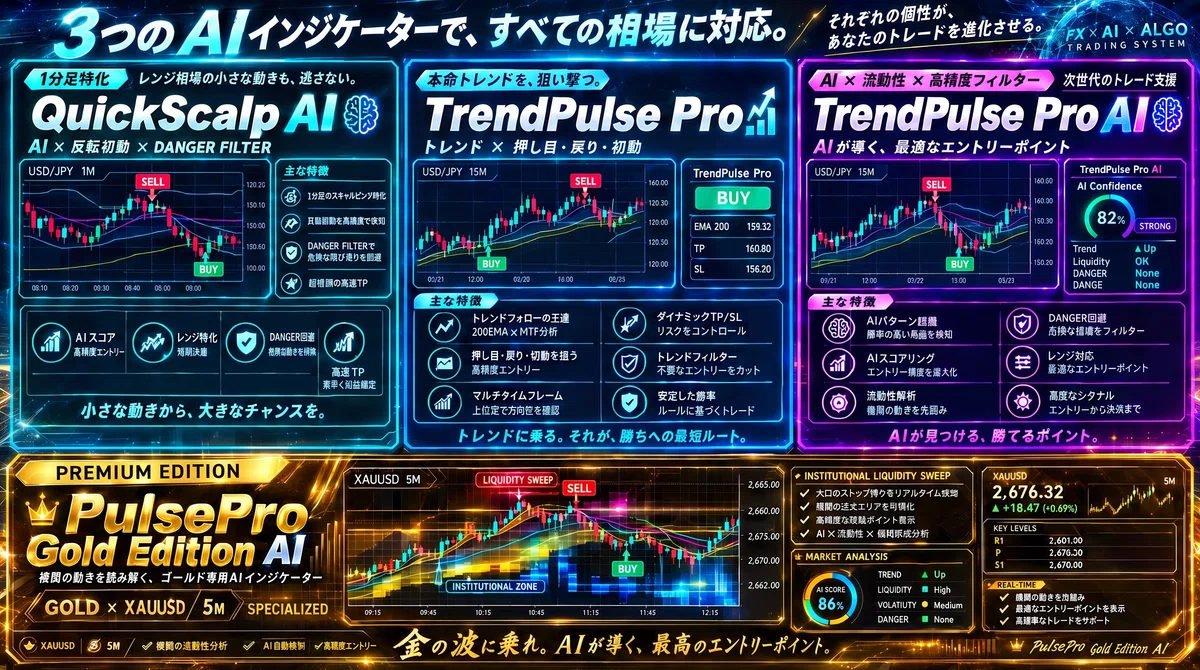
An indicator that eliminates emotion and captures the market with clear evidence and rules.
Function details and design logic are published on each product page
? [GogoJungle product page]