
[Procedure to divide into explainable losses] Record things you checked along the way
Are you changing your process after every loss and losing track of your own standards? How can you tell which losses to fix and which to leave alone?
Even though your notebook shows P/L numbers alongside “I’ll be careful next time,” rereading it brings up nothing.
Before long, you end up hating every loss and start looking for a different method.
If the result is the same negative, why do “losses you should fix” get mixed with “losses you don’t need to fix”?
Good evening!
I’m Masashi ^^
Today I’ll talk about a procedure for splitting losses into “explainable losses” and “unexplainable losses.”
What you rewrite isn’t your method, but the records you keep every day.
Record, line by line, what you checked before placing the order—the interim steps.
Only tweak your process when you have an unexplainable loss.
✅ Back when I added more checks after every loss
I used to reflect on literally every losing trade.
If I lost on Monday, I added one more check; if I lost on Tuesday, I added another.
By Wednesday night, I no longer knew what to look at in front of the chart… lol
The more checks you add, the slower each decision becomes.
Back then, I thought this was effort.
But if your process changes daily, you can’t even verify which process the loss came from.
✅ The more I reflected, the more the verifiable material disappeared.
? My week back then: [Lose / Add a check / No idea why I lost]
? A notebook filled with “I’ll be careful next time”
One weekend, I reread my notebook in bulk.
The first line was always the P/L number, followed by short remarks.
- I think the entry was too early
- I got greedy
- I’ll be careful next time
As I reread it, I froze.
None of the pages said what exactly I should be careful about ( ;'∀')
Even if I meant it when I wrote it, it gave next-week’s me zero clues.
All that remained was how I felt that day.
✅ I had records, but nothing I could actually review.
? With just P/L and impressions, rereading my notes did not produce any next actions.
? Impressions are written after seeing the result
Why does nothing come from recording impressions?
Because impressions are written after seeing the result.
With the same entry, on winning days I’d write “good decision.”
On losing days I’d write “the entry was too early.”
It looks like I’m evaluating the entry, but I’m just rephrasing the P/L.
Even if you stockpile hundreds of these, it’s hard to turn them into a system for evaluating trades.
✅ Records of impressions tend to be rephrasings of P/L.
? The me who knows the result has trouble judging on behalf of the me before entry.
? The same negative result comes in two types
If you only look at the amount, all losses look the same.
Open them up, and they split into two kinds.
[Explainable loss]
A loss where you followed the pre-decided checks and got stopped out at the preset spot.
[Unexplainable loss]
A loss where you can’t later say why you entered or what you looked at along the way.
In household terms, it’s like the difference between an expense with a receipt and money that vanished from your wallet.
Even if the amount is the same, a receipt lets you accept what you paid for.
✅ Explainable losses can be kept as expected costs.
? The criterion isn’t the amount—it’s whether you can say what you paid for.
? Being explainable doesn’t mean profitable
This is easy to misunderstand, so I’ll say it first.
Explainable does not mean winnable.
Even if you pass all checks, you’ll still lose sometimes—normally.
Price breaking levels set by the market will keep happening.
I totally get wanting to add checks to reduce explainable losses.
But trying to shave those takes you back down the same path I used to walk.
More precisely, explainable losses are excluded from what I try to reduce.
Stops are expected costs; don’t erase them—keep them in your records.
✅ I exclude explainable losses from what I try to reduce.
? I separate them to narrow down where to tweak. It doesn’t guarantee wins.
✔ Write what you verified before the order, line by line
So how do you tell the two kinds of losses apart?
Keep records from before the result—i.e., the interim steps up to the order.
While viewing the chart, write each check as a short, single line.
It’s fine to use your own rule’s exact wording.
[Checked where higher-timeframe levels are / Toggled with lower timeframe to observe movement / Chose stop-loss location]
The key is to write before you hit the order button.
If you delay, the you who knows the result will be the one writing.
There’s another tip for how to write.
Also write down what you did not check.
[Did not check the level locations]
It feels a bit embarrassing to write it yourself.
But when you reread later, this one line helps the most!
After closing, add a single word—“explainable” or “unexplainable”—before the P/L.
The criterion is whether you could explain to someone, using only the written interim steps, why you entered and why you exited.
If you look at P/L first, you’ll be swayed by the numbers again.
So write the numbers after adding the one word.
✅ Add the one word before the P/L.
? This isn’t a neat notebook. What matters is not hiding the checks you skipped.
? Put two losses from the same day side by side
Say you lost twice in one day.
The first record looked like this:
[Checked level locations / Waited for momentum to stall on lower timeframe / Placed stop first]
The result was a stop at the preset level.
The second record looked like this:
[Price had already moved when I opened the screen / Didn’t check levels / Considered the stop after entry]
The result was a much smaller negative than the first.
If I were only looking at P/L back then, I would have reflected on the bigger first loss.
When you line up the interim steps, which one to review can flip.
The first is an explainable loss, so there’s nothing to do.
The second only happened to be small; if you keep entering like that, a bigger loss may come.
✅ The amount lost and the need to review don’t always match.
? Losses that happened to stay small are easy to miss without records.
? Only fix the single line that broke
When a few unexplainable losses pile up, read them side by side.
Look for which line in the interim steps shows a break in verification.
In my case, I often decided the stop after entering.
I was checking levels but placing orders without deciding the stop location.
Looking back, that step was missing before mindset or method.
Only fix that one broken line.
- Fix only one place at a time
- Decide what to fix on the weekend
- Don’t fix anything for explainable losses
Right after a loss is when you most want to change your process.
For me, simply not tweaking that night helped stabilize my process.
✅ I only fix one spot on weekends.
? When I feel like going back to method-hunting, I reread the broken line first.
⚠ When “explainable” turns into an excuse
Let me undercut the discussion so far once.
There are two pitfalls to this split.
First is adding explanations after the fact.
After a loss, you might “remember” reasons that aren’t written, like “I did check levels then.”
Only count the lines written before the order.
Second is thinking that explainable losses are fine to keep repeating.
Even if you passed checks, repeated losses still draw down capital ( ;'∀')
Set a daily loss limit beforehand, separately from your records.
Once you hit the limit, close the screen even for explainable losses.
✅ Even for explainable losses, I close once I hit my limit.
⚠ I see records not as permitting losses, but as narrowing where to review.
⭕ What if price moves while you’re writing?
When I share this, I often get asked:
“What if price moves while you’re writing?”
That’s true—you don’t have time for long sentences.
Prewrite the checklist on paper and just circle items—that’s enough.
If price moves while you’re circling, simply skip that trade.
Add one line next to the skipped trade—that also counts as an interim step.
People also ask if they should write for winning trades.
Yes. If you won on a whim, mark it “unexplainable.”
✅ Also label unexplainable wins with the one word.
⭕ You don’t have to force yourself to write right after a loss. The writing belongs before the order; after a loss, just add the one word.
? Shorten the first line of interim steps
Once you start writing interim steps, one task gets added.
It’s rechecking higher-timeframe levels for the first line each time.
Bouncing between timeframes to redraw levels makes you want to skip it on tired days.
And on skipped days, you start seeing “[Did not check the level locations]” pile up.
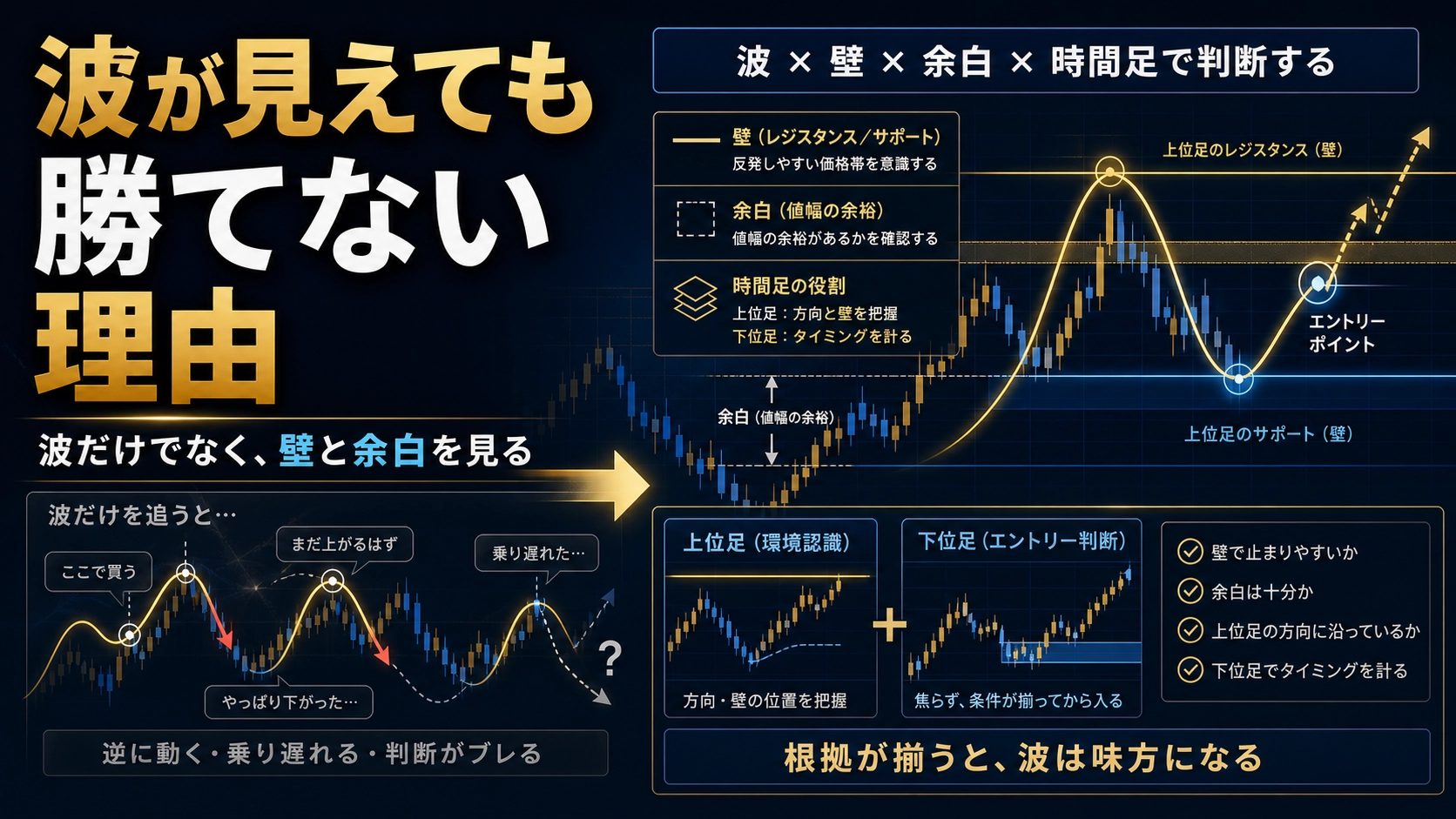
If level locations are visible in some way, it’s easier to shorten that first-line check.
However, tools don’t make decisions for you.
✅ If levels are visible, you may be able to shorten the first line.
? You decide what to check and whether that loss is explainable.
? Featured in GOLD Special Remedy ^^
If you want to organize from the foundation of decision-making, check the contents and limitations.
? Summary: Split losses into two and fix only the broken line
If you reflect on every loss, your process changes daily and you can’t tell which process led to the loss.
Since impressions are written after the result, they’re poor material for splitting the two kinds of losses.
So record the interim checks done before the order.
Also write a line for what you didn’t check.
After the trade, before looking at the amount, add just one word for whether you can explain it.
Keep explainable losses as expected costs, and only fix the broken line.
This week, before your next order, try writing just one line of what you checked ^^
Records can fix process, but there’s another dangerous screen on losing nights.
The deposit screen. I’ll write about that in the next article.
Whether you do the first-line check yourself every time or use a tool to shorten it—either is fine.
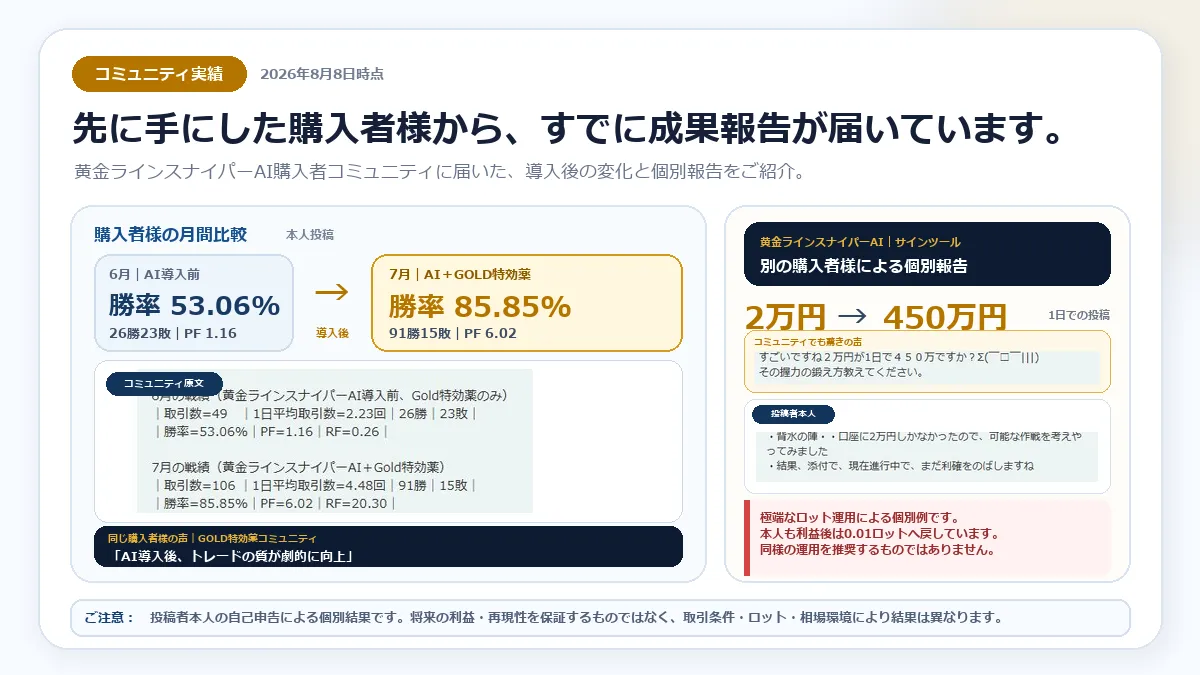
For those who want it shorter, Golden Line Sniper AI is one option.
It doesn’t decide entries or explain losses for you.
Use it on the premise that you confirm what it shows and its limits, and make the final decision yourself.
Before the next order, write one line of what you checked.
? This week’s one line: [Write what you checked / Also write what you didn’t check / Add the one word before P/L]
See details of Golden Line Sniper AI
Thank you for reading to the end today ^^