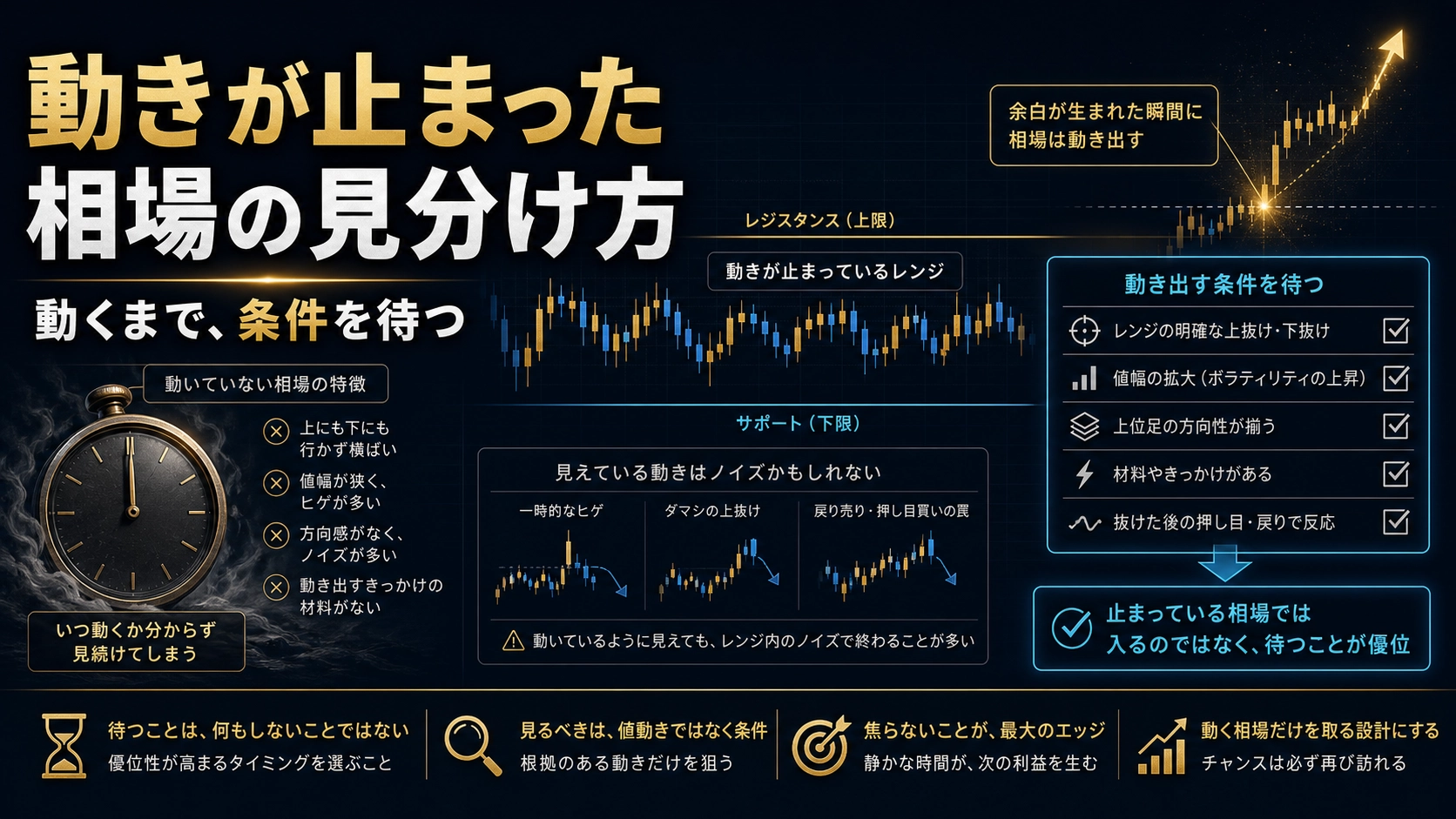

【Do not increase the screen with unrealized losses: steps】No need to count the reasons for adding after entry
When the minus has been increasing, haven't you opened a screen you hadn't looked at before entering?
As you approach the place you intended to cut, you suddenly start researching something.
Before you know it, the price has already passed the place you were supposed to cut at.
When you're in a loss, where should you look first to understand why you’re holding on?
Good evening!
This is Masashi^^
This time, I’ll talk about a night when you can’t cut losses even with a loss on paper.
It’s not about having guts; it’s about the procedure of what to look at first after noticing the loss.
What I decided for myself is to reread only one line before increasing the number of screens.
The reason I found after entering isn’t counted as a ground for holding on.
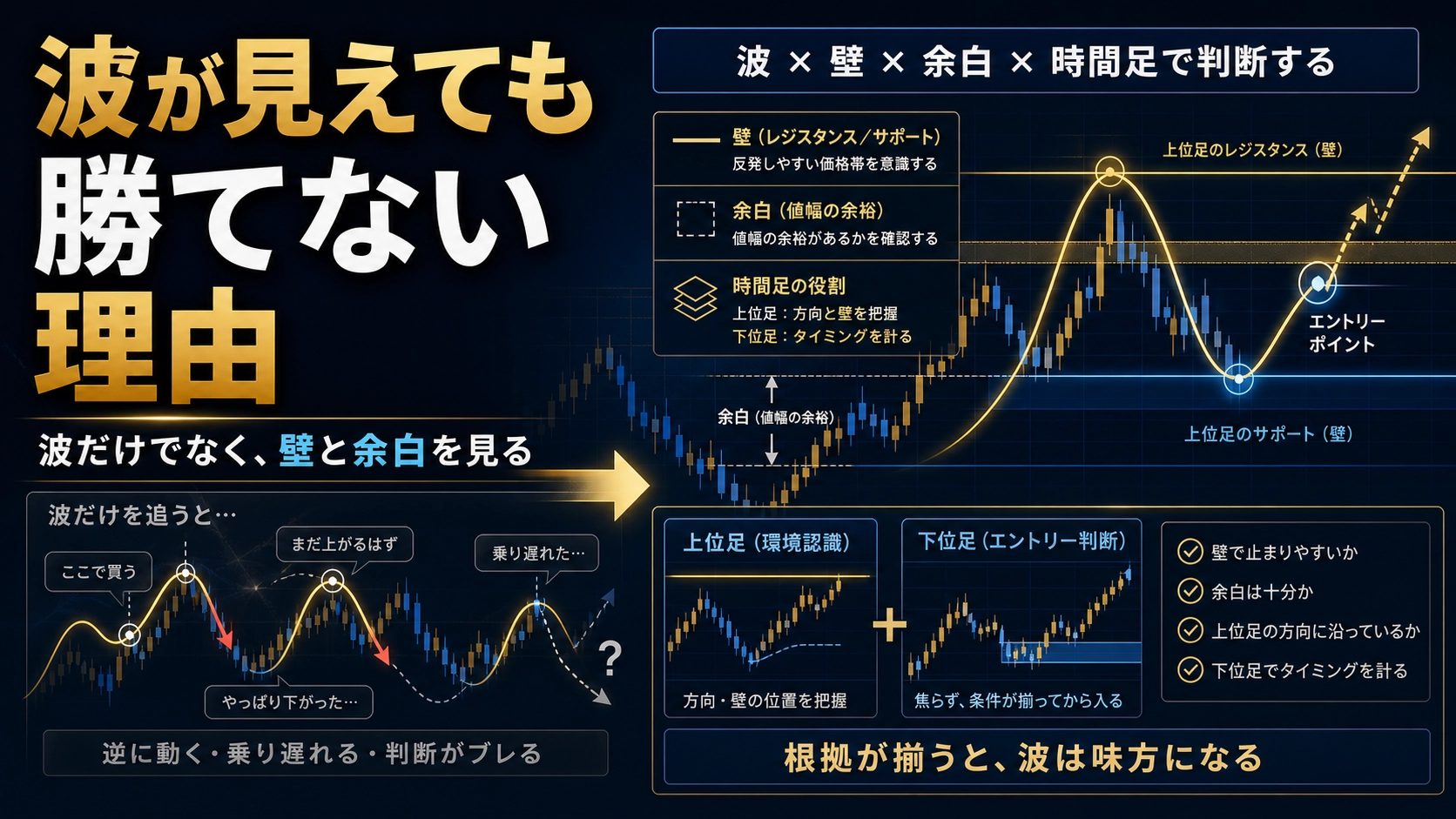
One line to reread is, for example【When it calms down under the wall, cut】such a short line.
✅ The chart you entered as one sheet will increase
I used to be the type where the number of charts increased when I had a loss on paper.
What I looked at when entering was almost only one lower-timeframe chart.
But when the price started moving the other way, I would open higher timeframes, even larger ones.
I would add lines that aren’t normally displayed, and still not enough, I would go look for news.
The thirty minutes after loss felt more serious than the five minutes before entering… w
✅ The thing I researched the most was during the loss rather than before entering.
? Night at that time: 【Enter with only a lower-timeframe / go against the trend / increase screens】
? I only picked up one side from the opened screens
What I did during those thirty minutes became clear when I reread the records.
I lined up the notes I wrote during the loss and looked at them later.
The notes I had while buying included words like these.
・The larger timeframe is still trending up
・The prior rebound low is close
・News is bullish
In one set of notes, there wasn’t a single reason to cut.
Even though I should have seen selling materials,“This is only a temporary move”and I brushed it off.
✅ Even while looking at the same screen, I was picking only the grounds to continue holding.
? When you read the notes, you can see what you were looking for at that time.
? Why doesn’t the judgment progress even though you’re researching it?
Some may think it’s important to check the situation precisely during a loss.
That’s partly true; reviewing the market itself isn’t wrong.
What you’re looking for or what opened the screen is the key.
If you want to confirm whether to cut, you should be looking at the place you decided before entering.
But at that time, I had already decided what to look for before opening.
If you’re buying, you look for a bullish factor; if you’re selling, a bearish one.
When what you’re looking for is fixed, no matter how many screens you open, your judgment won’t advance a step.
✅ The verification target had become my own hopes rather than the market.
⚠ Before opening the screen, try to put into words what you’ll look for.
? It’s like looking for a signboard when you’re lost on a road
This is a bit similar to when you might have taken a wrong turn in an unfamiliar town.
Before turning back, wouldn’t you first look for “proof that you’re on the right path”?
This is something I do often. The same convenience store sign as before, the direction should be roughly this way.
Every time you find one, you feel you can go a little further.
And as you go further, the road back becomes longer.
In a loss as well, every time the reason to hold becomes one more, the same thing happens.
✅ Even if the signs multiply, it doesn’t change whether you’ve gone the wrong way.
? I try not to count the moments I felt reassured as a ground for holding.
❌ The added reasons overwrote the pre-entry promise
With a little thought, the added reasons did not change the conditions you entered under.
The fact you broke the location you had anticipated at entry remains as is.
What changed is only the amount of your own satisfaction.
Ah, to be more precise, adding reasons isn’t bad in itself.
You end up overwriting the promise you made before entering with reasons you found after entering.
What I wanted to stop was this overwriting.
If you move the cut location once, it makes the hesitation to move it again smaller (;'∀')
✅ What should be fixed isn’t feelings, but the order you follow during a loss.
❌ In my case, the more I moved the cut location, the longer the notes became.
? Before placing an order, make the reasons and the cut location fit on one line
What you do is extremely simple.
First, before placing the order, write just one line on a sheet or on your phone memo.
【Enter when you see it stopping under the wall / Cut when it calms down under the wall】
The left of the slash is the reason for entry, the right is the place to cut.
If you can’t write the place to cut, the position of the wall may still be fuzzy.
In that case, instead of your order, go back and forth between the higher and lower timeframes to re-confirm the wall position.
✅ Only after you can write the cut location, do you consider the order.
? Whether you use paper or a smartphone, writing somewhere other than the chart makes it easier to reread.
✔ If you notice a loss, read before looking at the screen
If you notice a counter-move, open the memo before opening a new chart.
What you read is the cut location written to the right of the slash.
・Read one line before increasing the number of screens
・Look only at the same timeframe as before entering
・Reciprocate between higher and lower timeframes to confirm
If this becomes a loss-cut, it’s simply because the cost you anticipated before entering has appeared.
I don’t count a cut written at a place as a mistake in judgment.
✅ The words I read during a loss are the words I wrote before entering.
✔ After reading the cut location, there is only one thing to confirm.
? Do not count reasons written in other sections
That said, even if you decide to just read, thoughts will inevitably arise.
It’s natural to think, “That news was a bullish material after all…” w
So I decided not to forcibly delete it and instead write it in another section of the memo.
Section name【Reasons added after entry】and this isn’t counted as ground for holding.
When you review after finishing the trade, you’ll notice something interesting.
Most added reasons could have been checked before entering.
If it’s truly important material, you can check it before entering next time and write it to the left of the slash.
Added reasons become candidates for the next verification item.
✅ Added reasons are not used for the current position; they are moved to before the next entry.
? Just having a column to write in makes it harder for thoughts to morph into grounds.
⚠ Only a justification for exiting should be added
Let me interrupt the above once.
Is it true that you can ignore all post-entry information? Not exactly.
Even after entering, I still use information.
Information that helps lighten the position.
For example, when you realize a major indicator is about to release soon while holding.
Even if you haven’t broken the written location yet, you may close out without holding.
Adding a reason to exit doesn’t increase losses beyond what you’d already face, but adding reasons to hold can remove the loss cap.
If you find your cut-location writing is always off, fix it after the trade ends.
If you move it during a loss, it becomes overwriting rather than repairing.
✅ For information used after entering, use only items that lighten the position.
⚠ Fixing one line should be done in a calm time, for the next trade.
? A decrease in screens as you reread
Since adopting this procedure, the most noticeable change in my records was in the notes themselves.
The long notes listing reasons for safety disappeared!
Even with a loss, all you do is read one line, so the number of screens opened also decreased.
Of course, this doesn’t mean I stopped losing money.
There are still entries for cutting as before, and after cutting I don’t feel good either.
What changed was the records after cutting.
The way I wrote things changed from “felt like I was beaten” to “which reason did I add.”
✅ The days when the non-counted sections fill up show that I hadn’t checked enough before entering.
? Losing after writing a line doesn’t affect the next trade as much, I feel^^
⭕ What to do if it returns right after cutting?
When I talk about this, people often ask
“If it reverses immediately after you cut, don’t you wish you kept it?”
Honestly, I still feel that way a little.
So I also place those times in the same record to review how I behaved.
What should I do if I didn’t write a one-line before entering? Some ask.
In such cases, please try writing the slash’s left and right on the current screen.
If you can’t write it, I’ll consider closing out before seeking reasons.
・If you can’t write a line, consider closing out
・Lower the lot to a size you can close
・Confirm the wall position before entering
If you still can’t move your fingers, maybe your lot is too large to cut.
Before the next trade, try reducing to a size that you can close out on the screen.
✅ Next time you’re in a loss, read one line before the screen. Start there.
⭕ Write or decide to cut or not, it’s all up to you.
? A GOLD antidote feature has been specially organized^^
If you want to organize your foundation of judgments, please check the content and its limits.
? Summary: In a loss, return to the words you wrote before entering
When you can’t cut in a loss, it isn’t always because you lack information.
Sometimes you’ve opened screens you hadn’t looked at before and added reasons to hold on.
No matter how many added reasons there are, the fact that you anticipated a certain place when entering doesn’t change.
Therefore before placing an order, write in one line the reasons for entering and the cut location【Enter when it stops at the wall / Cut when it calms down under the wall】like this.
When you notice a loss, read that one line before looking at the screen.
Look only at the same timeframe as before entering, and go back and forth between higher and lower timeframes to confirm the cut location.
The arising reason is【Reasons added after entry】and it isn’t counted as grounds for holding.
I think it’s okay to use only information that suggests lowering the position.
Next time you open a chart, before placing an order【Cut when it calms down under the wall】like this, give it a try^^
Can you explain the loss after cutting in your own words?
I’ll write about that in the next article.
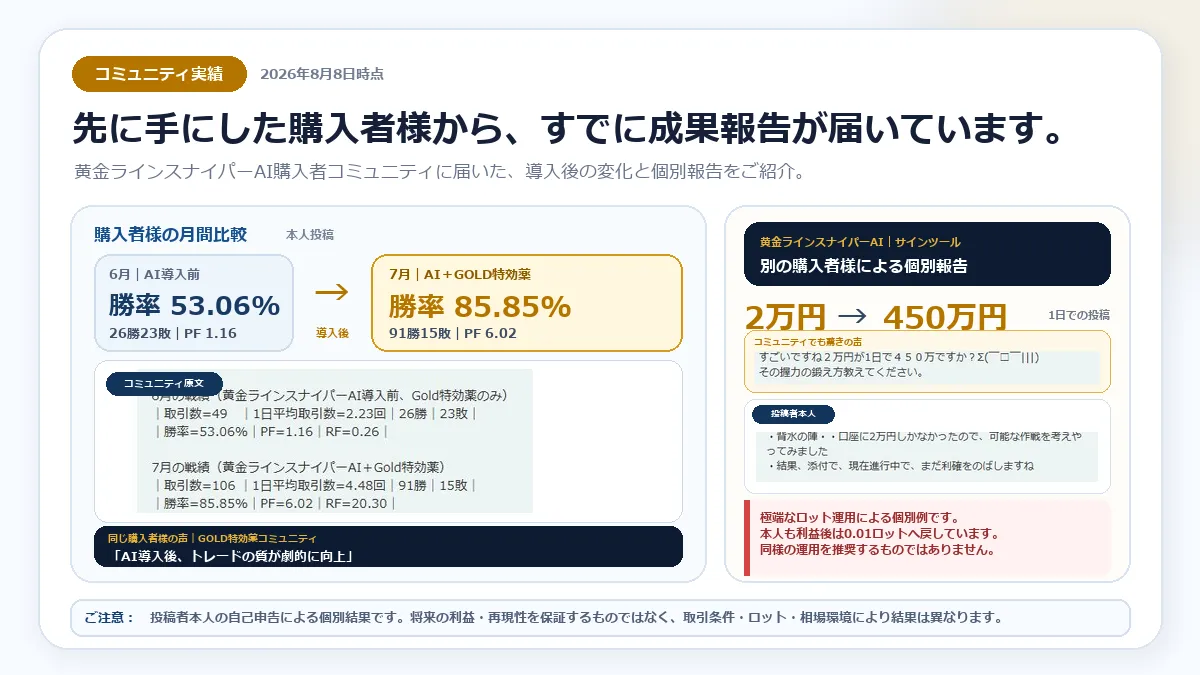
If you want to reduce the hesitancy when writing a line, GOLD Line Sniper AI is another option.
It doesn’t decide where to cut or whether to hold for you.
Please use it after confirming the display contents and limits, with the understanding that final judgment is yours.
✅ Before the next order, write one line up to the cut location.
? Tonight’s one line: 【Can you write up to the cut location / If you can’t write it, don’t place the order】
View details of GOLD Line Sniper AI
Thank you for reading to the end today as well^^