

[Introduction] Reference Rate and Gotō Day — How Actual Demand Flow Creates Time-of-Day and Date Bias and How to Read It
【Key Points】
・The midday rate is the standard rate used by banks for customer transactions. In Japan, it is determined based on the market rate around 9:55 a.m., before 10 a.m.
・Gotōbi (the Fifty-day) refers to the days ending in 5 or 0. It is said that corporate settlements tend to accumulate, increasing demand to buy dollars.
・Both are discussions of observed biases based on “real demand flows,” and there is no guarantee they occur every time. If you test them, time adjustments are a prerequisite.
■ 1. Terminology clarification
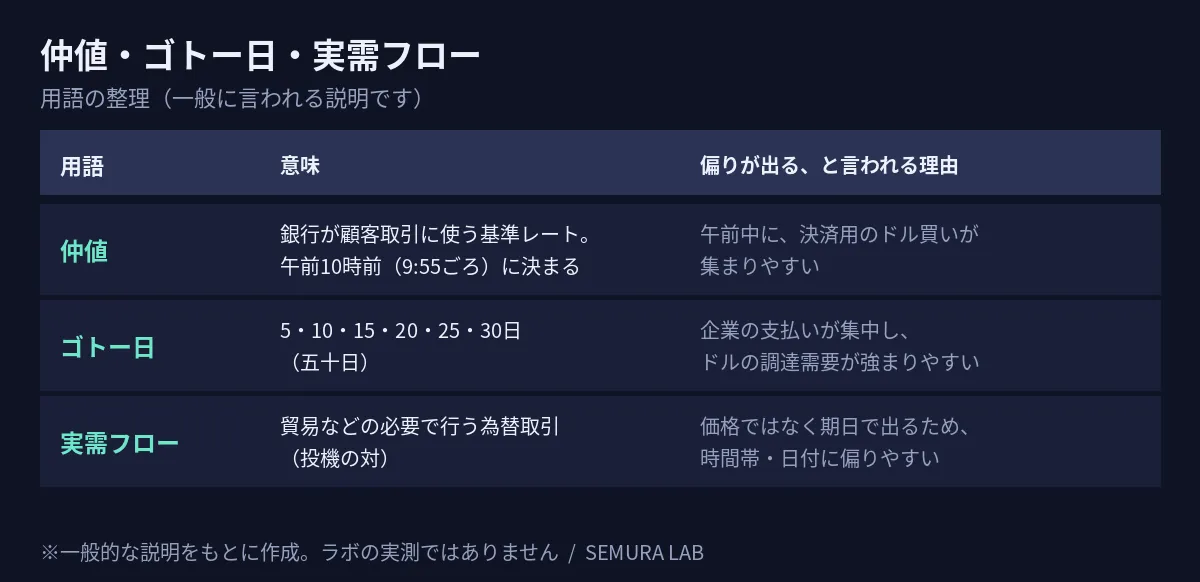
As the table shows, the midday rate concerns “time bands,” and Gotōbi concerns “dates.” Both are rooted in real demand flows. However, both are commonly stated explanations and not lab-measured findings.
■ 2. What is the midday rate?
The midday rate is the reference rate applied by banks to that day’s foreign exchange transactions with customers. When exchanging money or depositing foreign currency, the exchange rate is decided by adding or subtracting this midday rate’s fee. In Japan, major banks typically reference the market rate around 9:55 a.m. and publish it near 10:00 a.m.
Note that the method for determining the midday rate can differ in detail across banks; this article provides a general explanation.
The key point is that this decision is made once per day in the morning. Since customer rates are fixed in the morning, banks must arrange enough foreign currency in the market by that time to meet customer orders.
■ 3. Concept of real demand flow
Foreign exchange transactions include speculative trades aimed at price differentials and real demand trades accompanying trade and investment.
Real demand trades are not made by looking at prices; they are submitted as needed by settlement dates and other requirements.
Therefore, biases can arise by time of day or date. A hypothesis explains it as follows: Importing companies need to procure dollars for payments abroad.
That arrangement tends to concentrate in the morning ahead of the midday rate publication.
Because Japan’s trade structure tends to generate relatively large demand to buy dollars, there is a tendency for USD/JPY to rise before the midday rate.
After the midday rate passes, demand may cycle, and there can be a recoil. Meanwhile, exporting companies have demand to sell the dollars they receive.
In reality, trading is a mix of imports, exports, and fund movements by institutional investors, and the net demand/supply is determined.
Whether dollar buying is dominant varies by period.
However, this is only a hypothesis.
The 9 o’clock hour in the morning is when the Tokyo market starts moving, and more participants enter, leading to larger price movements.
Whether the effect is due to the midday rate or simply the naturally active time is difficult to separate.
■ 4. What is Gotōbi?
Gotōbi means the days ending in 5 and 0, referring to the 5th, 10th, 15th, 20th, 25th, and 30th (end of month).
In Japanese corporate practice, there is a tendency to consolidate payments and settlements on these days.
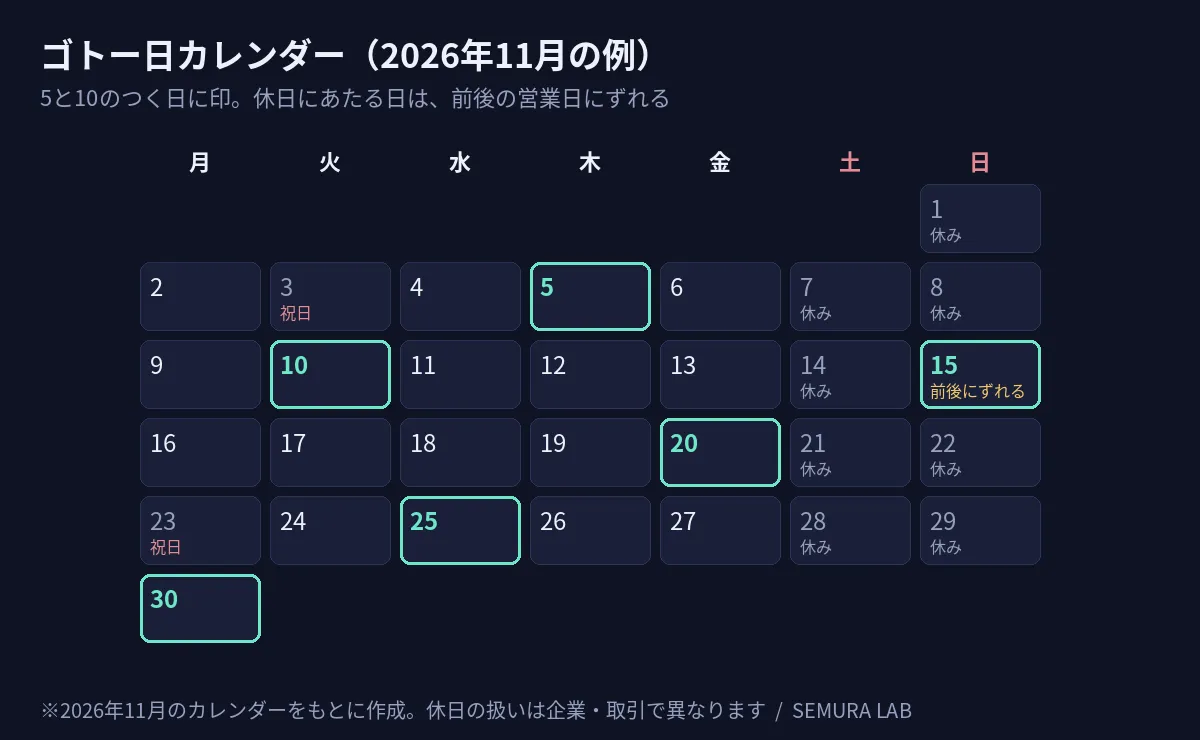
When payments concentrate, dollar procurement demand also tends to concentrate.
Therefore, it is said that dollar buying toward the midday rate tends to be stronger on Gotōbi than usual.
If the relevant day falls on a weekend or holiday, it shifts to the preceding or following business day. In the figure for November 2026, the 15th falls on a Sunday.
Among Gotōbi, the 5th, 10th, and month-end are particularly salient, but which day is stronger is more of an observed tendency than a universal rule.
Month-end not only coincides with Gotōbi settlements but also with other factors like cross-month funding adjustments, increasing complexity.
Even if the same “dollar-moving day” occurs, there may be multiple reasons behind it.
■ 5. Why we cannot declare a bias with certainty There are two main reasons.
First, the amount and direction of real demand vary year by year. If the trade balance or the exchange rate changes, the magnitude and direction of dollar demand can change.
Past observed biases do not necessarily appear in the same form in the future.
Second, once biases become widely known, transactions targeting that bias may increase, reducing the bias itself.
The more well-known a phenomenon is, the less effective it tends to be.
Thus, these biases should not be used as fixed rules, but rather treated as phenomena to be verified through testing.
■ 6. Considerations when validating
If you backtest biases in the midday rate or Gotōbi, pay attention to the following:
・Time adjustments: The midday rate is based on Japan time, but MT4 server time may differ from Japan time and shift by one hour for daylight saving vs standard time. You must adjust to server time and specify the time accordingly.
・Business day handling: Decide in advance how to treat Gotōbi that fall on holidays. Use the previous business day or the next one, as the choice affects results.
・Period and number of trades: Gotōbi occur only a few times per month, so short periods yield few trades. Use a sufficiently long period to ensure enough trades.
・Costs: In the morning, spreads may widen. Use realistically close spread values to verify.
It is also important to segment the period to check whether the bias consistently appears across periods.
A bias that only exists in a particular year has low reproducibility. Determine presence or absence by looking across multiple periods.
Even if a bias is observed in validation, it is premature to deploy it in live trading.
You must confirm whether the bias persists after time adjustments or when shifting the period.
■ 7. Summary
The midday rate relates to biases in the “time band,” and Gotōbi relates to biases in the “date”; both are grounded in the idea of real demand flows.
However, both are observed biases and do not guarantee future appearance.
Even if a bias is seen, whether to use or avoid it depends on the design purpose.
We at Semura Lab. treat time-band and date biases not as fixed rules, but as phenomena to be verified through testing.
Our lab’s GBPJPY Anomaly v04 also handles biases such as Tokyo midday rate trends and Gotōbi settlement demand by examining results of validation.
If you have questions about validating an EA or how to verify time-band biases, feel free to use the Help Desk at the following: https://www.gogojungle.co.jp/mypage/community/485