
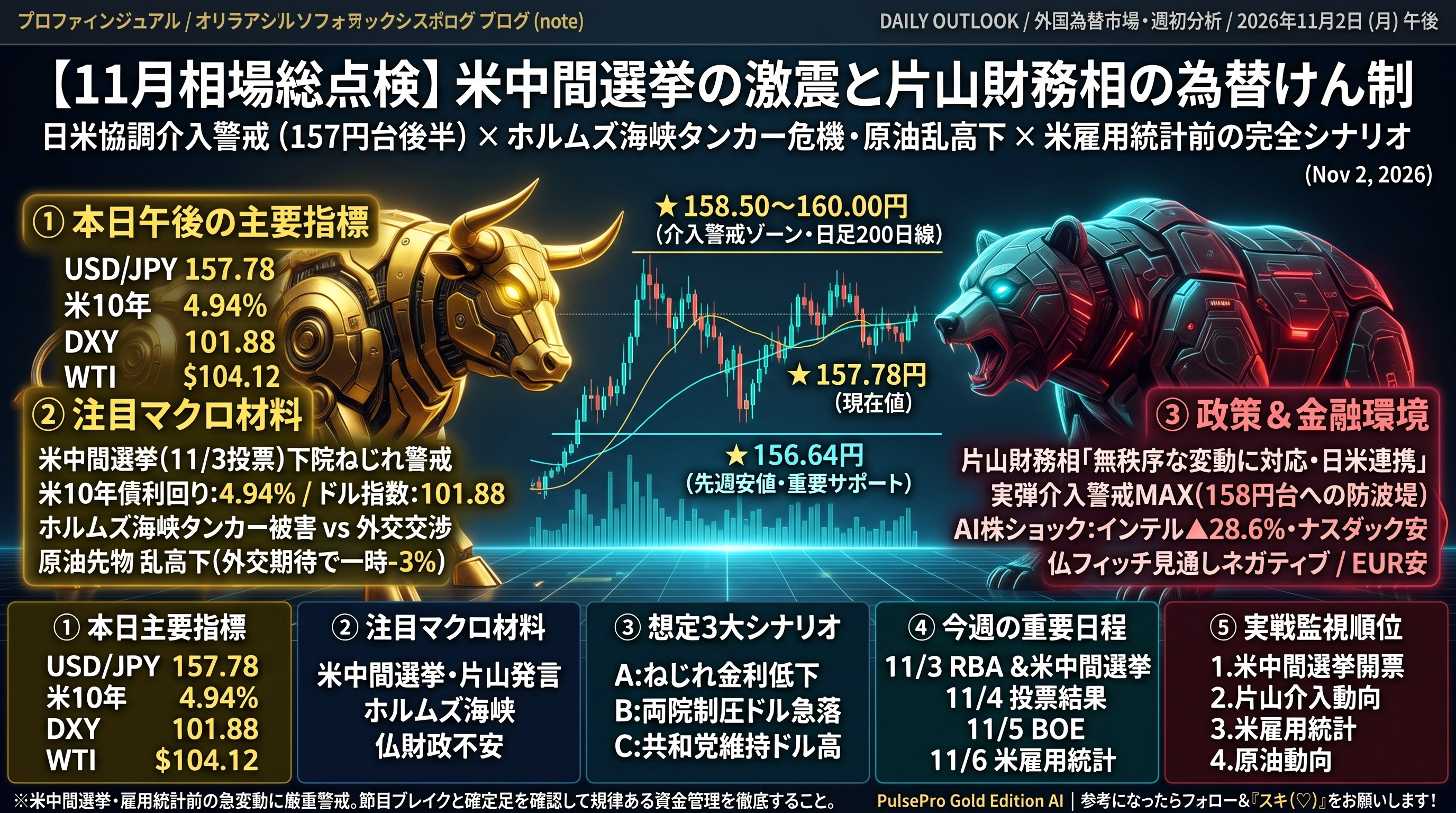
[World Financial Market Review] Eve of U.S. midterm elections; Finance Minister Katayama says "prepared to respond to disorderly fluctuations"; Hormuz Strait tanker incident and crude rebound—Comprehensive analysis of FX, stocks, and bonds as we enter the
On Monday, November 2, 2026, in the afternoon, as the world's foreign exchange and financial markets entered the first trading week of November, they opened in an extremely tense atmosphere in the face of numerous highly important events that could represent a historic turning point.
The core theme that will dictate this week's market is, above all, the "vote in the US midterm elections on November 3 in US time." With the House leaning toward Democrats regaining control and the Senate in a historic close race, the course of Presidential administration and fiscal and trade policies for the remaining two years of the Trump administration was expected to determine the market's overall direction.
At the same time in the foreign exchange market, Finance Minister Katayama Sachiko reiterated a strong sense of vigilance, saying she would "respond to disorderly currency fluctuations" and would "act against excessively speculative movements." As the dollar-yen hovered in the late 157 yen range, the announcement that both the US and Japan would closely coordinate on currency policy regardless of the election results further heightened the market’s concerns about the upside potential.
Furthermore in the international commodity and energy markets, while tanker incidents in the Strait of Hormuz involving Iran surfaced (two crude oil tankers on fire), wholesale crude oil prices temporarily fell by more than 3% due to hopes for diplomatic talks mediated by Qatar, creating a complex tug-of-war between geopolitical risk and diplomatic expectations. With the US jobs data and policy announcements from the RBA (Australia) and the BOE (Britain) approaching, multiple macro factors were intersecting.
Without any speculation, based on confirmed facts and official data as of 15:30 on November 2, this article logically explains the full picture of this week's financial markets and practical points to watch.
Chapter 1: The Market of the First Half of November Is Shaken
“Eight Major Points”
A summary of the main market drivers at the standard time this afternoon.
US midterm elections (November 3):The House is favored to be won back by the Democrats, while the Senate is in a historic close race between Republicans and Democrats.
Attention to Japan’s currency intervention:Finance Minister Katayama reaffirmed a stance to act against speculative, disorderly fluctuations and to continue United States–Japan currency coordination.
Japan–US coordination:Regardless of the midterm results, a close alignment of the two countries’ currency policies was confirmed.
Middle East tensions and oil:Tanker incidents in the Hormuz Strait and diplomatic talks proceed in parallel. Owing to diplomatic expectations, crude futures fell by more than 3% at times.
AI-related stock adjustments:Starting with earnings and outlooks from Intel (about a 28.6% plunge), concerns about AI investment payback spread across tech stocks in general.
France’s fiscal anxieties:Fitch downgraded France’s outlook to negative, and EUR/USD softened toward its lowest level in 17 months.
China’s business outlook:October’s Manufacturing PMIs by RatingDog remained in expansion at 52.0, though with a slight decline.
A rush of major central banks and economic indicators:RBA, BOE, and the US payrolls data over the weekend (Non-Farm Payrolls expected at +56,000, unemployment rate 4.2%) peaked market vigilance.
Chapter 2: Domestic Factors in Japan —
Finance Minister Katayama's Remarks and the Current State of USDJPY and Japanese Stocks
In the Tokyo market, while USDJPY remained in the upper 157s, strong warnings from government officials tightly constrained the upside in the market.
1. The true meaning of Finance Minister Katayama’s currency remarks
On November 2, Finance Minister Satsuki Katayama stated the following regarding the currency market.
“We will respond to disorderly fluctuations in the currency market.”
“We will act against excessively speculative movements.”
“We will continue consultations and collaboration with US authorities.”
“Compared with when USDJPY was over 160, the market environment has improved.”
Furthermore, Reuters reports emphasized that “regardless of the midterm results, the policy coordination between the US and Japan on currency remained unchanged.”
This statement goes beyond mere verbal intervention; it clearly indicates a framework in which, in a crucial moment ahead of the US elections, Japanese and US authorities align to deter speculative yen selling. In the 157–158 yen range, even in strong upward moves in USDJPY, surprise drops or intervention risk must be constantly considered within the market.
2. Japanese stock trends: The spillover from US tech stock declines
In the Tokyo stock market on November 2, the Nikkei Stock Average temporarily softened to around 62,714 yen (about 0.9% lower from the previous trading day).
Key declines:Sumitomo Mitsui Financial Group, SoftBank Group, Recruit, and others.
The sharp drop in AI-related and semiconductor stocks in the US market last week (Intel about 28.6% down, semiconductor index about 7.2% down) weighed on Tokyo’s tech and blue-chip stocks, creating a risk-off atmosphere.
Chapter 3: The Week's Biggest Showdown —
Structure and Market Impact of the US Midterm Elections (November 3)
The US midterm elections, with votes counted on November 3 (US time), will determine the policy execution power of the second half of the Trump administration and stand as the biggest political event for this period.
【Pre-election Outlook】
- House of Representatives (435 seats): Democrats are favored to retake the majority.
- Senate (100 seats): A historic close race between Republicans and Democrats.
Three election-result scenarios and their market transmission paths
Scenario A (Democrats win the House; Senate tight between Republicans and Democrats):
Impact:A split Congress would constrain large fiscal policies, additional tax cuts, and increased spending under the Trump administration.
Interest rates and FX:As concerns about excessive issuance of US Treasuries retreat, long-term US rates would face downward pressure, and the dollar would face modest downward pressure (the USDJPY upper bound would become heavier).
Scenario B (Democrats win both houses):
Impact:Policy implementation would be significantly constrained, expectations for fiscal expansion would retreat, and U.S. equities would become more volatile due to policy uncertainty.
Interest rates and FX:Lower US long-term rates and USD selling with JPY buying would be triggered, substantially increasing downside risk for USDJPY.
Scenario C (Republicans retain control of both houses):
Impact:Continuity of Trump administration policies would rise, and expectations for tax cuts and fiscal policy would be maintained.
Interest rates and FX:Concerns about budget deficits and debt issuance would re-emerge, and if US long-term rates rise, that would support dollar buying (pushing USDJPY higher).
Implications for AI and semiconductor policy
As one of the election issues, regulatory tightening for AI infrastructure investment is emerging. If Democrats gain influence in Congress, the tone of monitoring and regulation for AI-related companies and data centers could intensify, potentially increasing volatility in US semiconductor stocks led by NVIDIA and in Japan’s semiconductor manufacturing equipment shares.
Chapter 4: US Situation — Fed Rate Trends and Key Economic Indicators
Important Economic Indicators
In the US market, a mix of tech stock declines and macroeconomic data releases is occurring.
1. Investment payback concerns for AI-related stocks
Last week’s sharp drop in Intel earnings (-28.6%) and Nasdaq's -2.86% decline indicate not a single company’s issue but a broader evaluation that “astronomical AI investment will begin to show cash flow and profits when and how much.” This implies a broad reevaluation of corporate valuations and a cautious stance toward risk assets. Ongoing revisions to overall valuations are underway, and risk appetite across asset classes has cooled.
2. US Treasury yields and this week's data
US 10-year yield: about 4.94%
US 10-year real yield: about 2.60%
US Dollar Index (DXY): about 101.88
Although bond buying (yields falling) occurred somewhat with a stock market correction, the underlying expectation for further tightening and rate hikes ahead of the December FOMC (December 8–9) remains strong.
【Key US economic indicators to be released this week (Japan time)】
- November 2 23:00 ?? October ISM Manufacturing PMI
- November 4 22:15 ?? October ADP Employment Report
- November 4 24:00 ?? October ISM Non-Manufacturing PMI
- November 6 22:30 ?? October US Employment Situation (Non-Farm Payrolls, unemployment rate)
(Non-Farm Payrolls expected: +56,000; unemployment rate 4.2%; Average hourly earnings month-over-month +0.3%)
Especially the November 6 US jobs report will determine the Fed’s next move. If the labor market remains strong, rate hikes expectations would rekindle and lead to dollar buying; if weak, US rates could fall and dollar selling would accelerate.
Chapter 5: International Situations — Middle East Risks and the Oil Market’s Twist
and the Twist
The Middle East situation presents a highly complex landscape where military tensions and diplomatic negotiations move in parallel.
1. Hormuz Strait tanker incidents and diplomatic expectations
Tanker incidents:The Islamic Revolutionary Guard Corps announced that two crude oil tankers were set ablaze due to contact with mines and other devices. Attacks on a Qatar-led LNG carrier are also a concern, making maritime security threats concrete.
Oil price pullback:Meanwhile, reports of diplomatic talks between the US and Iran toward de-escalation and multilateral talks led by Qatar have caused oil prices to drop more than 3% from last week’s highs.
2. Notes on the oil–FX correlation
A fall in oil prices typically eases inflation concerns and supports a weaker dollar; however, given ongoing tanker incidents in the Strait of Hormuz, it would be premature to assume Middle East risk is fully resolved on diplomatic expectations alone. A renewed accidental military clash could trigger a rapid rebound in oil prices and disrupt global policy outlooks again.
Chapter 6: Europe and UK — Situations and Major Currencies
In European markets, fiscal issues and monetary policy are weighing on individual currencies.
1. France’s fiscal worries and the euro’s softness
Fitch downgraded France’s outlook from stable to negative.
As a result, EUR/USD moved toward around 1.1159 and stayed near its 17-month lows.
Budget deficits and domestic political stability concerns continue to weigh on European sovereign debt markets, with widening yield gaps between France and Germany pressing on the euro’s upside.
2. UK: Focus on BOE policy rate decision
The pound is around 1.3387 USD.
This week's biggest event isthe Bank of England’s policy rate decision on November 5. Market consensus is that the policy rate will be raised to 4.00%, and the probability of further tightening will determine the pound’s direction.
Chapter 7: Structure Analysis of FX Markets and Major Currency Pairs
Key currency levels as of the morning of November 2.
USD/JPY:157.78 yen (yen weakness and dollar strength in play)
EUR/USD:1.1159 USD (euro weakness)
GBP/USD:1.3387 USD (range-bound)
AUD/USD:0.7033 USD (awaiting RBA)
Dollar Index:101.94
Practical Observations by Currency
USD/JPY (Dollar-Yen):Rising US rates provide a floor, but the risk of intervention and lower-rate risk ahead of US elections keeps topside pressure in check. Simply buying dips is dangerous.
AUD/JPY (Aussie-Yen):RBA policy decision on November 3 (expected to raise to 4.85%) is the focal point. A hawkish hike would be supportive for AUD, but beware the tug-of-war with risk-off moves (stock declines and yen buying) driven by US stock market adjustments.
High-yield currencies (MXN/JPY, TRY/JPY):Carry trade appealing but vulnerable if results of US midterms or the plunge of US stocks cause capital outflows from emerging market currencies, potentially wiping out carry gains with swaps. Prudence in margin management is essential.
Chapter 8: This Week’s Important Economic Events and Calendar (November 2–6)
【This Week’s Schedule (Japan Time)**】
【This Week’s Schedule (Japan Time)**】
- November 2 24:00 ?? October ISM Manufacturing PMI
- November 3 12:30 ?? Reserve Bank of Australia (RBA) Policy Rate Announcement
- November 3 Tuesday ?? US midterm elections voting day
- November 4 Wednesday Morning ~ ?? US midterm election vote counting updates
- November 4 22:15 ?? October ADP Employment Statistics
- November 4 24:00 ?? October ISM Non-Manufacturing PMI
- November 5 21:00 ?? Bank of England Policy Rate Announcement
- November 5 23:50 ?? Bank of Japan Meeting Minutes
- November 6 22:30 ?? October US Employment Situation (Non-Farm Payrolls and unemployment rate)
Chapter 9: This Week’s Market Scenarios and Overall Conclusion
We logically synthesize the macro factors covered so far and present the overall judgment expected for this week.
Risk Scenarios to Watch For
Most caution is warranted for a scenario in which Democrats win the House (and possibly both houses), leading to a sharp decline in US long-term interest rates, while Japanese government measures to curb yen weakness and actual intervention reach maximum intensity. In this case, simultaneous downward pressures on USDJPY from falling US yields and from government intervention and yen buying could accelerate the market’s adjustment beyond expectations.
Conversely, if the Republicans maintain congressional control and US payrolls data show stronger-than-expected results, a renewed upside trend for USDJPY remains possible.
Practical Trading Principles
This week is not the time to determine a position solely on individual technical indicators or a single economic indicator.
Prioritize verifying the actual reaction speeds of US 10-year yields and the dollar index to the election results on November 4 (Wednesday).
Maintain vigilance for verbal and real interventions by Katayama and other authorities, and avoid reckless long positions near highs.
Until the November 6 US employment data, adhere to strict risk management (maintain margin levels) to withstand potential volatility spikes.
As uncertainty peaks this week, focus on capital preservation and high-survival-rate trading rather than rushing for profits.
If you found this helpful at all, please follow and press the “Suki (♡)” at the bottom of the screen to encourage updates!

“TrendPulse Pro” Free Trial:https://www.gogojungle.co.jp/tools/indicators/86532?via=users
“TrendPulse Pro AI” Free Trial:https://www.gogojungle.co.jp/tools/indicators/86529?via=users
“QuickScalp AI” Free Trial:https://www.gogojungle.co.jp/tools/indicators/86523?via=users
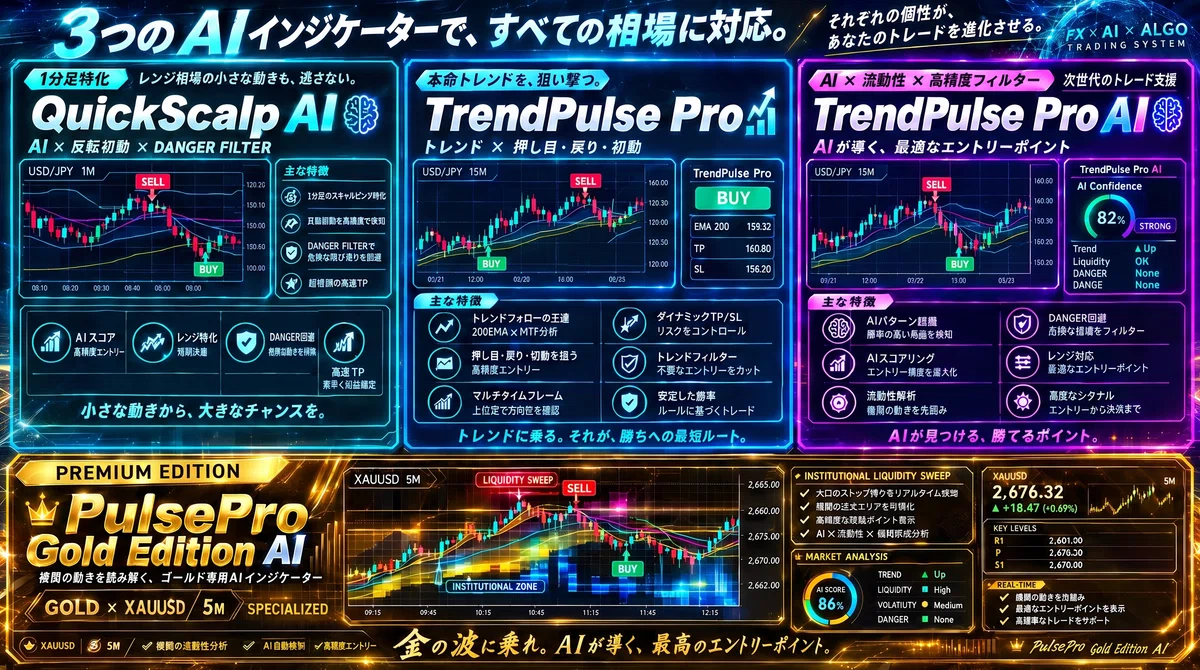
An indicator that eliminates emotion and captures the market with clear grounds and rules.
The function details and design logic are published on each product page
? [GogoJungle Product Page]