
Trader Aptitude ○× Test? The thoughts of those who win are all the same
Thank you for participating in the Twitter poll.
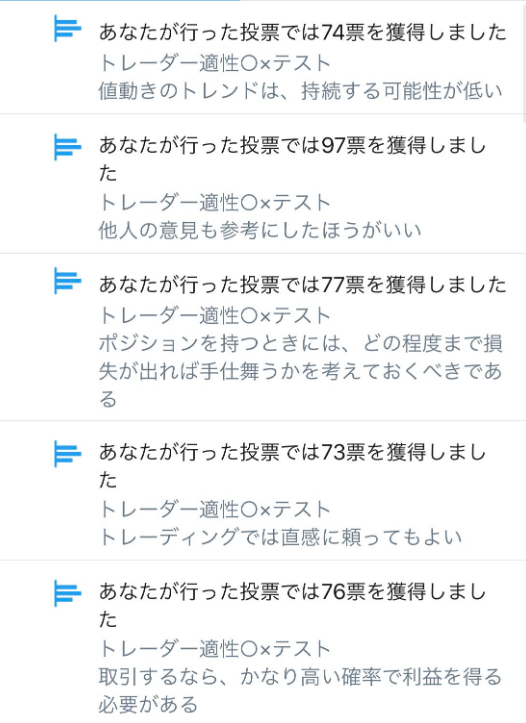
This issue is a part of the screening questions Richard Dennis, known as a charismatic trader, asked when training traders (the Turtles).
Let’s go through the questions one by one.
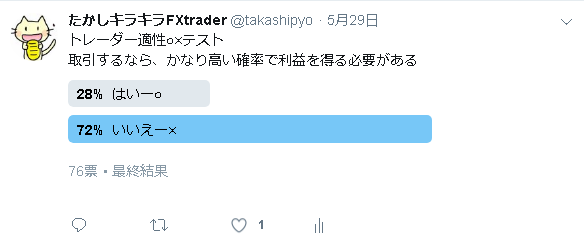
Correct answer: No — ×
Saying “you need to make profits with a fairly high probability” means you need a high win rate.
A trade can win even with a low win rate.
Even with a low win rate, if the risk-reward is high, you can win in trading.
Risk-reward refers to the ratio of profit to loss.
For example, if you lose 100 yen nine times and gain 1000 yen once, you end up with a net gain of 100 yen.
Loss is 100 yen and profit is 1000 yen. The ratio is 1:10
The risk-reward would be 1:10.
Even a 10% win rate can be profitable, right?
The method Richard Dennis taught was a low-win-rate method.
Therefore, people who think you must have a high win rate (preconceived notions) would find it mentally difficult to continue trading with a low win rate.
So, “you need to make profits with a fairly high probability” is false.
You do not need to achieve profits with high probability.
Next question.
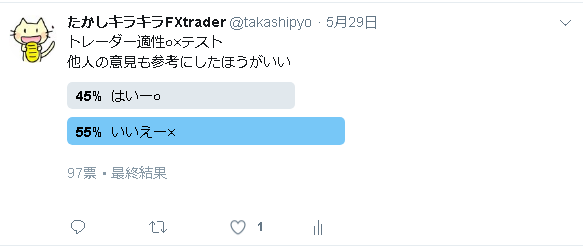
Correct answer: No — ×
I have never heard of traders winning by following others’ opinions.
To win in trading, you should follow your own methods and rules.
Looking at the poll results, the split is such that
some may interpret that “it’s better to参考 other people’s opinions when studying trading.”
I thought some might interpret it that way because I often say “learn from those before you.”
I wondered if someone took it as “learn by also considering others’ opinions.”
Next question.
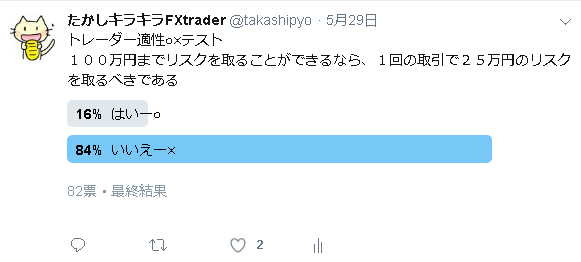
Correct answer: No — ×
Limiting to four losses is narrow-minded.
Even good traders experience five or more consecutive losses; setting four as the limit would be too restrictive and overly risky.
Next question.
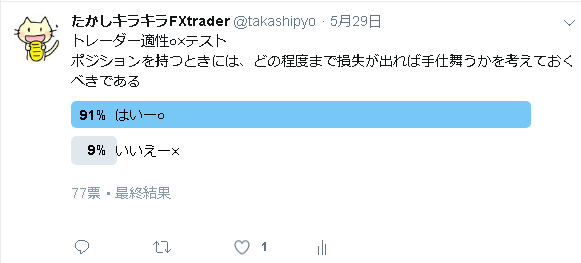
Correct answer: Yes — ○
Next question.
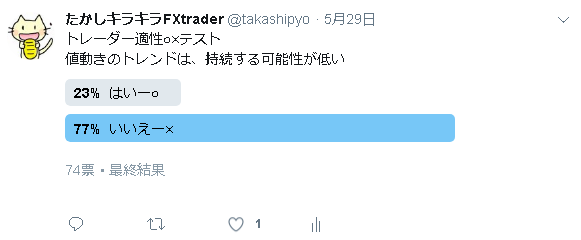
Correct answer: No — ×
Professionals bet on the trend — trend following
Amateurs bet on reversals — contrarian
Richard Dennis also taught to bet on the trend and follow the trend.
Next question.

Correct answer: No — ×
Intuition: not through deduction or reasoning, but grasped by a sense.
If you act purely on a feeling, the market is designed to make you lose.
It’s important to trade mechanically according to rules, not by feel.
Famous cannitrader says “become a machine and eat a simple noodle”
Put the rules above yourself.
Next question.
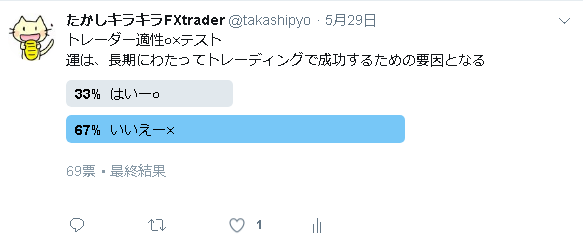
Correct answer: No — ×
In the long run, luck is not a factor.
Q: In trading, what proportion of luck plays a role?
Richard Dennis
If you look at it over the long term, it’s zero. I don’t think anyone in this industry got rich because they were lucky.
Q. But doesn’t luck clearly affect individual trades?
Richard Dennis
That’s where confusion comes in.
When you look at individual trades, it’s almost all luck.
The issue is how you choose your strategy. If you take a method that succeeds 53% of the time every time, in the long run it may succeed 100% of the time.
That concludes it.
From the poll results, the option with the most votes was considered fully correct.
I think the base is that people who follow me vote more, so if more of the readers of my blog participate, the accuracy rate will be higher.
The questions used in the poll come from this book.
“The Turtle Traders: The Complete Story” by Michael W. Kobel, FPO Co., Ltd.
I didn’t study the Turtles and trade by them, but the mindset of those who win seems to be the same for everyone.
Those who answered incorrectly in the poll would be thinking like those who cannot win.
Common thought patterns of those who cannot win:
- Think a high win rate is necessary, try to raise win rate, and when win rate is low, the mental state collapses. They jump on products that boast high win rates.
- Trade by参考 others’ opinions. They cannot trade consistently by their own rules.
- They can’t endure five consecutive losses; they take on too much risk.
- They do not decide in advance how much loss will trigger exiting a position, so losses exceed expectations.
- They think trends will not continue, so they pursue reversals. Amateurs bet on reversals — contrarian.
- They trade by intuition rather than analysis.
This is how the incorrect-thinking side feels.
First, the thinking process.
Some may wonder, “Why is this way of thinking not winning?”
If you read my past articles, you’ll find there are many thoughts written, which may be helpful.
Past article links ↓
https://www.gogojungle.co.jp/finance/navi/699/1107
Past blog
https://takashipyo.blog.so-net.ne.jp/
I’d be happy to hear your feedback and impressions. I’d like to use them for future reference.
Feedback / contact: takashipsychology@yahoo.co.jp