
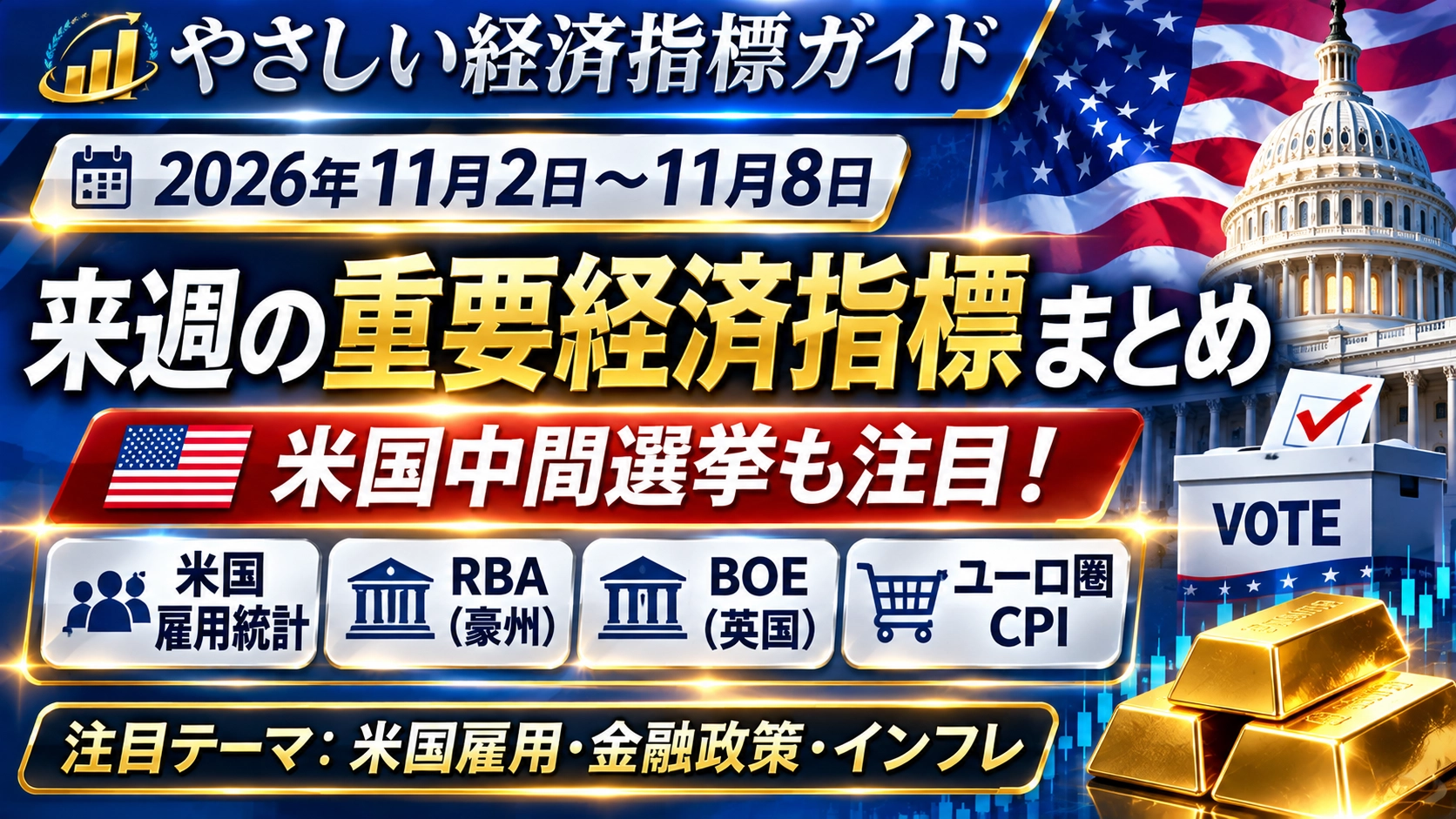
Economic Indicators Guide: Summary of Important Economic Indicators for Next Week | November 2–8, 2026
?This article was posted on November 1, 2026 ⇒Latest related articles?
This Week's Focus Topics: US Employment, Global Monetary Policy, and Inflation Trends
Next week is packed with important events, focusing on US jobs data, monetary policy by the Reserve Bank of Australia (RBA) and the Bank of England (BOE), US sentiment indices, and euro area inflation statistics.
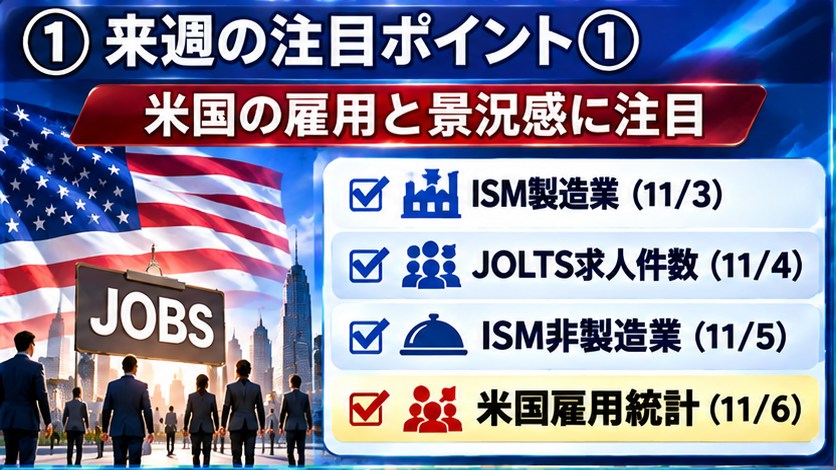
What to watch most are the RBA policy rate decision on November 3, the BOE policy announcement on November 5, and the US employment report on November 6.
If US employment is strong, rate-cut bets may retreat, supporting a stronger dollar and weaker gold. Conversely, if employment is weak, rate cuts could be expected, potentially causing the opposite move.

? List of Important Economic Indicators Next Week
Period: Monday, November 2, 2026 to Sunday, November 8, 2026
November 2 (Mon)
?? 10:45 China Manufacturing PMI ★★★
?? 00:00 US ISM Manufacturing Index ★★★
?? 12:30 Australia RBA Policy Rate Announcement ★★★
November 4 (Wed)
?? 00:00 US JOLTS Job Openings ★★★
?? 19:00 Euro Area Flash CPI ★★★
November 5 (Thu)
?? 00:00 US ISM Non-Manufacturing PMI ★★★
?? 21:00 UK BOE Monetary Policy Announcement ★★★
November 6 (Fri)
?? 22:30 US Employment Situation ★★★
※ US daylight saving time begins on November 1. Announcement times are in Japan time.
※ This is the author’s own assessment of importance based on market impact.
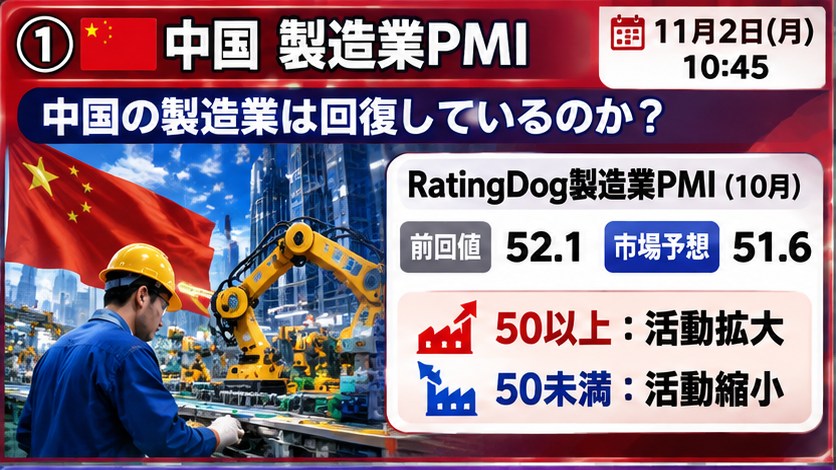
① ?? China October RatingDog Manufacturing PMI
? Is China’s manufacturing recovering?
Overview:This is a sentiment index for activity in China's manufacturing sector. Based on surveys of purchasing managers, it assesses new orders and production activity.
Release Date/Time:November 2 (Mon) 10:45
Previous:52.1
Market expect:51.6
?If better than expected:China's manufacturing may be seen as solid, raising hopes for an economic recovery. This could be positive for commodities tied to China, such as AUD and resources-related markets.
?If worse than expected:Slowdown in China’s economy could weigh on AUD and resources-related markets.
➡️If in line with expectations:Attention to whether the index remains above 50 and whether the breakdown of new orders improves.
Key point:China is one of the world’s largest manufacturing nations. Its economic health affects trading partners like Australia through demand for raw materials and resources.
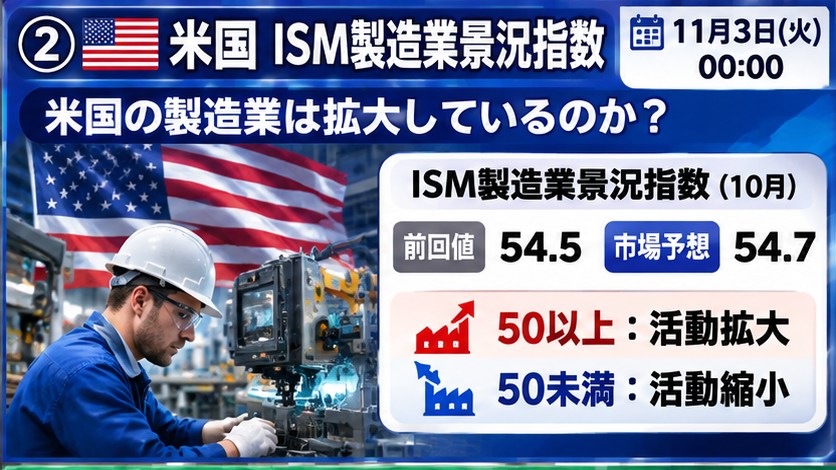
② ?? US October ISM Manufacturing PMI
? Is US manufacturing expanding?
Overview:This index measures activity in US manufacturing. It surveys new orders, production, employment, supplier deliveries, and inventories. Above 50 indicates expansion; below 50 indicates contraction.
Release Date/Time:November 3 (Tue) 00:00
Previous:54.5
Market expect:54.7
?If better than expected:Manufacturing activity is solid, boosting expectations for the US economy. Could push US rates higher and the dollar up.
?If worse than expected:Manufacturing slowdown may raise caution about the economy. Bets on rate cuts could strengthen, supporting dollar weakness.
➡️If in line with expectations:Watch new orders, employment, and price indices. Price indices especially help gauge inflation trends.
Key point:This forecast is 54.7, a modest rise from 54.5. Whether manufacturing expansion continues or its momentum slows is key.
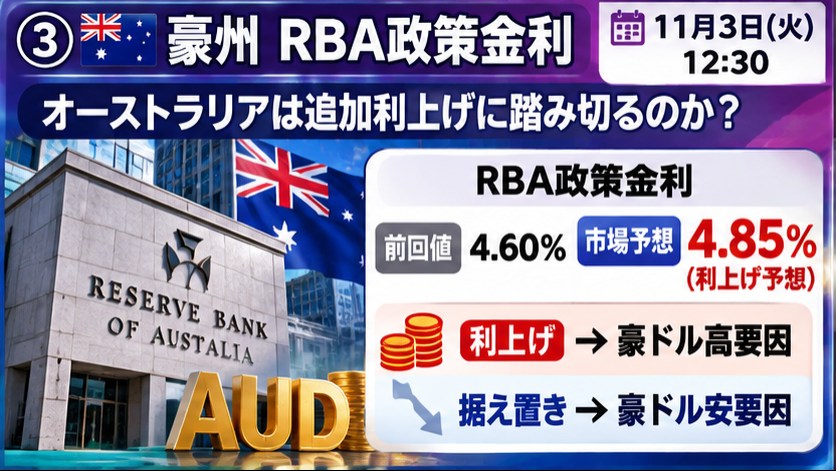
③ ?? Australia RBA Policy Rate Announcement
? Will Australia proceed with another rate hike?
Overview:The RBA will announce its policy rate. If rates rise, borrowing costs increase, cooling consumption and investment to curb inflation.
Release Date/Time:November 3 (Tue) 12:30
Previous:4.60%
Market expect:4.85% (rate hike expected)
?If rate hike is as expected:Rising Australian rates could make AUD more attractive on a yield basis, supporting AUD gains.
?If rate hike is avoided:Markets had priced in a hike; expectations recede and AUD may weaken.
➡️If rate rise occurs:Future rate hikes will be considered; statements and a press conference will be important.
Key point:This is not just a rate decision. The market has largely priced in a hike. The guidance on future policy is crucial.
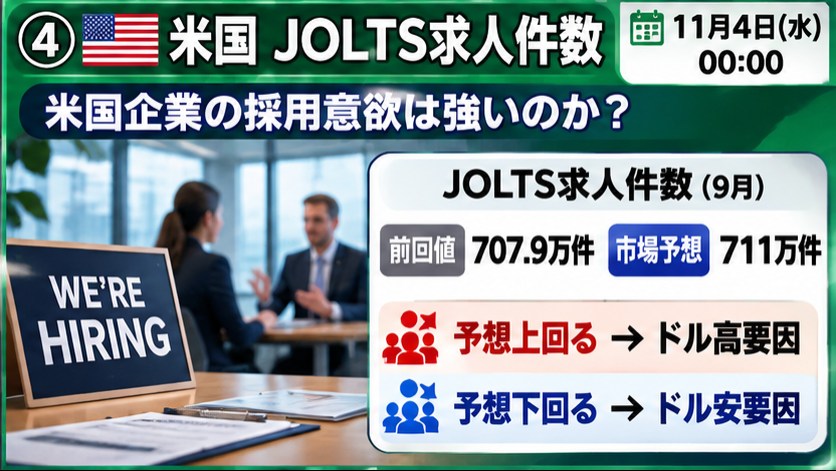
④ ?? US September JOLTS Job Openings
? Are US firms eager to hire?
Overview:JOLTS measures job openings, hires, and separations in US firms.
More openings indicate stronger hiring demand and a robust labor market.
Release Date/Time:November 4 (Wed) 00:00
Previous:7.079 million
Market expect:7.11 million
?If better than expected:Hiring demand is strong, reinforcing the view of a resilient labor market. Bets on Fed rate cuts may retreat, supporting the dollar.
?If worse than expected:Hiring intentions are weak, suggesting labor market slowdown. Bets on rate cuts may strengthen, supporting dollar weakness.
➡️If in line with expectations:Pay attention to openings, hires, and voluntary separations.
Key point:JOLTS reveals how many positions firms are trying to fill, offering a leading view on labor market trends beyond the headline employment numbers.
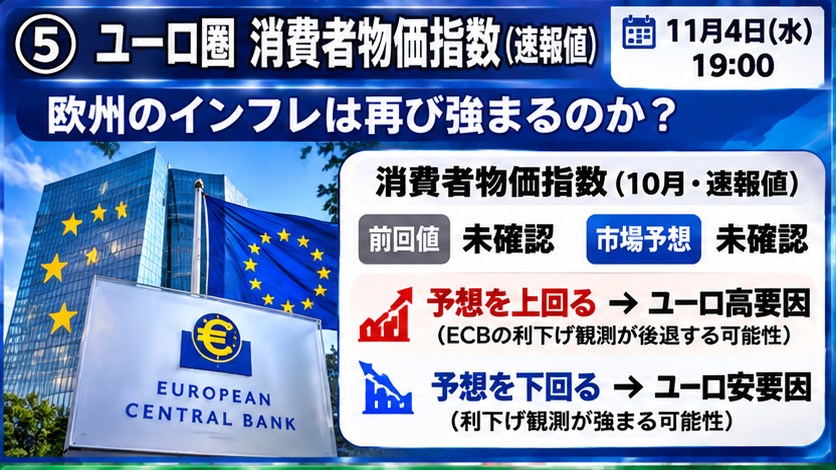
⑤ ?? Euro Area October Consumer Price Index Flash
? Will Europe’s inflation re-accelerate?
Overview:Euro area HICP (Harmonized Index of Consumer Prices) measures price changes for goods and services bought by households. A high inflation rate suggests ECB remains in tightening mode.
Release Date/Time:November 4 (Wed) 19:00
Previous:Unconfirmed
Market expect:Unconfirmed
?If better than expected:Inflation persistence may be seen, reducing expectations for ECB rate cuts. Could be a driver for euro strength.
?If worse than expected:Inflation pressures easing may boost expectations for rate cuts and weigh on the euro.
➡️If in line with expectations:Besides the headline, core inflation excluding energy and food is also important.
Key point:European inflation dynamics influence ECB policy and, together with US rate expectations, help shape EURUSD directions.
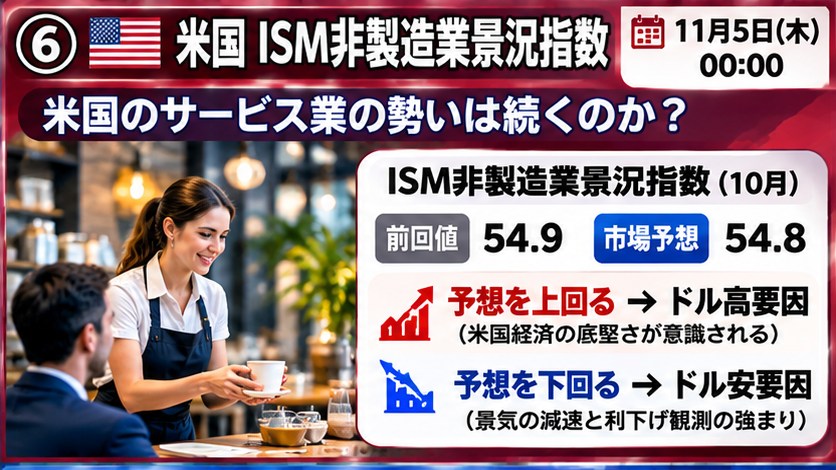
⑥ ?? US October ISM Non-Manufacturing (Services) PMI
? How vigorous is the US services sector?
Overview:This index tracks activity in the US service sector, which dominates the economy, making it a key gauge of overall economic health.
Release Date/Time:November 5 (Thu) 00:00
Previous:54.9
Market expect:54.8
?If better than expected:Services activity is robust, signaling a resilient US economy. Could push up rates and the dollar.
?If worse than expected:Services activity slowing may raise caution about the economy. Bets on rate cuts may strengthen, supporting the dollar weakness.
➡️If in line with expectations:Watch employment indices and price indices, especially price indices as they reflect inflation pressures in services.
Key point:Manufacturing alone cannot determine the US economy. It’s crucial to see whether services stay firm or slow down.
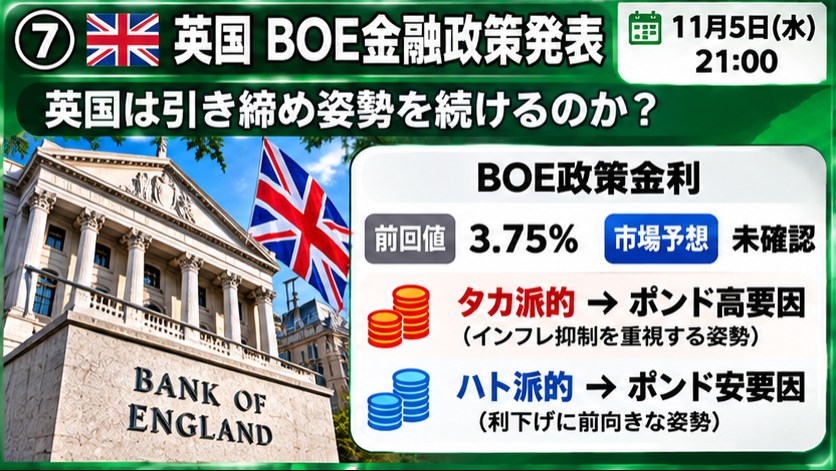
⑦ ?? UK BOE Monetary Policy Announcement
? Is UK policy leaning toward tightening?
Overview:The Bank of England (BOE) will release its monetary policy decision, along with the minutes from the Monetary Policy Committee and the economic outlook.
Release Date/Time:November 5 (Thu) 21:00
Previous:3.75%
Market expect:Unconfirmed
?If more hawkish than expected:A focus on inflation restraint could push UK rates higher and the pound higher.
?If more dovish than expected:A dovish stance could be interpreted as signaling rate cuts, weighing on UK rates and the pound.
➡️If in line with expectations:Beyond the policy rate, the vote outcome, inflation outlook, and future policy direction are important.
Key point:This time the Monetary Policy Report will also be published. Not only current rates but the outlook for inflation and policy decisions need attention.
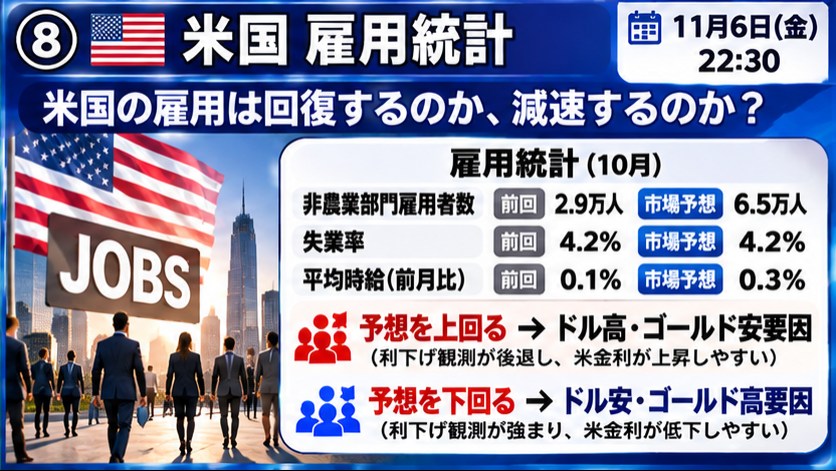
⑧ ?? US October Employment Situation
? Will US jobs recover, or slow down?
Overview:The US employment report includes nonfarm payrolls, unemployment rate, and average hourly earnings, providing a key view of labor market conditions.
It also strongly influences the Fed’s policy, making global financial markets watch closely.
Release Date/Time:November 6 (Fri) 22:30
- Previous: 29,000
- Market expect: 65,000
- Previous: 4.2%
- Market expect: 4.2%
- Previous: MoM 0.1%
- Market expect: MoM 0.3%?If better than expected:If payrolls rise more than expected and unemployment falls, the US labor market is considered firm.This could reduce urgency for Fed rate cuts and push US rates higher, supporting the dollar.?If worse than expected:If payroll growth slows and unemployment rises, labor market weakness is anticipated. Bets on rate cuts may rise, supporting dollar weakness.➡️If in line with expectations:Pay attention to payrolls, unemployment, and especially average earnings as indicators of inflation pressure.Key point:This employment report expects nonfarm payrolls to rise from 29,000 to 65,000. But payrolls alone aren’t enough; unemployment and average earnings must be considered to gauge labor market conditions.?? US Midterm Elections — How Will Congressional Power Change?? Election Day: November 3 (Tue)Next week’s US midterm elections are another important event.This time it’s not a presidential election; all 435 House seats and 35 of the 100 Senate seats are up for grabs.The election results could shift the balance of power in Congress for the next two years.Why Are Financial Markets Paying Attention?In the US, presidential agendas can be difficult to implement without congressional cooperation.Three key aspects to watch are:Fiscal policy:Tax cuts and government spending, which affect future fiscal management.Economic policy:The ease of pursuing tariffs, deregulation, and industrial support policies could change.Political uncertainty:A divided Congress can hinder budget and debt ceiling negotiations.Impact on Currencies and GoldThe election outcome could change views on fiscal policy and government operations, affecting US Treasuries, US rates, and the dollar.Political uncertainty could also drive gold as a safe-haven asset.However, election results alone do not determine dollar moves. The market’s pre-event pricing and post-election policy actions are what matter.? Focus Points:Besides the November 3 voting results, watch the balance of power in both chambers and how Congress operates afterward. In particular, the impact on fiscal policy and budget negotiations on US markets is of interest.? Next Week’s Trading Points to WatchThe week's biggest theme will be the US labor market.ISM Manufacturing, JOLTS job openings, and ISM Services will provide early-week signals on the US economy.Then on Friday, the most important US employment data will be released.If jobs are strong, rate-cut expectations for the Fed may retreat, US rates could rise, and the dollar may strengthen, weighing on gold.If jobs are weak, rate-cut expectations may rise, US rates may fall, lifting the dollar lower and gold higher.Impact on GoldGold is a non-yielding asset.Thus, when US rates rise, the appeal of gold versus yield-bearing assets like bonds tends to decline.US rate rises → dollar tends to strengthen → gold fallsUS rate falls → dollar tends to weaken → gold risesNevertheless, if the economy worsens or financial market risks escalate, gold can still be bought as a safe haven.Watch AUD, GBP, and EUR as wellNext week, policy and inflation data from other major economies will also matter.If RBA hikes, AUD could rise; if BoE remains hawkish, GBP could rise; if eurozone inflation remains strong, EUR could gain.In addition to the US dollar, pay attention to various countries’ interest rate differentials.The week will center on US employment and each country’s monetary policy.The key focus remains on the RBA rate on November 3, the BOE policy on November 5, and the US employment data on November 6.Additionally, the US midterm elections on November 3 are also on the horizon.Beyond rate expectations, post-election parliamentary dynamics and fiscal policy expectations could move the dollar, gold, and stock markets.Next week, evaluate the US market from both economic data and political event perspectives.
?If better than expected:
If payrolls rise more than expected and unemployment falls, the US labor market is considered firm.
This could reduce urgency for Fed rate cuts and push US rates higher, supporting the dollar.
?If worse than expected:
If payroll growth slows and unemployment rises, labor market weakness is anticipated. Bets on rate cuts may rise, supporting dollar weakness.
➡️
If in line with expectations:
Pay attention to payrolls, unemployment, and especially average earnings as indicators of inflation pressure.
Key point:This employment report expects nonfarm payrolls to rise from 29,000 to 65,000. But payrolls alone aren’t enough; unemployment and average earnings must be considered to gauge labor market conditions.
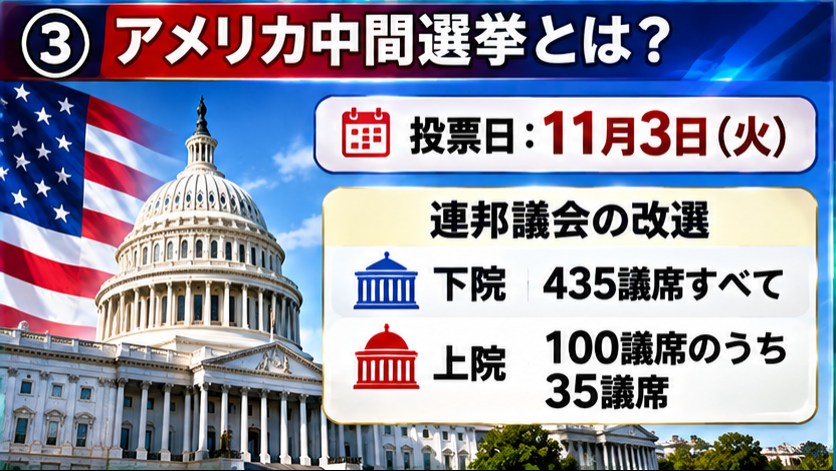
?? US Midterm Elections — How Will Congressional Power Change?
? Election Day: November 3 (Tue)
Next week’s US midterm elections are another important event.
This time it’s not a presidential election; all 435 House seats and 35 of the 100 Senate seats are up for grabs.
The election results could shift the balance of power in Congress for the next two years.
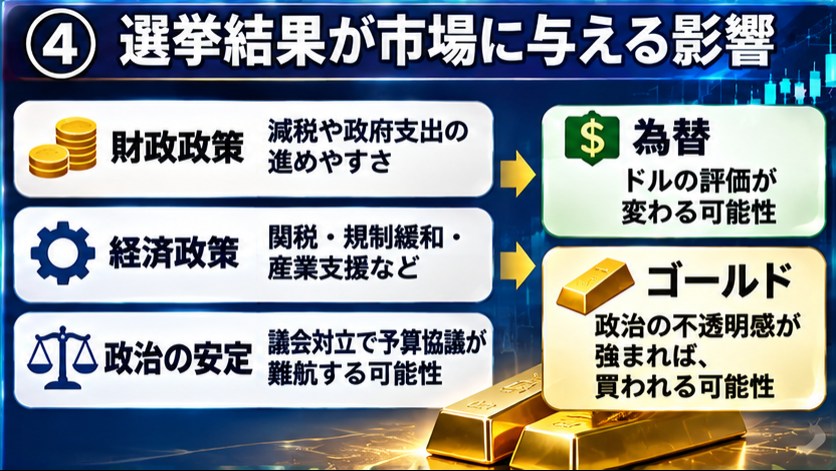
Why Are Financial Markets Paying Attention?
In the US, presidential agendas can be difficult to implement without congressional cooperation.
Three key aspects to watch are:
- Fiscal policy:Tax cuts and government spending, which affect future fiscal management.
- Economic policy:The ease of pursuing tariffs, deregulation, and industrial support policies could change.
- Political uncertainty:A divided Congress can hinder budget and debt ceiling negotiations.
Impact on Currencies and Gold
The election outcome could change views on fiscal policy and government operations, affecting US Treasuries, US rates, and the dollar.
Political uncertainty could also drive gold as a safe-haven asset.
However, election results alone do not determine dollar moves. The market’s pre-event pricing and post-election policy actions are what matter.
? Focus Points:Besides the November 3 voting results, watch the balance of power in both chambers and how Congress operates afterward. In particular, the impact on fiscal policy and budget negotiations on US markets is of interest.
? Next Week’s Trading Points to Watch
The week's biggest theme will be the US labor market.
ISM Manufacturing, JOLTS job openings, and ISM Services will provide early-week signals on the US economy.
Then on Friday, the most important US employment data will be released.
If jobs are strong, rate-cut expectations for the Fed may retreat, US rates could rise, and the dollar may strengthen, weighing on gold.
If jobs are weak, rate-cut expectations may rise, US rates may fall, lifting the dollar lower and gold higher.
Impact on Gold
Gold is a non-yielding asset.
Thus, when US rates rise, the appeal of gold versus yield-bearing assets like bonds tends to decline.
- US rate rises → dollar tends to strengthen → gold falls
- US rate falls → dollar tends to weaken → gold rises
Nevertheless, if the economy worsens or financial market risks escalate, gold can still be bought as a safe haven.
Watch AUD, GBP, and EUR as well
Next week, policy and inflation data from other major economies will also matter.
If RBA hikes, AUD could rise; if BoE remains hawkish, GBP could rise; if eurozone inflation remains strong, EUR could gain.
In addition to the US dollar, pay attention to various countries’ interest rate differentials.
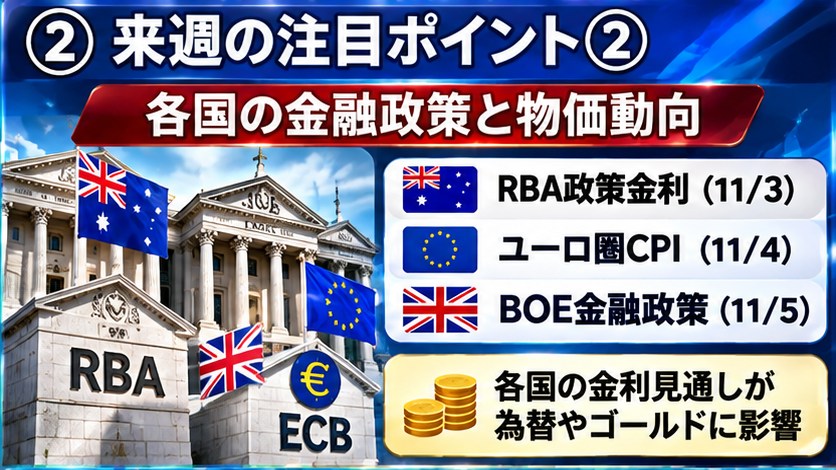
The week will center on US employment and each country’s monetary policy.
The key focus remains on the RBA rate on November 3, the BOE policy on November 5, and the US employment data on November 6.
Additionally, the US midterm elections on November 3 are also on the horizon.
Beyond rate expectations, post-election parliamentary dynamics and fiscal policy expectations could move the dollar, gold, and stock markets.