

【The Trading Edition】 Episode 31: Find the "one destiny" from thousands of stocks? A sincere scan method that doesn't rely on magic

In the last time (the 30th session), we learned the importance of evaluating the quality of a trade not by the amount of money, but by the proportion (grade) of the opportunities the market provides. And we talked about how asking yourself, before entering, “Is this a Grade A trade?” can reduce unnecessary losses.
However, I think you will encounter one big question here. “There are thousands of株 (stocks); how can we find candidates for that ‘Grade A’ among them?”
This time, please allow me to share Elder Dr. Elder's practical and grounded guidance on narrowing down promising trade candidates from an enormous universe of stocks through scanning (screening). I myself used to rely on convenient tools and failed. That is why I want to approach this topic with humility.
1. Scanning is not a “magic wand”
Modern traders can search thousands of stocks in an instant using high-performance computers and software.
However, Dr. Elder first pins this down.“Have realistic expectations for scanning. You cannot pull a needle from a haystack.”
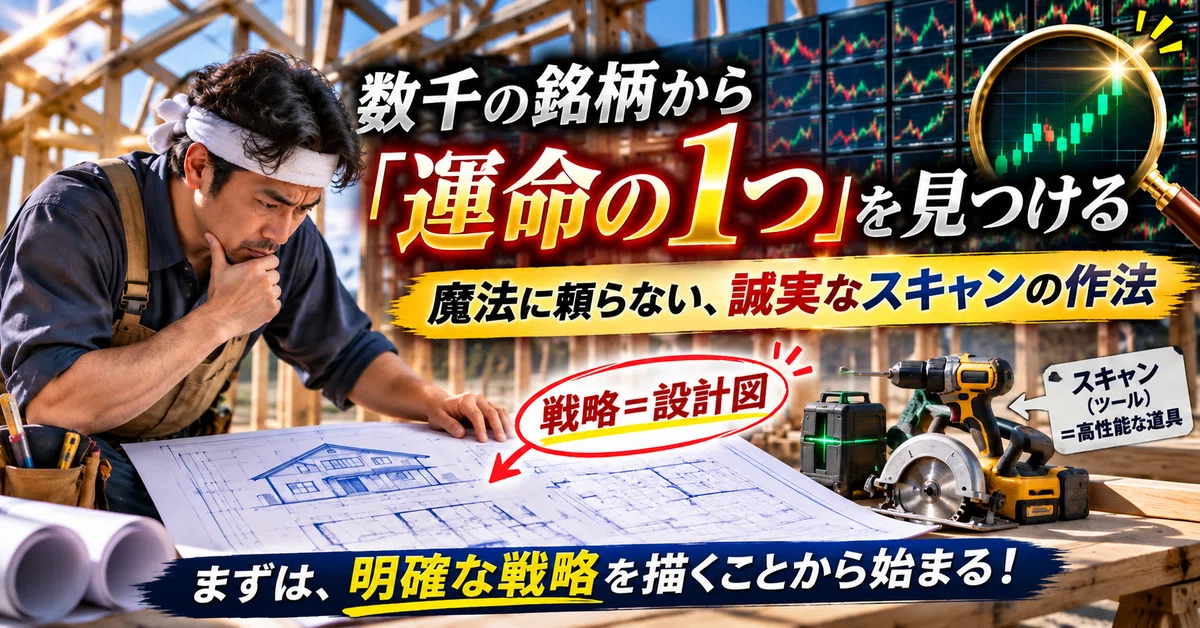
A scanning tool is not a magical instrument that automatically finds a unique perfect trade. The fact that you can perform excellent scans only means that you can select a group of candidates that we should focus our attention on. It does not release us from the “work (final judgment)” required to choose stocks; we must humbly accept that reality.
2. The essential premise before operating tools
If you do not have a clearly defined strategy, then what on earth are you going to scan?
Dr. Elder says that before scanning for promising stocks, you must first develop (define) a trading system or strategy you can trust. Are you looking for “pullbacks in a strong uptrend” or “reversals from bearish divergences”? Defining the pattern you trust is the first step, and scanning with a computer is only the second step that comes much later.
And once you look at the list of candidates extracted by the scan, you must throw that magic question at them first.“Is this a Grade A trade?”(Does the stock fit the ideal pattern?) Only if the answer is yes can you begin preparing the trade.
3. Defensive filters to protect beginners
When performing scans, in addition to specifying your desired conditions (e.g., MACD turning up), it is extremely effective to add negative conditions that exclude stocks you should not touch.
For example, by applying filters like the following, beginners can prevent unnecessary incidents.
Exclude low-volume stocks:Include a condition such as “exclude stocks with an average daily volume under 500,000 shares (or 1,000,000 shares).” Low-volume stocks can cause slippage—difficult to buy when you want to buy and hard to sell when you want to sell—so this helps avoid that.
Exclude price-poor stocks (too cheap):Stocks with prices that are too low can suffer fatal impact from small price movements, so they are excluded.
Narrow the focus to major indices:Rather than scanning all stocks from the outset, focusing on stocks that comprise indices like the S&P 500 or Russell 2000 is an efficient and safer approach.