

【Weekly Market Summary】U.S. inflation re-ignition, Bank of Japan hawkish shift, and Red Sea tanker attack clash—AI stock plunges and Middle East crisis shake up the final week of October, revealing the full picture
On the afternoon of October 31, 2026 (Saturday), global foreign exchange and financial markets closed the entire schedule of the volatile last week of October (October 26–31) and headed into weekend close.
This week's markets were a week in which macroeconomic material of a magnitude that cannot be explained by a single theme exploded in all directions at the same time.
FOMC of the U.S. Federal Reserve kept the policy rate at 3.75%–4.00%, but the 10–2 vote (two members advocated a rate hike) thoroughly shattered market expectations of early rate cuts.
U.S. GDP released on Oct 29 (quarterly rate +3.4%) and PCE inflation (year over year +3.6%) were strong, clearly highlighting the persistence and re-acceleration of inflation.
Bank of Japan policy meeting (the 30th) held rates steady (1.25%), but Governor Haruhiko Kuroda signaled that “rate hikes every few months could be an option,” causingstrong expectations of further hikes from December onward.
In the Middle East, ships in the Strait of Hormuz were attacked by explosives, sending WTI crude to $104.12 and Brent crude to $117.64, with monthly gains exceeding 15%.
In the U.S. stock market, massive profit-taking in AI-related stocks surged as Intel (roughly a 29% plunge) and others reported results, triggeringa sharp fall in the Nasdaq by 2.9%.
As inflationary pressures push rates higher and stock markets plunge with risk-off behavior colliding head-on, the dollar/yen battled in the 157–158 range, while precious metals like gold and silver fell sharply under the weight of rising rates and liquidation selling.
Based on confirmed facts and carefully selected public data up to 3:32 PM on Oct 31, this article details the full picture of this week’s financial markets and provides trading strategies for the week ahead (Nov 2–week with U.S. midterms, jobs data, and RBA/BOE meetings).
Chapter 1: This Week’s Most Important Macro Events
(FRB, BoJ, ECB)
First, we organize the decisions of the three major central banks that moved global monetary policy this week and their logical consequences.
【Late October 2026: Comparison of Major Central Banks’ Stances】
・U.S. Federal Reserve (10/28 FOMC):
Policy rate held at 3.75%–4.00% (10–2 hawkish split).
Completely suppressing rate-cut expectations.
・Bank of Japan (10/30 meeting):
Policy rate held at 1.25%. Governor Kuroda hinted at “rate hikes every few months,”
raising hawkish expectations.
・European Central Bank (10/29 ECB):
Policy rate kept unchanged. Caution about inflation pressures from energy and potential impact on growth.
① U.S. Federal Reserve / FOMC: Elimination of Rate-Cut Expectations and the Shock of “10 to 2”
At the Oct 28 FOMC, the policy rate was kept at 3.75%–4.00%. But the real story was not merely a hold but the voting result: a “10–2 vote,” with Lisa Cook (Lia Cook) and Betsey Hamaek (Beth Hamack) voting for a 0.25% rate hike, which was a striking opposition.10–2 vote. In the statement, the U.S. economy was upgraded from “modestly expanding” to “expanding at a robust pace.” The market’s key assumption that inflation would slow quickly and the Fed would cut rates within the year collapsed, replaced by a scenario where further rate hikes were even more conceivable.
② U.S. GDP and PCE inflation: Too strong an economy and troublesome prices
On the 29th, the major U.S. economic indicators reinforced the Fed’s hawkish stance.
【Q3 2026 and September U.S. Economic Indicators】
・Real GDP (annualized): +3.4% (previous quarter +2.2%)
・PCE price index (year-over-year): +3.6% (significantly above the Fed’s 2% target)
・Core PCE (month-over-month): +0.3%; Personal consumption expenditures: +0.5%
This data suggested the economy was strong and inflation remained high, making it the most challenging environment for the Fed to manage. There was no hurry to cut rates, and the U.S. 10-year yield remained high in the 5% range, supporting the dollar.
③ BoJ – Monetary Policy Meeting: Governor Kuroda’s “hawkish tone”
The BoJ kept the policy rate at 1.25% as anticipated, but Governor Kuroda’s post-meeting remarks created notable market tension.
The underlying pace of price increases has reached a level consistent with the 2% inflation target.
Rising energy and commodity prices are beginning to pass through to consumer prices, necessitating vigilance for upside inflation risks.
“We will not simply wait idly.” The economy, prices, and financial conditions will be reviewed at each meeting to adjust policy.
Hiking every few months could become an option(not promising a specific timing, but clearly acknowledging the option).
This statement caused the market to immediately price in expectations of additional rate hikes in December. As Japan’s rate normalization becomes more plausible, there is now a clear “yen appreciation pressure” against the dollar, limiting yen depreciation.
Chapter 2: Geopolitical Risk Explosion — Israel’s Elections and Hormuz Strait Shock
Israel’s elections and Hormuz Strait tremors
Alongside monetary policy, the week’s market upheaval was driven by developments in the Middle East, rapidly changing geopolitical risk.
1. Israel’s elections: With a narrow majority and stalled coalition talks
The final distribution of seats in Israel’s elections, ongoing since last week, has been confirmed (AP).
Likud-led governing bloc:53 seats
Opposition bloc:48 seats
Arab parties:19 seats
Total:120 seats (more than half requires 61 seats)
No bloc won an outright majority, leaving Parliament deeply divided. The new parliament is scheduled to convene on November 10, but opposition coalition-building faces extreme difficulty, making a prolonged political vacuum and coalition talks a near certainty. This political instability has directly affected domestic assets (shekel depreciation, stock declines, and rising national bond yields).
2. Tanker attack in Hormuz Strait and oil prices surpassing $117
As political vacuums and regional military tensions peaked, a decisive incident occurred on Oct 30.The UK Maritime Trades Organization (UKMTO) officially reported that a commercial tanker in the Hormuz Strait was subjected to an explosive attack by a small vessel.This raised physical supply risks in the strait and sent energy markets into a panic-driven rally.
This development firmly anchored oil above $117, creating a major risk for global inflation outlook and pressuring central banks to consider further rate hikes.
【Oil market close on Oct 30】
・Brent (North Sea): $117.64 (+2.4%); monthly gain +13.6%
・WTI (Texas) : $104.12 (+2.08%); monthly gain +15.2%
※ October monthly gain: Brent +13.6%, WTI +15.2%
Diplomatic discussions among Saudi Arabia, Turkey, Pakistan with Iran, seeking to ease tensions, were immediately overshadowed by the tanker attack. Settling around $117 oil prices could be the trigger for global inflation re-acceleration, representing the greatest threat.
Chapter 3: Shock in U.S. Equity Markets — AI Stocks Collapse and Weekend Plunge
AI-related stock shocks and sharp weekend sell-off
This weekend, U.S. stock markets saw a historic drop centered on high-valuation tech stocks after peaking earlier in the week.
【U.S. equity close on Friday, Oct 30 — daily gains/losses】
・S&P 500: 7,580.07 (-1.8%)
・Nasdaq Composite: 25,437.00 (-2.9%)
・Dow Jones Industrial: 51,770.31 (-1.1%)
・Russell 2000: 2,811.84 (-1.7%)
Reasons for the decline: AI investment unwind and profit-taking
Intel’s plunge:a record drop of about 29% due to weak earnings guidance.
Earnings of Amazon and others:as cloud growth and massive AI-related capital expenditure were flagged, doubts arose about whether such investments would yield returns commensurate with the scale, triggering market-wide concerns.
S&P 500 and Nasdaq posted the largest single-day declines since last June, with heavy downside pressure centered on tech stocks.
This stock-market decline acted as a strong trigger for currency markets, prompting risk-off yen buying and U.S. Treasury buying as safe assets (lower yields).
Chapter 4: Weekly Analysis of Major FX Markets
(USD crosses and Crosses vs JPY)
In this volatile macro environment, how did major currency pairs fare over the week?
【Weekly trends for major currencies, Oct 26–31】
・USD/JPY:
Early week in the mid-156s, surged to 158.34 following FOMC and U.S. GDP, then fell back to around 157.5–157.7 due to BoJ hawkish shift and U.S. equity sell-off driven by U.S. rate declines.
・EUR/USD:
Softened to around 1.1178. Inflation vigilance by the ECB weighed on prices but European growth concerns capped gains. Monthly drop about 1.3%.
・GBP/USD:
Maintained relative stability around 1.3392, up about 1% for the month.
・AUD/USD:
Driven by a sharp acceleration in Q3 CPI (annualized 4.3%), expectations for RBA rate hikes in November surged, lifting the Aussie.
・NZD/USD:
RBNZ unexpectedly kept rates at 2.75% (4–3 vote). After a brief dip, it recovered modestly.
USD/JPY weekly path and practical levels
This week, USD/JPY ranged from a weekly low of156.644to a weekly high of158.341with a choppy 1.70-yen range, closing near 157.5–157.7 by week’s end.
【USD/JPY Technical Levels (as of Oct 31)】
・159.00: psychological level and potential turn point for yen weakness acceleration
・158.30–158.50: week’s high zone; strong resistance
・158.00: psychological milestone
・157.50: recent inflection point
・157.00: short-term important support candidate
・156.64: week’s low
・156.00: psychological absolute defense line
Current market assessment:The USD/JPY rose into the 158 range on hawkish Fed stance and higher U.S. yields, but was pulled back by the BoJ’s hawkish tilt and by the late-week decline in U.S. long-term yields due to stock weakness. It is premature to declare a pure “yen appreciation trend,” but with BoJ's shift to a rate-hiking posture, a traditional unconditionally yen-selling and dollar-buying environment is becoming less viable.
Chapter 5: The Surge of Precious Metals, Commodities, and Crypto
Volatility
Rising rates, a strong dollar, and geopolitical risk created a historic twist in the commodities market.
1. Gold (XAU/USD) and Silver (XAG/USD) Plunge
Despite extreme geopolitical risk from the Hormuz Strait tanker attack, gold and silver recorded historically large declines.
Gold futures close (Oct 30):$3,885.70 (intraday -3.29%; October monthly drop -6.49%)
Silver futures close (Oct 30):$49.097 (intraday -5.93%; October monthly drop -18.31%)
Why did gold sell off?Typically, wars or Middle East crises spark “gold as a safe haven,” but this week was overwhelmed by the dominant
“monetary policy and interest-rate factors.”
The primary drivers were:
1) Fed rate-cut expectations vanished as U.S. long-term yields stayed high (real rates rose).
Geopolitical risk was outweighed by the higher-for-longer rates, stronger dollar, and the need to liquidate assets.
2. Oil (WTI and Brent) Soaring
On the other hand, oil markets, facing a direct supply risk, surged to record highs.
Brent (North Sea Brent):$117.64 (+2.4%); monthly +13.6%
WTI (Texas light crude):$104.12 (+2.08%); monthly +15.2%
The tanker explosion in the Hormuz Strait turned into a real supply risk, worsening inflation prospects in the U.S., Europe, and Japan and intensifying central-bank rate-hike pressures, creating a vicious cycle.
Chapter 6: Next Week (Nov 2–6) Schedules and Alert Scenarios
超重要 schedules and warning scenarios
The first week of November promises an even more intense slate of macroeconomic and geopolitical events than this week.
【Ultra-important November 1st week Schedule (Japan time)】
・Nov 2 (Mon) ?? U.S. October ISM Manufacturing Index (focus on Prices)
・Nov 3 (Tue) ?? RBA policy rate decision and statement ???
・Nov 3 (Tue) ?? U.S.-China midterm election results ???
・Nov 4 (Wed) ?? U.S. October ADP employment data / ISM services index
・Nov 5 (Thu) ?? Bank of England policy rate decision ???
・Nov 5 (Thu) ?? Weekly initial jobless claims
・Nov 6 (Fri) ?? U.S. October employment report (nonfarm payrolls, unemployment rate, average hourly earnings) ????
Top 3 political/economic events to watch next week
U.S.-China midterm elections (Nov 3):If the balance of power in Congress shifts, fiscal spending, tariffs, and energy policy could be heavily affected, further heightening dollar and U.S. stock volatility.
Australia RBA meeting (Nov 3):With Q3 CPI accelerating to 4.3% year-on-year, market odds for a 25bp rate hike rose to about 85%. An actual move would be a strong upside driver for AUD/JPY.
U.S. Jobs Report (Nov 6):Following solid GDP and PCE data, the health of the labor market will be scrutinized again. If nonfarm payrolls beat estimates, unemployment rate falls, and wages rise, the odds of further Fed rate hikes will rise, accelerating the dollar and gold’s decline.
Chapter 7: Next Week’s Market Outlook — Three Scenario Analysis
Based on this week’s data and weekend market conditions, here are three scenarios for next week.
【Scenario A】
Strong U.S. jobs data and midterm risk clearance = Dollar strength, Yen weakness resumes
・Conditions: U.S. October payrolls beat expectations, U.S. 10-year yields rise toward 5.1% again. BoJ rate hikes are perceived to be further in the future.
・Movement: USD/JPY back to the 158 handle, rising toward 158.50; gold and high-priced stocks face further downside pressure due to risk on.
【Scenario B】
Continued correction in U.S. stocks and risk-off = Yen strength and dollar weakness
・Conditions: AI stock crash shock spills over to the broader U.S. equity market; investors adopt risk-off, buying U.S. Treasuries (yields fall).
・Movement: Lower U.S. long-term yields and yen buying push USD/JPY below 157.00, into the mid-156s (weekly lows); cross-yen declines spread.
【Scenario C】Middle East escalation = Oil spike and stagflation risk
・Conditions: Heightened risk of Hormuz Strait closure or Israeli military action pushes oil toward $120.
・Movement: Inflation fears push U.S. yields and oil higher simultaneously, triggering panic selling in stocks. A volatile environment with real-dollar strength and yen buying as a safe asset.
Summary: Trading Discipline for Next Week
The last week of October was a turning point with a rare misalignment between central banks’ policies — “the fading of Fed rate-cut expectations” and “BoJ hawkish shift” — alongside “oil surge from Hormuz” and “AI stock shock-driven U.S. stock sell-off.”
Discard the notion that “USD/JPY = one-sided yen depreciation”:With the BoJ formally hinting at rate hikes every few months, Japan’s policy stance is clearly changing. Monitor the trajectory of U.S. yields together with the BoJ’s tone.
Prioritize oil prices and Middle East headlines:With WTI around $104 and Brent around $117, energy costs are a major constraint on the global economy, posing the greatest risk of triggering a stock-bond rally reversal.
Position-sizing ahead of key events:Before the November 3 midterms and November 6 employment data, reduce exposure to avoid spread widening and slippage; stay disciplined by awaiting realized price action before following.
As the volatile November market opens, use calm, objective analysis and strict risk management to secure profits.
If this was helpful, please follow and press the "Like" (♡) icon at the bottom of the screen to encourage further updates!

TrendPulse Pro free trial:https://www.gogojungle.co.jp/tools/indicators/86532?via=users
TrendPulse Pro AI free trial:https://www.gogojungle.co.jp/tools/indicators/86529?via=users
QuickScalp AI free trial:https://www.gogojungle.co.jp/tools/indicators/86523?via=users
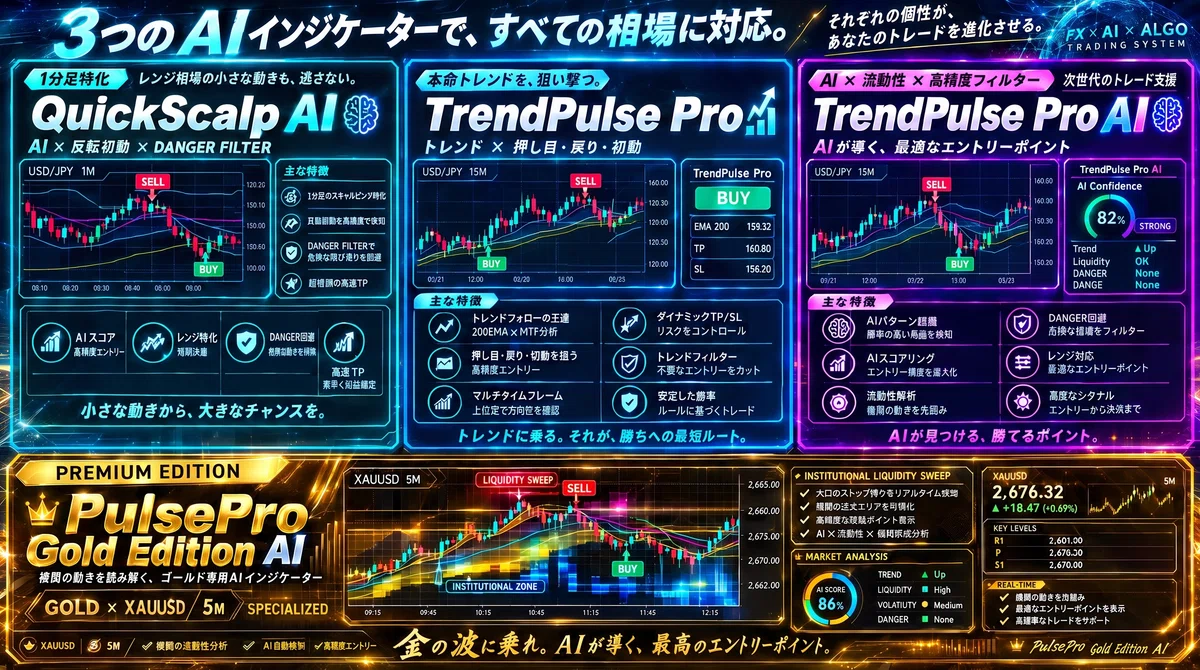
An indicator that eliminates emotion and captures the market with clear fundamentals and rules.
Details of features and design logic are published on each product page
? [GogoJungle Product Page]