
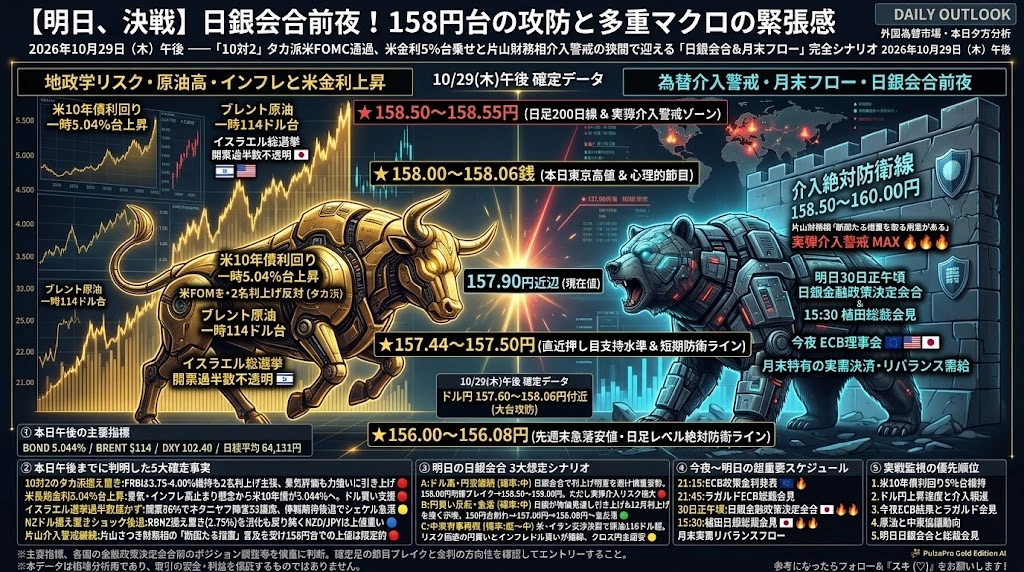
[Market-wide Review] U.S. 10-year bonds in the 5% range; USD/JPY at 158 yen—intervention warnings amid pre-FOMC hawkish hold, the eve of the Bank of Japan decision meeting, and a volatile scenario where Middle East peace talks and Israeli political develo
On the afternoon of Thursday, October 29, 2026, global currency and financial markets have moved past the release of the results from the U.S. Federal Open Market Committee (FOMC), entering an extremely tense phase ahead of the Bank of Japan's monetary policy decision meeting, which will disclose its results tomorrow, the 30th.
The U.S. Federal Reserve Board (FRB) kept policy rates unchanged, but maintained a hawkish tone as two directors dissented to call for a rate hike. In response, the U.S. 10-year yield rose to the 5.04% range. The USD/JPY in Tokyo's market briefly rose to 158.06 yen, testing the 158 yen level again.
However, the weight of Prime Minister Satsuki Katayama's warning of "decisive measures" looms overhead, keeping expectations of actual intervention firmly in check. Europe has the ECB Council meeting tonight, the Middle East carries hopes for diplomacy with Iran alongside ongoing uncertainty in the Israeli election results. End-of-month corporate settlements and rebalancing demand add more layers of factors intersecting the market.
Based on confirmed objective facts and logical market transmission paths, I will整理 the current market structure and practical key points in detail.
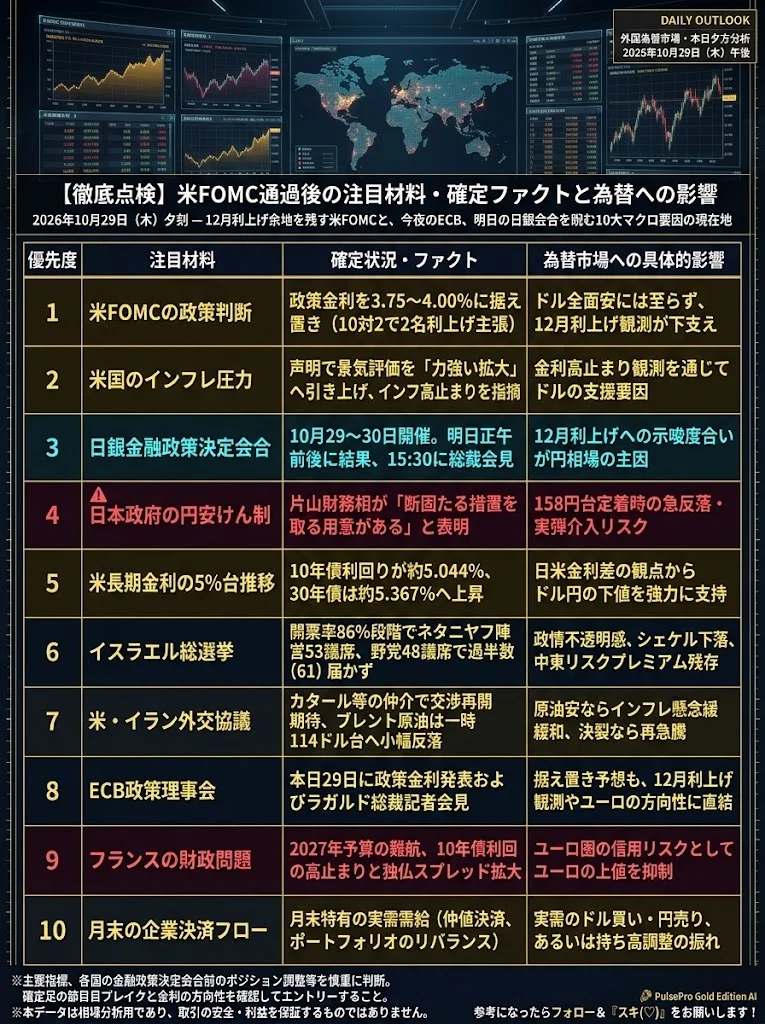
Chapter 1: The 10 Major Macroeconomic Materials Disclosed Today
The priority and current state of the key factors affecting the market at the moment.
Chapter 2: U.S. FOMC Verification — The "10 to 2"
Hawkish Hold and U.S. Long-Term Rates
The FOMC statement released in the early hours of the 29th Japan time conveyed a tightening bias that went beyond mere status quo.
【Key Facts of the FOMC (released October 28, 2026)】
・Policy rate: kept at 3.75%–4.00%
・Policy decision: 10 votes in favor, 2 votes against. Note: Governor Lisa Cook and President Beth Hammack argued for a 0.25% hike and dissented.
・Economic assessment: upgraded from previous “solid rate of expansion” to “expansion at a vigorous pace.”
・Price recognition: inflation rate has slowed over the past year, but remains elevated.
Bond Market Reactions and Logical Consequences
After the FOMC, U.S. government bond markets faced heightened yield pressure.
U.S. 2-year yield: about 4.731%
U.S. 10-year yield: about 5.044%(roughly +5 basis points from the previous day)
U.S. 30-year yield: about 5.367%
Typically, a unanimous hold would lead to lower yields and dollar selling as the factors are exhausted, butthe fact that two executive board members advocated a rate hike strongly signals that the Fed’s cycle is not yet finished。
In an environment where the economy remains strong and inflation stays elevated, a rapid shift to cuts is extremely difficult, and the persistence of U.S. long-term rates around the 5.0% level provides the logical basis for the dollar/yen to stay supported.
Chapter 3: The 158 Yen Range Battle and
The Realism of “FX Intervention”
In the morning of the 29th in Tokyo, the USD/JPY briefly reached158.06. After dipping to around 157.70 immediately following the FOMC, supported by rising U.S. yields and a rebound in Japanese equities (Nikkei up around 177 points to the 64,131 level), it again moved into the 158 range.
【USD/JPY — Technical Structure and Warning Levels】
★ 160.00 yen: Psychological absolute ceiling (zone of large-scale actual intervention in the past) ↑
★ 159.00 yen: Overreaction caution band when intervention fears peak ↑
★ 158.50–158.55 yen: Daily 200-day moving average and structural resistance ↑
★ 158.00–158.06 yen: Today's Tokyo high and psychological milestone (whether it can be settled) ——————————
Current level: late 157s to around 158
——————————
【Lower Support Levels】
★ 157.44–157.50 yen: Near-term dip support ↓
★ 157.00–157.10 yen: Roll-reversal support band ↓
★ 156.00–156.08 yen: Last week’s sharp low and daily defense line
Katayama Minister of Finance’s Warnings and Practical Considerations
Minister of Finance Satsuki Katayama stated on the 27th that she is “ready to take decisive measures,” representing the strongest possible form of verbal intervention.
What to watch here is not only the level but the speed of market rise (volatility).
If U.S. yields rise slowly and the USD/JPY meanders around the 158 range, authorities may remain on the sidelines. But if overseas markets and month-end flows push the pair sharply into the upper-158s to 159s, the risk of actual intervention (buying yen, selling dollars) increases due to attempts to curb volatility. Careful positioning is crucial in high-price zones.
Chapter 4: Eve of the BOJ Policy Meeting —
Market Expectations for a Hawkish Hold
The Bank of Japan will hold its policy meeting from October 29–30, with policy decisions around noon tomorrow, and a press briefing by Governor Kazuo Ueda at 15:30.
【BOJ Policy Meeting Schedule】
・October 30 (Fri) around midday: Policy rate decision, economic
・Outlook for Prices (Outlook Report) release
・October 30 (Fri) 15:30: Governor Ueda’s press conference
・November 10 (Tue) 08:50: Release of “Main Opinions” from October meeting
Policy Judgment Tipping Point
Market consensus is to keep the policy rate unchanged (current 1.25%). Therefore, the hold itself tends to be a price-in/known factor, with focus narrowing to four points.
Assessment of Core Inflation Trend:How to express confidence in achieving the 2% target after the September nationwide core CPI (+2.1%) release last week.
Raising the inflation outlook in the Outlook Report:Whether the price outlook for 2026 and 2027 will be upgraded.
Preparations for December rate hike:Whether Governor Ueda’s press conference will strongly imply a rate hike at the next December meeting (to 1.50%).
Consideration of fiscal policy and long-term rates:A central bank’s independent view on the government’s proactive fiscal stance and concerns about increasing government bonds.
If the Governor signals a hawkish stance toward a December hike, a rapid yen buyback could occur. Conversely, if he emphasizes caution due to high U.S. rates and overseas economic uncertainties, market expectations may falter, potentially causing a temporary yen weakness (a sharp rebound in USD/JPY).
Chapter 5: Middle East Tensions and the Oil Market —
Diplomatic Negotiations and Supply Risk
In energy markets, diplomatic efforts to ease tensions counterbalance physical military risk on the ground.
North Sea Brent crude futures: briefly around 114 dollars per barrel (slightly down from yesterday)
U.S. WTI crude futures: briefly around 101 dollars per barrel
1. Expectations for Diplomatic Progress
A framework proposal for a ceasefire among the United States, Israel, and Iran, facilitated by Qatar, and behind-the-scenes efforts by Vice President Kamala Harris were reported, easing excessive supply disruption concerns and causing crude futures to retreat from highs.
2. Remaining Supply Bottlenecks
However, there are reports of reluctance from Iran on the proposed agreement, and threats from pro-Iran Houthis against Saudi oil facilities and ships navigating the Red Sea and Hormuz Strait continue.
The fact that oil remains around the 114-dollar range continues to exert strong inflationary pressure on the global economy and remains a factor that prevents major central banks from cutting rates.
Chapter 6: Israeli Election Vote Counting Confusion and the Shekel Plummet
Sharp Fall in the Shekel
The Israeli general election held on October 27 is further complicating the outlook for Middle East affairs.
【Media projections at 86% vote counting for Israeli election (Reuters report)】
・Right-leaning bloc led by Netanyahu: 53 seats
・Opposition bloc (Mr. Eisenkot and others): 48 seats
・Arab-list bloc: 19 seats※ With 120 seats in Parliament, a majority requires 61 seats
The right-leaning bloc performed better than expected but did not reach an outright majority (61 seats). As a result, it is likely to be one of: staying Netanyahu’s government with a hardline stance toward Iran, or political vacuum due to difficulty in coalition negotiations, with market expectations for an early ceasefire and reduced geopolitical risk receding.
This outcome caused the Israeli shekel to fall more than 2% against the dollar, the Tel Aviv stock index to drop about 2.5%, and Israeli government bond yields to jump, rattling financial markets.
Chapter 7: ECB Council and European Affairs and the Major Cross-Yen Landscape
Major Crosses’ Power Map
From this evening, the European Central Bank (ECB) policy council is in session, with euro-area rate decisions and France’s fiscal concerns interplaying.
1. ECB Council Points (announced today)
Market expectation: Policy rate (deposit facility) held at 2.5% is favored.
Focus:Wary of inflation re-ignition due to crude oil, will there be any hints of tightening in December?
Dilemma:As indicated by rising French bond yields and widening Germany-France yield differentials (spreads), tightening under a backdrop of Eurozone credit risk could further cool the European economy.
2. Determination of Major Currency Pairs
EUR/USD (around 1.1139):U.S. rate remains high and French fiscal concerns weigh; unless the ECB adopts a hawkish stance, upside is limited.
EUR/JPY (around 175.96):Euro weakness and yen weakness offset each other; direction is less clear compared to USD/JPY.
AUD/JPY:Japanese stock gains are positive, but the impact on global demand from higher oil and concerns about China’s slowdown advise caution on upside moves.
NZD/JPY:The NZD remains pressured by the NZD’s fall following surprise RBNZ hold at 2.75%, with a slow recovery.
MXN/JPY (Mexican peso/yen):High-yield appeal, but in a 5% range for U.S. long yields, potential capital outflows from emerging markets remain a risk. Watch for sudden risk-off declines.
Chapter 8: End-of-Month Real Demand Flows and Future Trade Scenarios
Trading Scenarios
From today, October 29 through tomorrow, end-of-month demand fluctuations (portfolio rebalancing and dollar funding by importers) will compound. Illiquid order books may experience sudden spikes that ignore technicals, so caution is needed.
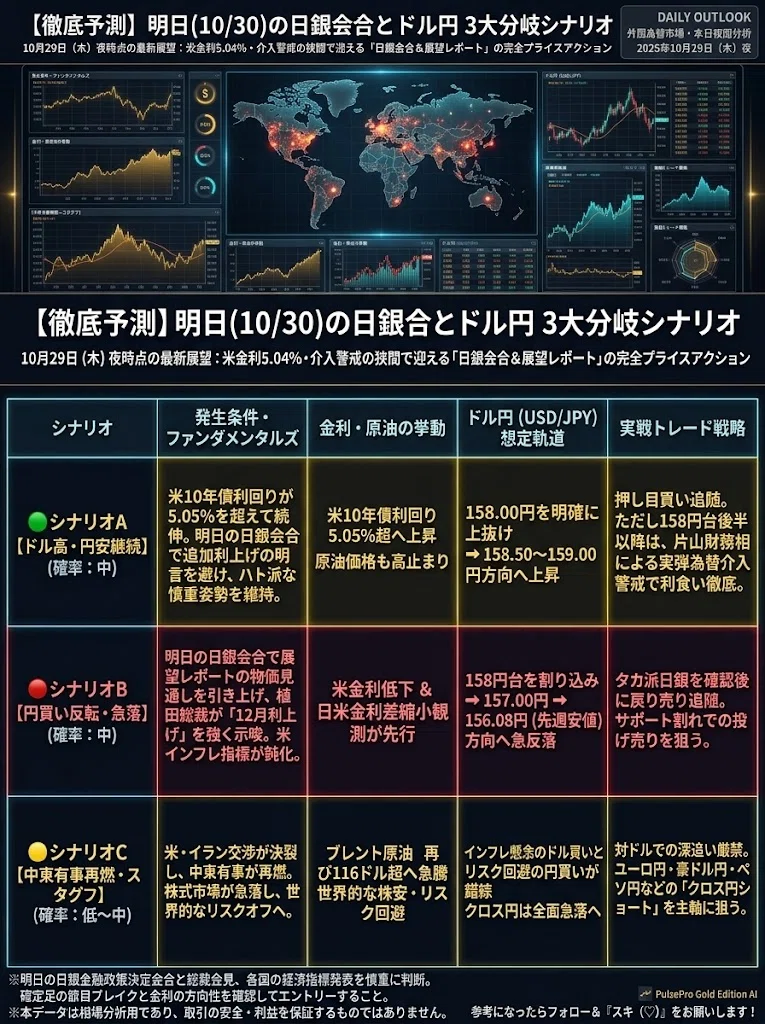
Three Major Scenarios for the Outlook
Summary: Based on Objective Facts
Tonight's Watch List
Rather than speculating about the market, monitor the market in this order based on confirmed data.
Maintainment of U.S. 10-year yield at 5.0%:As long as the 5% range holds, the downside for the dollar remains very solid.
Speed of USD/JPY rise and intervention headlines:Duration of stay around 158 and any additional warnings from authorities.
ECB Council results and Lagarde’s press conference (tonight):Outlook for European rates and euro reaction.
Crude oil and Middle East peace talks movements:Continuation of a retreat from the 114-dollar range or a fresh surge?
BOJ decision meeting tomorrow and Governor Ueda’s press conference (noon–evening):Degree of rate hike expectations for December.
In markets that are moving, avoid emotional entries and contrarian bets based on price level alone. Stick to confirmed price action and money-management rules.
If this is at all helpful, please follow and tap the "Like" (♡) at the bottom of the screen to encourage updates!

“TrendPulse Pro” Free Trial:https://www.gogojungle.co.jp/tools/indicators/86532?via=users
“TrendPulse Pro AI” Free Trial:https://www.gogojungle.co.jp/tools/indicators/86529?via=users
“QuickScalp AI” Free Trial:https://www.gogojungle.co.jp/tools/indicators/86523?via=users
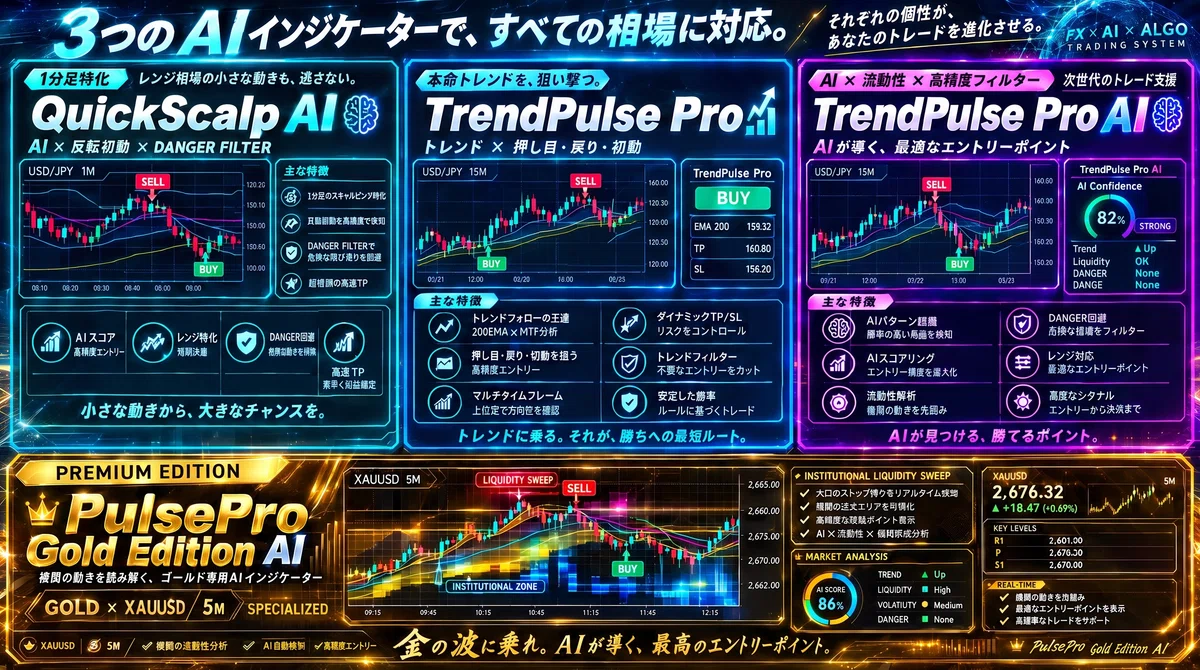
A unique indicator that removes emotion and captures the market with clear fundamentals and rules.
Functionality details and design logic are published on each product page
? [GogoJungle Product Page]