
[Verification Data Published] How does saving 10,000 yen per month change things? Backtest results of an AI self-made EA, and the reason I prioritize "not breaking down" above all else|ORB_RR_Portfolio
Introduction
In the previous article, I explained the structure and logic behind the self-made EA (ORB_RR_Portfolio) with two brains and multi-asset, developed together with AI (Claude).
This time, I will finally reveal the backtest verification data openly: did that EA actually win in historical price data?
Before looking at the data, please allow me to share one philosophy that I value most in EA development.
What I seek most in an EA—that it must “never fail.”
When you look around the FX and EA world, you’ll see seductive phrases like “50% monthly return!” or “10x your assets in a short period.”
However, chasing enormous profits always hides a significant “shadow (risk).”
Even if assets temporarily rise due to excessive leverage or averaging down, it has no meaning if the account is wiped out by a single market shock. If you’re forced to exit the market, everything ends there.
Rather than “making a big profit,” surviving any market conditions and staying in the game is the goal. For a person with zero programming knowledge like me, the aim with AI was not to strike it rich but to build a robust, crash-proof system.
Why the “monthly 10,000 yen積み立て (savings) model?”
In pursuing “not breaking down,” I arrived at the idea of “monthly 10,000 yen savings operations.”
In society, asset formation is often promoted with NISA or iDeCo, but I had honest concerns: the mechanisms are complex and hard to control, and there’s fear of future tax system changes.
Rather than relying on a system controlled by others, it is more convincing for me to understand the mechanism myself and invest 10,000 yen per month in an EA I built with AI.
Most importantly, saving has a big defensive benefit: it builds the stamina to withstand drawdowns. Even during a losing streak, by adding 10,000 yen each month to the balance, you prevent a cash shortage and safely endure the “endurance period” until the EA regains its original performance.
Backtest results (January 2018 – September 2026)
This is the result of testing with an account balance of 1,000,000 yen using XM〇〇〇g (K〇〇〇 elite account) data in the MT5 Strategy Tester.
? Backtest verification results (January 2018 – September 2026)
① 1-minute OHLC (standard verification)
Period: 2018/01 – 2026/09
Net profit: +6,119,153 yen
PF: 1.20 | MaxDD: 23% | Trades: 4,215
② Realistic (precise verification)
Period: 2022/01 – 2026/09
Net profit: +5,336,055 yen
PF: 1.21 | MaxDD: 19% | Trades: 2,567
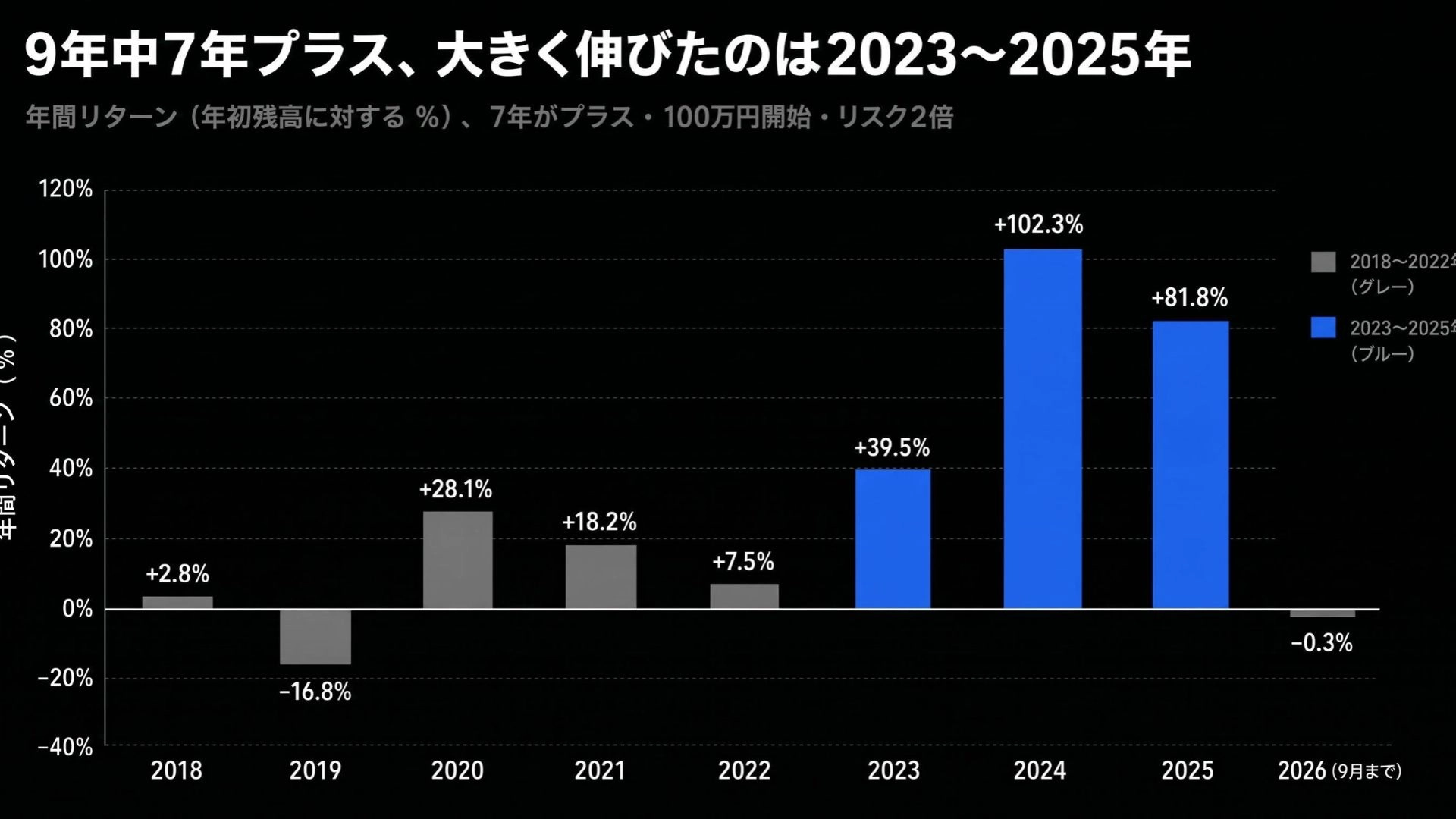
③ Monthly 10,000 yen accumulation model (recommended!)
Period: 2018/01 – 2026/09
Net profit: +10,273,704 yen
PF: 1.20 | MaxDD: 14% | Trades: 4,215
By saving 10,000 yen every month (total deposits of 1,040,000 yen), not only did profits exceed 10,000,000 yen, but the maximum drawdown was significantly reduced from 23% to 14%. (Note: The drawdown figure decreases because monthly deposits fill the balance even during downturns; it does not mean the trades themselves lost less.)
Even in the “Realistic verification (②)” which strictly accounts for spread variations, PF is 1.21 and max DD 19%, confirming genuine reproducibility rather than curve-fitting.
Deliberately showing the “worst year (2019)” and the limits of risk
I’m not going to show only favorable data. In tests with different risk multipliers, you can see realistic data like the following.
⚖️ Differences by risk multiplier
Risk 1x (conservative operation)
Net profit: +3.71 million yen | MaxDD: 14% | 2019: -9.0%
Risk 2x (the value used now!)
Net profit: +5.03 million yen | MaxDD: 23% | 2019: -16.6%
※ The balance between returns and risk is best in this setting
Risk 3x (high risk)
Net profit: +3.73 million yen | MaxDD: 38% | 2019: -27.3%
※ Drawdown becomes too high, so not adopted
2019 did not fit the market environment; there was a long losing streak where trend-following would hit stop rules. If you increase risk to 3x and operate, drawdown can soar to 38%, increasing bankruptcy risk and reducing total profit...
From this verification, AI (Claude) and I concluded that the golden balance to prevent bankruptcy is to keep risk around 2x and supplement with savings to maintain stamina, rather than chasing爆益 (huge profits).
Conclusion (Next time preview)
No matter how good the numbers look in backtesting, what matters is how it will move in real-market conditions going forward.
Next time, I will share the real-time forward test progress and the latest data as I run this “ORB_RR_Portfolio” on a XM〇〇〇 demo account!
※This data is based on historical backtest results and does not guarantee future performance. Please invest at your own risk.