

[Emergency Market Thorough Check] Finance Minister Katayama's Saying "Ready to take decisive measures" Sends FX Intervention Alert to MAX — Israel General Election, Brent Crude at $115, Pullback, French Political Instability and Subsidy Revisions Set Up t
On the afternoon of Tuesday, October 27, 2026, as the world’s foreign exchange and financial markets were enveloped in the tension of the upcoming “U.S.–Japan–EU–China central bank week,” an extremely powerful new material arrived that could overturn the markets.
This morning Finance Minister Satsuki Katayama stated in Parliament that she is prepared to take “decisive measures” in the foreign exchange market and that she would monitor rapid market moves with a strong sense of urgency, raising the tone of verbal intervention one notch.
Moreover, international affairs, energy, and geopolitical risks were moving in unison.
Today, October 27, the Israeli general election voting and counting is underway. The focus is on whether Netanyahu will remain in office or whether there will be a change of administration, shaping the course of military actions toward Iran and the prospects for a Middle East ceasefire.
Following reports of diplomacy among Saudi Arabia, Turkey, and Pakistan on relations with Iran, North Sea Brent crude briefly fell to $115.15 per barrel (WTI at $101.32). Nevertheless, attacks by the Houthis continue, and supply risk remains.
In France, large-scale protests of around 410,000 people intensified amid surging living costs. With difficulty passing the 2027 budget, yields on 10-year government bonds temporarily exceeded 5%, exerting pressure on the euro as a new European credit risk.
In Japan, a plan to gradually reduce gasoline subsidies (a monthly 5-yen increase from December) and a revival of electricity and gas bill assistance were raised. This complicates inflation, fiscal policy, and the Bank of Japan’s rate-hike decisions.
“With Minister Katayama’s ‘decisive measures’ remark, will USD/JPY move to actual intervention?”
“How will Israel’s general election and oil at $115 affect the currency market?”
“What trading strategies should we adopt ahead of tomorrow’s Australia CPI, the Bank of Canada, and the RBNZ on the 29th, and the FOMC on the 29th and BOJ meeting on the 30th?”
We will thoroughly organize the confirmed facts and latest developments as of 14:30 on October 27 and provide a detailed practical scenario to survive the turbulent market.
Chapter 1: The 5 Major Macro Variables Confirmed Today
Here are the core materials driving the current market and their importance rankings.
【Main Indicators and Confirmed Factors as of 2026-10-27 Afternoon】
• USD/JPY:
In the upper-150s toward the 157 area (the warning of intervention by Katayama suppresses upside)
• U.S. 10-year yield:
4.974–4.99% (just below the psychological 5.00% level)
• North Sea Brent crude futures:
$115.15 (−0.57% from the previous day; slight decline on diplomatic expectations)
• U.S. WTI crude futures:
$101.32 (−0.43% from the previous day)
• Domestic political factor:
Katayama Finance Minister mentioned “decisive measures” in the forex market
• International geopolitical factor:
Israel’s general election voting and counting (exit polls early morning on the 28th local time)
• European political factor:
France 10-year yield temporarily above 5%, widening the spread with Germany to 157bp
Chapter 2: Japan — Finance Minister Katayama
The True Meaning of “Decisive Measures” and Intervention Warnings
Today’s biggest news in the Tokyo market is the forex intervention hint from Finance Minister Satsuki Katayama.
【Key Points of Katayama’s Remarks and Market Interpretation】
• “We are prepared to take decisive measures in the foreign exchange market.”
• “We are monitoring market moves with a high sense of urgency.”
• A reply to questions about how fiscal policy affects the forex market and long-term government bond yields
1. Why did this statement come out “now”?
This expression of “firm action” is the highest-level warning word used immediately before an actual currency intervention by domestic authorities.It is not only a restraint on speculative dollar selling but also a response to questions such as whether the Akimoto (note: likely a reference to a political administration) administration’s expansionary fiscal policy and tax cuts are undermining long-term yields or the yen’s credibility.
Consideration for import prices: With oil staying above $115, further yen depreciation would directly harm households and corporate costs.
A shield before the U.S.-Japan central bank week: Ahead of the FOMC (29th) and BOJ policy meeting (30th), there is an aim to preemptively block speculative traders from testing 158–159 yen strongly.
2. Absolute trading cautions
This statement signals willingness to intervene, but“intervention has not been carried out yet”. It also does not specify whether the defense line is 158 or 160 yen.
However, in practice it is extremely important. If the dollar/yen rises due to U.S. interest rate hikes, there will always be a risk of a sudden rate drop of several yen in the upper-157s to 158 range due to real intervention or a sharp check.
Even when attempting a breakout trend-long, take profits early and maintain strict tight stops.
Chapter 3: Japan’s Energy Subsidy Policy — Transmission to Prices and BOJ Rate Hikes
Paths of impact on prices and BOJ policy
Regarding Japan’s inflation and fiscal policy behind the forex, large-scale subsidy policy reviews are proceeding in parallel.
【Three major energy support measures currently under consideration】
① Gasoline subsidy gradual reduction plan (Liberal Democratic Party proposal):
From December, the nationwide average target price (currently about 170 yen/L) will be raised by about 5 yen per month. (Current subsidy is about 43 yen/L; subsidies will be phased out.)
② Reinstatement of electricity and gas bill support:
A proposal to restart subsidies in December using contingency funds or supplementary budgets, after ending them in September.
③ Heating oil price containment measures (10/21–2027/3/20):
To curb winter heating costs, subsidies covering the gap between imported prices and domestic wholesale prices will begin.
Macro Economy and BOJ Policy Impact
Policy direction and price (CPI) impact on financial markets
• BOJ impact: gasoline subsidy reductionsDirectly push up gasoline prices,
to push CPI higher while reinforcing a rationale for BOJ to raise rates,
but potentially chilling household consumption.
Reinstatement of electricity and gas subsidieswould ease household burdens andlower apparent CPI
increase debt issuance concerns (rising long-term yields) due to larger fiscal outlays
Thus, the interplay of subsidy reductions and reinstatements means the BOJ may not rush to raise rates based solely on apparent CPI figures. The BOJ will prioritize core inflation excluding energy volatility (services prices and wage pass-through) in its judgments.
Chapter 4: Middle East Situation and Oil at $115 —
Diplomatic expectations versus supply concerns
In commodity markets, oil prices have edged down on hopes for easing diplomatic tensions.
Brent crude: $115.15 per barrel (−0.57%)
U.S. WTI crude: $101.32 per barrel (−0.43%)
1. Saudi Arabia–Turkey–Pakistan diplomatic talks with Iran
Delegations from Saudi Arabia, Turkey, and Pakistan visited Tehran and agreed to establish a diplomatic channel with Iran to prevent regional tensions from escalating. This diplomatic effort eases fears of excessive supply disruption and prompts profit-taking after last week’s sharp rise.
2. Persisting physical risks
However, attacks by Yemen’s pro-Iranian Houthi militants on Saudi infrastructure continue, and tanker traffic around the Hormuz Strait remains at risk.
Although crude has fallen toward $115, the market remains near six-month highs. If diplomatic talks fail, risk of a sudden rally to 116–120 dollars persists.
Chapter 5: Today’s Israel General Election —
Focal Points and Timeline
Today, October 27, the Israeli general election voting and counting are underway to determine the Middle East’s trajectory.
【Basic structure of the Israeli election】
• The opposition and Likud-led right-wing religious alliance
VS
Led by former Chief of Staff Benny Gantz and others, the opposition bloc
• The major issues:
Whether to adopt a harder line on Iran, Gaza, and Lebanon,
security and defense responsibilities from Oct 7, 2023, and the issue of ultra-Orthodox Jewish exemption from military service.
Timeline for results (Japan time)
Voting hours:Local time 7:00–22:00 (Japan time Oct 27 14:00–Oct 28 05:00)
Exit polls release: Japan time around Oct 28, 04:00–05:00(local TV outlets are expected to publish)
Vote counting and coalition negotiations:A majority of 61 seats out of 120 is required. A very close race is expected; forming an official coalition government could take weeks to months.
Market Impact Scenarios
Continuation of Netanyahu administration and right-wing victory:Hard-line stance toward Iran persists. The geopolitical risk premium on oil remains high, exerting pressure on oil prices, gold, and equities.
Opposition victory and regime change:Expectations of ceasefire negotiations and cooperation with the U.S. could trigger a sharp oil pullback (below $110). Global risk-on, with higher stock prices and lower U.S. yields, might emerge.
Averaged or coalition negotiations stalled: Political vacuum could form, keeping Middle Eastern tensions and high oil prices.
Chapter 6: Europe’s Powder Keg — France Political Turmoil and
Yields Breaking 5%
In European markets, France’s political and fiscal crisis weighs on the euro.
【France’s Multifaceted Crises】
① Intensification of large-scale protests:
On Oct 24, 410,000 protested rising living costs and shrinking public services. Security forces stood at 70,000.
Plans for Oct 31 (Yellow Vests) and Nov 5 (union strikes) are also scheduled.
② 2027 budget talks — dilemma: Prime Minister Le Maire faces rejection of social security budget. A stalemate between reducing the deficit (GDP ratio 5.4%) and supporting households threatens parliamentary consensus.
③ Surge in government bond yields: France’s 10-year yield briefly exceeded 5% (highest since 2002). The spread to German bonds widened to 157bp.
Moody’s kept France’s sovereign rating at Aa3 but maintained a negative outlook. France’s rising credit risk is a clear upper bound factor for the euro (EUR/USD, EUR/JPY) ahead of the ECB Policy Council meeting on the 29th.
Chapter 7: U.S. Earnings Week and the Major Currency Pairs’ Landscape
This week, mega-cap tech earnings will drive volatility into the currency markets.
【U.S. Tech Earnings Schedule (Japan Time)】
• Oct 27 (Tue) evening–Oct 28 (Wed) early morning: Seagate, NXP Semiconductors, Cadence
• Oct 29 (Thu) early morning: Microsoft, Alphabet (Google) ???
• Oct 30 (Fri) early morning: Amazon, Intel ???
If AI companies’ massive investments in capacity translate into profits, U.S. stocks may rebound and risk-on could occur; if disappointed, the cycle of “stock sell-off → U.S. Treasuries rally (yields fall) → yen buyback” could reaccelerate.
Judgment Criteria for Major Currency Pairs
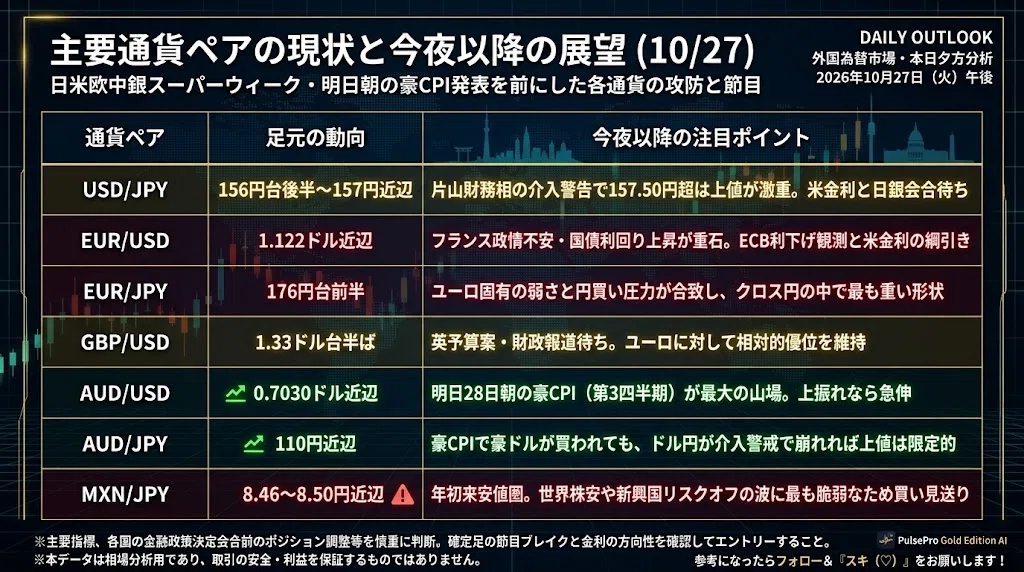
Chapter 8: Tonight to Tomorrow’s Ultra-Important Schedule
“Ultra-Important Schedule”
From tomorrow morning, the 28th, events that determine market direction will ramp up at a frenzied pace.
【Key Dates from Here (Japan Time)】
・10/27 (Tue) 17:00 Announcement of resumed liquidity-supplying auctions by the Ministry of Finance
・10/27 (Tue) 23:00 U.S. October Conference Board Consumer Confidence Index
・10/28 (Wed) 04:00–05:00 Israel election exit polls
・10/28 (Wed) 09:30 Australia Q3 CPI
・10/28 (Wed) 10:00 New Zealand OCR (RBNZ) policy rate announcement
・10/28 (Wed) 22:45 Bank of Canada policy rate announcement
・10/29 (Thu) 21:15 ECB policy rate announcement & 21:45 Lagarde press conference
・10/30 (Fri) 03:00 U.S. FOMC policy announcement & 03:30 Powell press conference
・10/30 (Fri) around noon Bank of Japan policy meeting & Outlook Report release
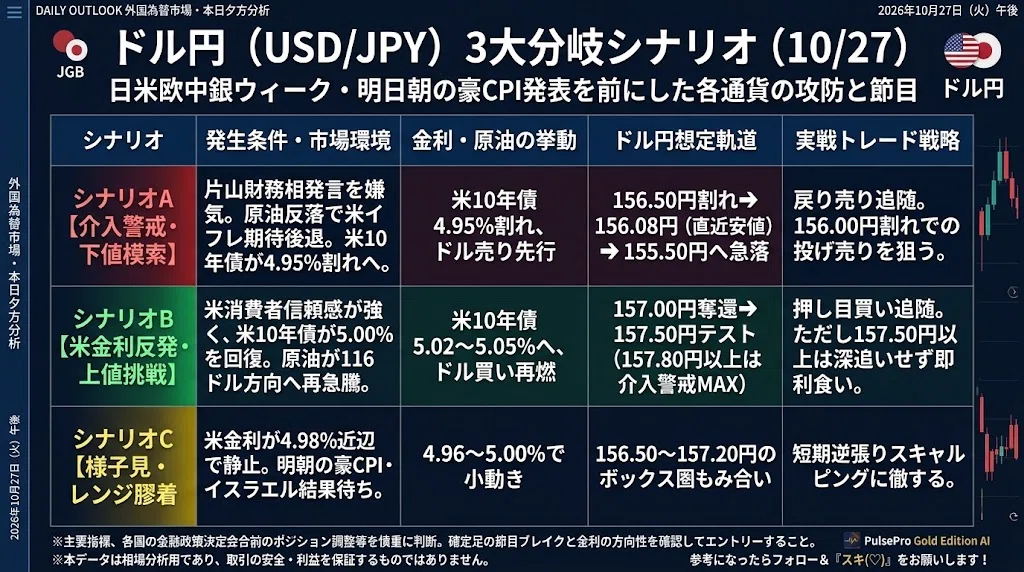
Chapter 9: USD/JPY Real-World Three Major Branches of Scenarios
and Power Dynamics
A price action group for USD/JPY aimed at European and American markets.
Chapter 10: Practical Chart Analysis and “Defense Lines”
Technical pivot points to monitor when executing trades.
【Upper Resistance Levels】
★ 158.50–158.55 yen: 【200-day simple moving average and actual intervention warning zone】
↑
158.20–158.30 yen: recent retracement high, upper resistance band
↑
★ 158.00 yen: psychological milestone (whether price can break and hold above here is the key to ongoing upside)
↑
★ 157.80–157.85 yen: recent retracement resistance (first resistance upon European market entry)
【Lower Support Levels】
★ 157.44–157.50 yen: today’s Tokyo session low and short-term dip defense line
↓
★ 157.00–157.10 yen: psychological milestone and rollover support zone
↓
156.50 yen: recent dip support line
↓
★ 156.00–156.08 yen: last week’s closing low and absolute defense line on the daily chart
Summary: What to Prioritize in Today’s Market
In sum, today’s market presents a clash between “yen-buying pressure due to Bank of Japan intervention warnings from Finance Minister Katayama” and“oil at high levels and U.S. long-term yields near 5% (dollar strength)”
these two enormous energy forces are colliding head-on.
Do not dismiss Minister Katayama’s verbal intervention:
With the phrase “firm action” in play, long positions in the upper-157s to 158 yen range carry a very high risk premium.
Watch Israel’s exit polls (early morning on the 28th):
Before Tokyo markets open tomorrow, headlines from the Middle East may fly, so be cautious of oil price volatility.
Australia CPI at 9:30 a.m. tomorrow morning to ignite Oceania markets:
Monitor AUD/JPY and calmly capture the volatility of the first leg of central bank week.
Ahead of important events, reduce positions a bit and maintain disciplined risk management to prepare for abrupt moves driven by headlines.
If you find this helpful, please follow and press the “Like” (♡) at the bottom of the screen to encourage updates!

TrendPulse Pro: Free trial:https://www.gogojungle.co.jp/tools/indicators/86532?via=users
TrendPulse Pro AI: Free trial:https://www.gogojungle.co.jp/tools/indicators/86529?via=users
QuickScalp AI: Free trial:https://www.gogojungle.co.jp/tools/indicators/86523?via=users

Eliminating emotion and capturing the market with clear fundamentals and rules—our own indicator.
Details of features and design logic are published on each product page
? [GogoJungle product page]