
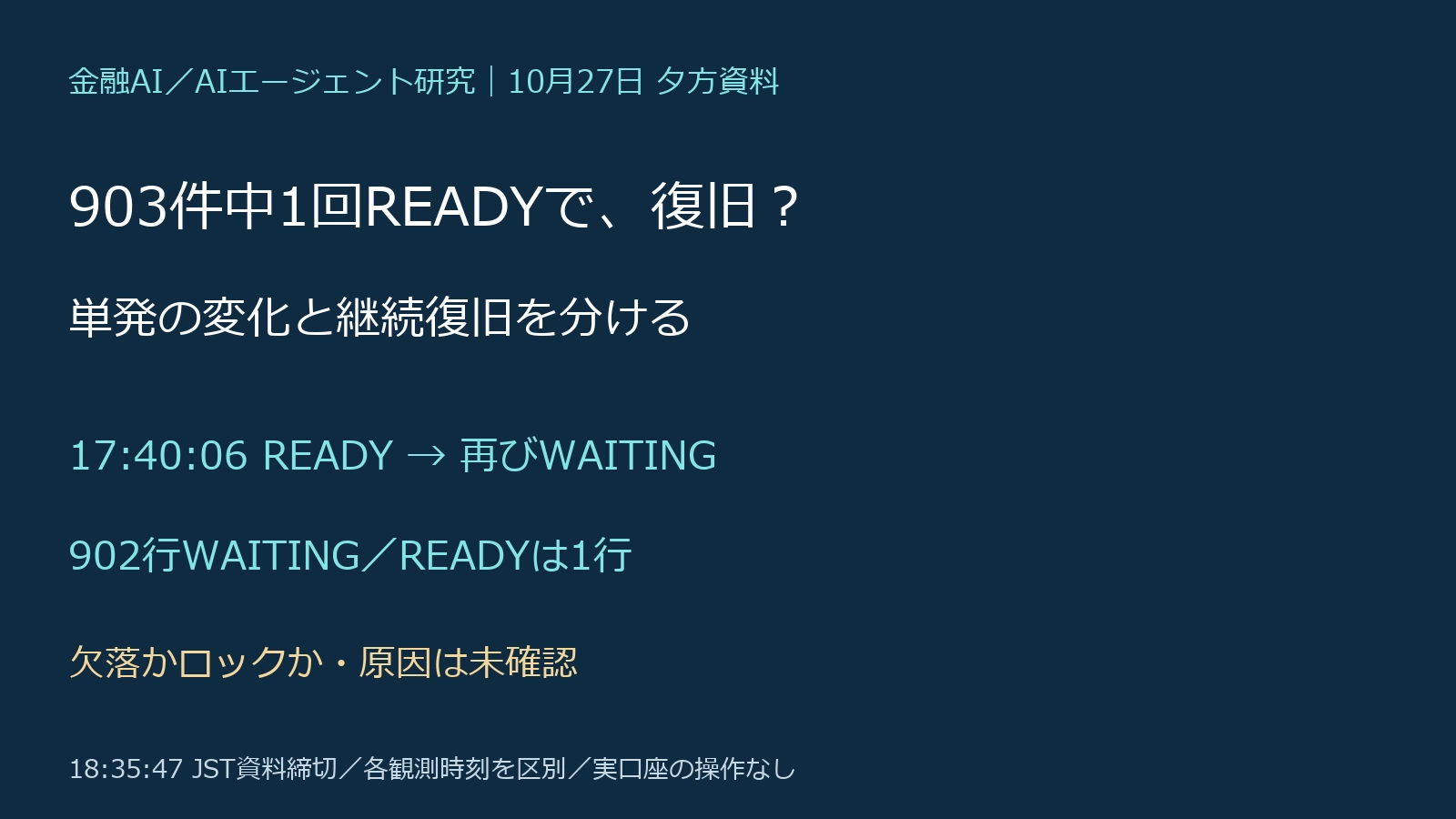
【Finance AI Research】1 recovery out of 903 if READY? Separating ledger standby and old scores
If READY appears once out of 903 orders, has the ledger been recovered?
The conclusion is: READY once does not confirm ongoing recovery.From 00:00:28 to 18:35:06 JST on October 27, direct audit covered 903 entries, 902 were WAITING, and only one READY at 17:40:06. After that it returned to WAITING. These numbers do not indicate 903 orders, 902 failed orders, or a single profit realization.
For research and development of financial AI and AI agents, and for testing of custom indicators and EAs, we separate local audit output from production processing. Sources are DAILY_BRIEF, incidents, audit_summary, and evidence excerpts finalized at 18:35:47 JST on October 27. The entire original JSONL lines were not independently re-aggregated by the editing team, and there has been no VPS direct audit or configuration changes.
Evidence: Read as a pair of status name, reason, and duration
| Observation | Reported value / unit | Unconfirmed meaning |
|---|---|---|
| direct audit | 903 lines, 902 WAITING lines, 1 READY line | Not production trading or failure count |
| READY at 17:40:06 | new_ex_events_only_no_backfill | Not recovery of the entire ledger including past entries |
| latest state at 18:35:06 | WAITING / ex_indicator_ledger_missing_or_locked | missing or locked not yet determined |
| account score | as generated at JST 02:59:08 on 10/20 | Cannot be used as of 10/27 for account evaluation |
The reason for READY includes the scope of “only new events, do not backfill past entries.” This line is not generalized to the entire history and balance. The reason for WAITING also remains a name with multiple possibilities such as missing or locked; it is important not to conclude that a file disappeared or another process occupied it.
The next condition would be continuous READY plus ledger reads for the same event ID and fresh history/balance verification. This has not yet been established.
The flag for structure shadow validity is not a trading performance indicator
From 00:00:09 to 18:34:52 JST, the structure shadow has 181 lines. closed_24h_valid=true has 0 lines, m1_valid=true has 33 lines, m5_valid=true has 179 lines, m15_valid=true and h1_valid=true have 181 lines each. These are validity flags for each perspective, and multiple can exist on the same line, so they are not summed. It does not imply 33 wins, 179 fills, and 181 all account histories.
Even if the short-bar value is valid, its validity is separate from the 24-hour settlement history. Conversely, even if closed_24h_valid is false, it does not prove that there was no trading on the account or that AI did not review anything. The reasons for stopping an old account score and the conditions for regeneration are still unknown, and today’s account performance cannot be substituted.
Limitations and next verification: do not consolidate CSV and ledger into a single cause
The local EA log on the day shows err=5004 with 0 string matches, and the ledger waiting in direct audit are separate records. Causality between the two is unconfirmed, and we cannot conclude that the ledger was fixed because the CSV error disappeared. There is no documentation showing a new implementation, deployment, compilation, or release switch. Do not present edits as technical recovery achievements.
What is needed is multiple consecutive READY events, ledger reads corresponding to event IDs, and fresh score generation time and history/balance verification. These are the evidence criteria for the next steps and are not instructions to restart or modify buy/sell code in this article. The following is the background from the morning cutoff documents regarding the previous day’s CSV logs. Do not confuse the 903 lines in the evening with the number of production failures.
Background: records of err=5004 from the morning cutoff documents
If there are 276 lines of err=5004, did that mean EA failed 276 orders?
The conclusion is no. The 276 lines represent the number of lines in the local October 26 log where the string err=5004 matched. It is stated that the handover recorded Open failures in a spread CSV, but it has not been confirmed as 276 failed orders, 276 missed trading opportunities, or VPS production stoppages. The number of error lines and the impact on trading are reported separately.
In the research on Financial AI and AI agents, not only good results but whether data was read correctly is an inspection target. This article handles the local CSV reading issue reported in the study of custom indicators and EAs. For questions like “What happened?” and “Did production stop?” we indicate what is known and do not fill in unknown causes or profits.
Evidence: the original materials include 23:00ish open failures
Source is LOCAL_CODEX_HANDOFF_2026-10-27_0610_JST. The target period is 10/26 06:10 to 10/27 06:10 JST, but the creation work began around 12:25 JST on 10/27, with Drive save at 12:26 JST. We distinguish planned deadline and actual time the materials could be used. Receiving this handoff does not confirm production operation at 12:26.
Referenced local logs are 20261026.log, 283,857 bytes, last updated 00:00:09 JST on 10/27. The total number of lines with err=5004 is reported as 276, which includes lines outside the target period. Therefore, we do not treat 276 as the exact count within the target time window. The unit is the matching line; this is not the count of independent failure events or orders.
The document also notes that lines 1941–1944 from 23:34–23:35 include open failures in spreads_20261026.csv within FUNDAFX_signals, but the log time zones have not been reconciled. This allows the interpretation that failure records exist near the end of the log, but does not confirm how many hours in a row could not be read or that the same issue occurred on VPS at JST at that time.
| Observation | Confirmed range | Unconfirmed |
|---|---|---|
| err=5004: 276 lines | Whole local log lines that match the handover | Number of lines within target time and independent failures |
| Lines 1941–1944 | Open failure records in CSV for 23:34–23:35 | Time reference and the state of the file at that moment |
| Reference CSV | Date-stamped spread CSV name | Actual reference destination, permissions, locks, opening method |
| Impact on trading | Not determined in this document | Orders, fills, and P&L on the VPS |
Figure: Observations of errors and causes are separate stages
Causes, recovery, and production impact are not confirmed in this article. This diagram presents the investigative order and is not a completion report of repair or production testing.
Why separate the stages? If you redo the file merely based on failure display, you may leave issues such as mis-referenced locations or a problem with how it is opened during sharing. Conversely, if you assume past failures were misstatements because the file exists now, you may overlook conditions that could not be referred to at the moment of failure. The items listed here are investigation candidates, not confirmed causes in this report.
Limitations: do not directly compare 276 lines with the previous day’s 913 lines
In the previous article, 913 lines of err=5004 from a different date were discussed. Subtracting from 276 and claiming a decrease in failures or a certain improvement percentage is not done. We have not confirmed that the file dates, aggregation ranges, excluded times, recording frequency, and uptime align. A simple count of matching lines from different populations does not constitute an outage rate comparison.
If you want to compare improvements, you must standardize the total read requests, the number of failed requests, the number of repeated requests, and the time to recover. Those figures are not fixed values for this handover. We will not present 276 as numerator with an unsupported denominator to claim a failure rate. Numbers from past articles are treated as background observations and are not retrofitted into today’s results.
This article does not independently audit the original log, EA code file opening specifications, file attributes at the relevant time, access rights, or exclusive locks across all records. It preserves the scope in which the handover is considered UNKNOWN. It does not present as definitive solutions such as “permissions caused it,” “the file was corrupted,” or “restarting MT4 will fix it.” No changes to trading environment are made for the sake of article production.
The same materials also include 88 lines matching GOLD13 REALTIME and 0 lines matching OrderSend and ticket=, but it is not linked how those spread CSV errors affected those 88 lines. Zero string matches do not prove there were no production orders. Data acquisition, candidate generation, AI judgment, order placement, and fills require evidence at each stage.
In particular, it is premature to treat the absence of trading as proper AI-driven postponement. If information cannot be obtained, either the policy is to postpone or to continue with alternative values, or to wait. The practical version and processing path must be verified. This article’s local log alone does not select any of these paths. VPS actual settings and positions, orders, and P&L are unconfirmed, and we do not conclude that losses were avoided or incurred.
Next verifications: first align timing and reference sources without changing anything
The first requirement is to compare the failure time reference with a common standard such as JST. Check whether the file date switch and log time differ, and fix the start and end of the targeted interval. Then read to confirm which CSV the EA attempted to reference at that location. Do not treat similar-named local and VPS files or shared areas as the same location merely because names resemble each other.
Next is the moment of failure conditions. You must compare the existence of the file, update time, attributes, the writer’s state, and the reader’s method on the same time axis. Do not conclude that the past was the same by current attributes alone. If there is no saved record for that time, leave the state as unconfirmed. Listing many possible causes and confirming a cause are different tasks.
Even if a cause is narrowed down, you must separate the fix proposal, verification in an isolated environment, approved reflection into production, and post-reflection rollback. This article does not report having done those. Proceed within the range where you can verify without creating new trades, and keep decisions about live accounts and orders separate from article management authority. Not changing code or settings is also an important boundary to preserve verification conditions.
When reporting recovery, it would be desirable to confirm not only that error lines decreased but that the target EA could read the necessary values and which candidates were used. Merely updating the file and saving the担当 AI handover does not satisfy this condition. If discussing production impact, you must also cross-check VPS logs, decision responses, order tickets, and history for the same time window. This series of evidence is not complete in this article.
In the morning edition, the cross-check with the evening additional material was incomplete. The results of that verification are added at the beginning of this article. However, the separation between local observations and VPS direct confirmation, and cross-checking individual candidates to orders and settlements, remains incomplete.
Weekday 24-hour trade-live broadcasts cover the progress of research, but the existence of a broadcast alone does not certify the CSV’s audited cause. Verified recordings that correspond to the same trading incident as the fault record are not yet confirmed. Do not stage a production recovery with unrelated videos; if relevant materials are confirmed, clearly indicate the target and its limits using GogoJungle’s video feature.
Information about the research subject can be checkedon the GogoJungle product pagePlease verify the current conditions and do not treat this article’s log observations as a guarantee of profits or purchase recommendations. The main points are that 276 lines do not mean 276 failed trades and that causes and production impact are unconfirmed. Next, align timing, reference source, and the state at the moment of occurrence without changing the environment.