

[Early Weeknight Comprehensive Inspection] Brent crude at $115 retreat and battle with U.S. 10-year at 5% — On the eve of the “Fed/ECB/BOJ/ECB/Nikkei (Japan) Super Week” with December rate hike expectations and intervention warnings from the Bank of Japan
On the night of October 26, 2026 (Monday), the world forex market entered the opening of the “Major Central Bank Policy Week,” the biggest milestone of the year, with trading proceeding in an extremely tense atmosphere.
What governs the current market is not a single-direction trend. The forces clashing globally include: oil price pullback from Middle East tension-relief talks, fierce battles around the psychological 5% level in the US 10-year yield, expectations of additional rate hikes ahead of the October 30 Bank of Japan monetary policy meeting and potential actual intervention, and a rush of policy decisions from the FOMC, ECB, RBNZ, and the Bank of Canada — all colliding head-on.
Last week, North Sea Brent crude, which briefly surged to around $116, fell back to around $115 a barrel due to diplomatic efforts toward easing tensions between the US and Iran via Qatar and profit-taking,
with WTI at around $101 per barrel, but the physical supply concerns in the Middle East remain unresolved, and with long-term US yields staying near 5%, the deep-rooted inflation and the interest-rate differential continue to support the dollar-yen’s downside.
“Will the oil pullback trigger dollar weakness, or will Middle East tensions flare up again and accelerate dollar strength?”
“Ahead of the BOJ meeting (30th) and the FOMC (29th), large players are
how are they positioning yuan against the dollar at 156–157 yen?”
“For AUD, NZD, CAD, MXN, and other major cross yen pairs, how should we assess the risk of breakdown?”
Using the latest confirmed information as of tonight, this article analyzes the dynamics of the currency, bond, energy, and equity markets in a three-dimensional way and provides a detailed practical trading scenario to survive the week.
Chapter 1: Tonight’s Market Dominants
“Five Major Macro Materials”
These are the core factors that will decide price formation this week.
【Night of October 26, 2026: Key Market Indicators and Confirmed Materials】
• USD/JPY:
In the high 156s to around 157 (US yields staying high vs intervention and BOJ caution)
• US 10-year yield:
4.974–4.99% (the psychological benchmark near 5%)
• Brent crude futures:
Around $115 per barrel (though surged last week, staying near the high range)
• WTI crude futures:
Around $101 per barrel
• EUR/USD:
Around 1.1228 (Germany’s IFO business climate improving vs France’s fiscal concerns)
• EUR/JPY: Around 176.15
• Central bank schedule: RBNZ, Bank of Canada (28th) → FOMC, ECB (29th) → BOJ (30th)
① US–Iran diplomacy and crude pullback
In addition to profit-taking from last week’s oil surge, reports of easing tensions between the US and Iran via Qatar led oil futures lower. Nevertheless, localized military risks such as Houthi attacks on Saudi facilities persist, and supply concerns are not fully resolved.
② US 10-year yield’s watershed at “5%”
The US 10-year yield remains around 4.97–4.99%, clustering around the absolute psychological threshold of 5.00%, with intense range-bound trading surrounding this level.
If rates stay above 5%, dollar strength pressures intensify; if they clearly fall below 5%, this could trigger a corrective decline in USD/JPY.
③ BOJ: On October 30, a “hawkish hold” is the market focus
The BOJ is likely to hold policy rates at the current 1.25% at this weekend’s meeting, but with wage-price dynamics in a favorable loop and nationwide CPI (excluding fresh food) at +2.1% YoY, the key question is whether they will issue a statement or outlook report that strongly hints at a further rate hike in December or January next year.
④ The dilemma of FX intervention caution and trade deficit
After last week’s yen rebound, official rhetoric remains subdued, but if the dollar-yen suddenly strengthens, there is a risk of renewed strong currency controls and intervention. Meanwhile, Japan’s structural trade deficit in the first half of fiscal 2026 remains supported by the real demand for yen from importers, keeping downside support robust.
⑤ Resource- and emerging-market currencies enter policy week
This week features Australia’s CPI (28th), RBNZ, and BoC policy rate announcements. Divergence in rate paths among these nations could push cross-yen volatility higher.
Chapter 2: The Dynamics of Oil Prices and FX —
Why Oil Stress Does Not Equal Dollar Weakness
When linking energy market trends directly to currency trading, simple assumptions can be fatal.
【Two opposing vectors oil price movements exert on FX】
Pattern A:
Inflation–interest-rate path (current leadership) Oil up ➔ US inflation fears reaccelerate ➔ US long-term rates rise ➔ 【Dollar buying, dollar strength】 Oil down ➔ Inflation concerns ease ➔ US rates fall ➔ 【Dollar selling, dollar softness】
Pattern B: Real demand and terms-of-trade path (Japan’s structural issues) Oil up ➔ Japan’s energy import bill surges (trade deficit widens) ➔ 【Structural yen selling】 Oil down ➔ Japan import costs ease ➔ 【yen buying support】
Oil pulling back toward $115 supports US inflation pressures easing temporarily and caps US long-term yields, functioning as a “dollar-selling” factor. But for Japan, it also eases the pressure of a large trade deficit, acting as a yen-supporting factor.
When analyzing tonight’s market, it is crucial to confirm whether the three conditions are present: oil down, US yields below 5% (down to sub-5), and USDJPY down.
If oil rebounds again and US yields rise above 5%, the decline in USDJPY will end as a mere pullback.
Chapter 3: Domestic Japanese Factors —
“BOJ December rate hike priced in” and the intervention mood
Domestic factors are full of catalysts reinforcing caution toward a stronger yen.
1. BOJ October 30 meeting’s three major scenarios
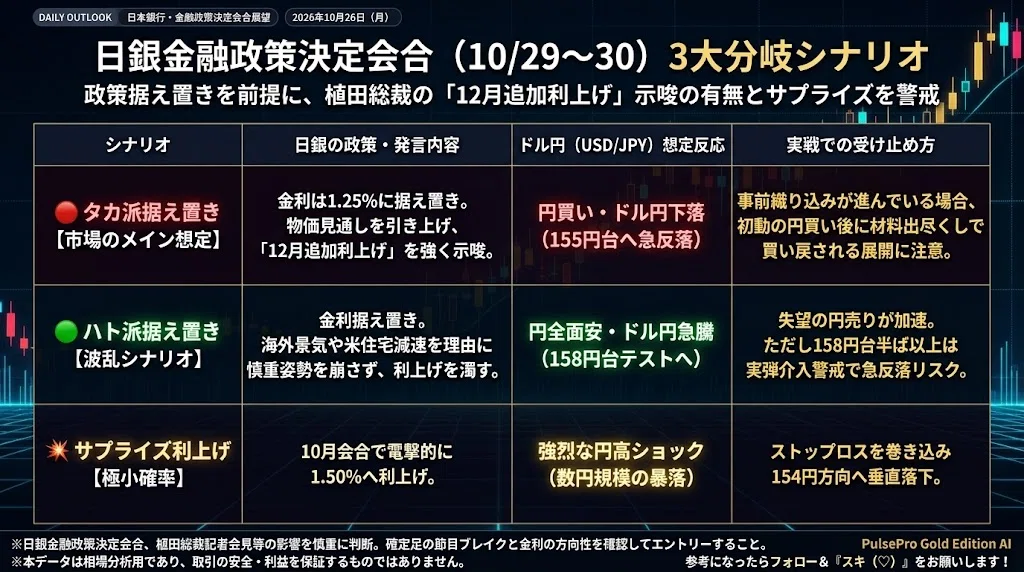
2. The line of defense for FX intervention
This week USD/JPY trades in the 156–157 range, not at a level for immediate actual intervention. However, if the dollar strengthens after the FOMC or BOJ takes a dovish stance, volatility could push to the high 158s–159s, triggering rate checks or actual intervention by the government and the BOJ. This possibility should be watched closely after the announcements.If the dollar surges to the high 158s–159s with volatility, the trigger for rate checks or intervention may be pulled.
3. Chapter 4: U.S. Markets — US 10-year yield’s Fight at 5%
and the Path of Tech Earnings
The U.S. market is in a highly sensitive phase where macro rates and corporate earnings intersect.
1. The standard for judging the US 10-year yield at 5%
If it clearly moves above 5.00%:Dollar upside resumes. USD/JPY likely to push higher toward 157.50–158.00.
Narrow range of 4.95–5.00%:Awaiting the FOMC; market lacks directional bias.
If it drops below 4.95% sharply:Risk-off from AI stock declines or concerns about economic slowdown lead to bond buying. USD/JPY could test below 156.00.
2. Major tech earnings (Alphabet, Microsoft, Amazon, etc.) spillover
This week, major U.S. tech firms report earnings. Will the second wave of stock declines and bond buying due to concerns about recovering AI investment, triggered last week, occur, or will strong earnings revive risk-on sentiment and influence FX safe-haven demand (yen, Swiss franc)?
Chapter 5: Europe, Oceania, and Emerging Market Currencies —
Latest Trends
We organize the individual factors for major currency pairs.
【Current positions and points of note for major currencies】
• EUR/USD (1.1228):
Germany’s October IFO is improved to 90.2 (vs 89.8 expected), giving a solid floor. Yet rising France 10-year yield and fiscal deficits weigh on the euro’s upside.
• GBP/USD:
Speculation around the UK budget and fiscal policy leads. Inflation remains sticky, keeping a floor on the pound.
• AUD/USD and AUD/JPY:
Australia’s October CPI on the 28th is the key event. If inflation accelerates again, the market expects further RBA rate hikes and a rebound; if it cools, expect a sharp drop.
• NZD/USD:
Q3 CPI rose +3.7% against the 1–3% target, and the RBNZ meeting on the 28th is pricing in rate hikes.
• CAD/JPY: Oil’s pullback weighs; the BoC on the 28th and oil prices put pressure from both sides.
• MXN/JPY (Mexican Peso/JPY):
Carry-unwind pressures persist due to global stock weakness and high U.S. rates. Averaging down in the low price area is very risky.
Chapter 6: This Week (Oct 27–30) Ultra-Important Events Calendar
Wealth volatility peaks from Wednesday to Friday across global markets.
【Key Schedule This Week (Japan Time)】
• 10/27 (Tue)
21:30 US September durable goods orders; 23:00 US October Consumer Confidence Index
• 10/28 (Wed)
09:30 Australia Q3 CPI ???
• 10/28 (Wed)
10:00 New Zealand Reserve Bank policy rate announcement ???
• 10/28 (Wed)
22:45 Bank of Canada policy rate announcement ???
• 10/29 (Thu)
21:15 European Central Bank policy rate announcement
21:45 Lagarde press conference ???
• 10/29 (Thu)
21:30 US Q3 GDP (preliminary) / US September core PCE deflator ★★★★★
• 10/30 (Fri)
03:00 US FOMC policy announcement
03:30 Powell press conference ???
• 10/30 (Fri)
12:00 Tokyo core CPI preliminary for October
• 10/30 (Fri)
Around noon: BOJ Monetary Policy Meeting and Outlook Report release ???
• 10/30 (Fri)
15:30 Ueda, BOJ Governor, Regular press conference ???
Chapter 7: USD/JPY
Tonight’s Three Major Practical Divergence Scenarios
These are price-action scenarios for USD/JPY aimed at the Western markets.
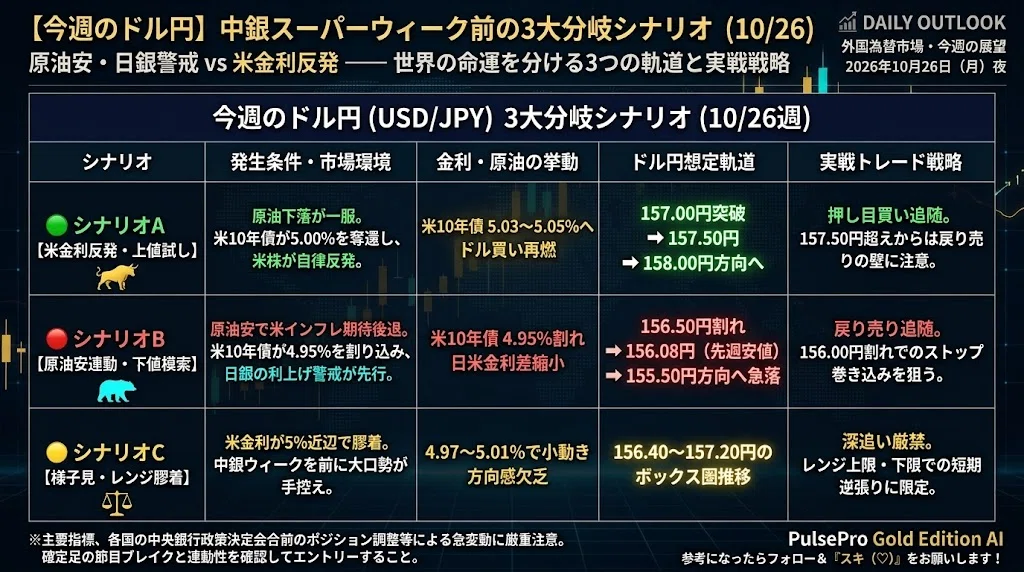
Chapter 8: Practical Chart Analysis and “Defensive Lines”
Technical checkpoints to monitor when executing trades.
【Upper Resistance Layers】
★ 158.50–158.55 yen: 【Daily 200-period Moving Average & Structural Ironclad Resistance】
↑ 158.00 yen: Psychological milestone ↑
★ 157.50 yen: Recent high rebound point and strong selling peak ↑
157.00–157.10 yen: Short-term resistance (whether it can be broken and held is the focus)
―――――― Current price: around 156.70–156.90 yen――――――
【Lower Support Layers】
★ 156.40–156.50 yen: today’s Tokyo–Europe session support line ↓
★ 156.00–156.08 yen: 【last week’s sharp drop low & absolute psychological defense line】 ↓ 155.50 yen: milestone ↓
★ 155.00–155.20 yen: strong rock-solid support band on a daily basis
Summary: Practical Rules to Survive Tonight Through This Week
The most important rule to control this week's market is: do not lock in a position with a directional bet just before key indicators or central bank announcements.
Prioritize monitoring the behavior of US 10-year yields around 5%:
While oil sits around $115, the direction of the dollar is determined by US long-term rates. Determine whether it will clearly break above 5% or dip toward 4.90% with冷-blooded clarity.
Watch for a reversal in BOJ hawkish expectations:
If the market has priced in December hikes too aggressively, even a modestly cautious BOJ stance on October 30 could trigger a sharp “disappointed-yen selling (USDJPY spike).” Do not chase the initial move; wait for confirmation before entering.
Risk management for high-yield currencies (MXN, etc.)
Volatility tends to surge during a mega-week, widening cross-yen spreads and creating longer wicks. Maximize margin and prioritize defense.
With a storm of central bank policy rushes this week, remove emotion completely and aim to retain profits with objective price action and strict money management.
If this was at all helpful, please follow and press the “Like (♡)” at the bottom of the screen to encourage updates!

TrendPulse Pro free trial:https://www.gogojungle.co.jp/tools/indicators/86532?via=users
TrendPulse Pro AI free trial:https://www.gogojungle.co.jp/tools/indicators/86529?via=users
QuickScalp AI free trial:https://www.gogojungle.co.jp/tools/indicators/86523?via=users

An indicator that eliminates emotion and captures market moves with clear fundamentals and rules.
Details of features and design logic are published on each product page
? [GogoJungle product page]