
[Procedure to add scenes where you won't use them] A section to look at before rethinking the method
Have you ever had a method that worked for three weeks, but on one night you were stopped out three times in a row?
The entry point, the placement of the stop, everything was the same as usual.
You start to think, “It no longer works,” and begin to look for a new method.
Before discarding the method, what should you confirm?
Good evening!
This is Masashi^^
This time, I’ll talk about the “how to use” for a method that’s been working well.
Not about the content of the method itself, but about the range in which you use it.
In my notes on my method, I create a column for “scenarios in which I do use it” and another for “scenarios in which I don’t use it.”
When I get stopped out repeatedly, before changing the method I look to see if I can add a line in that column.
✅ Three weeks, the same method worked well
Even in my younger days, there were times like this.
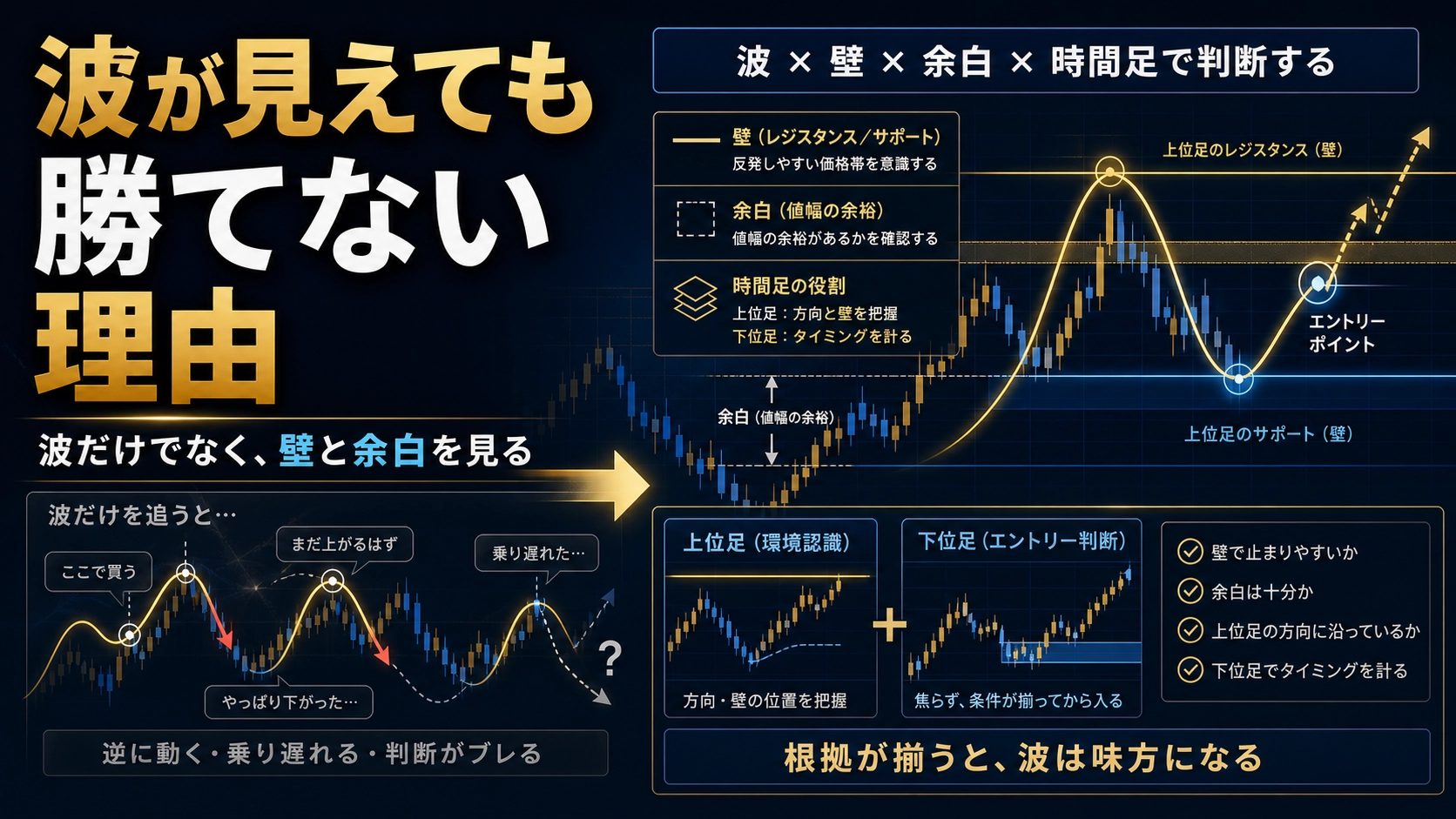
I would check the wall position on higher timeframes, wait for the price to approach it on lower timeframes, and enter.
What I was doing was almost the same each time.
For about three weeks, when I looked back at the records, there were almost no deviations in the procedure.
Gradually I began to think this method suited me.
And it started to feel like I could use it anywhere.
✅ The more things go well, the more the contexts where you use it naturally expand.
? In the old notes: It only said, “Enter when it looks like this,” and did not say where to use it.
❌ One night, three consecutive stop-outs with the same method
One night I opened the chart at a time I normally wouldn’t.
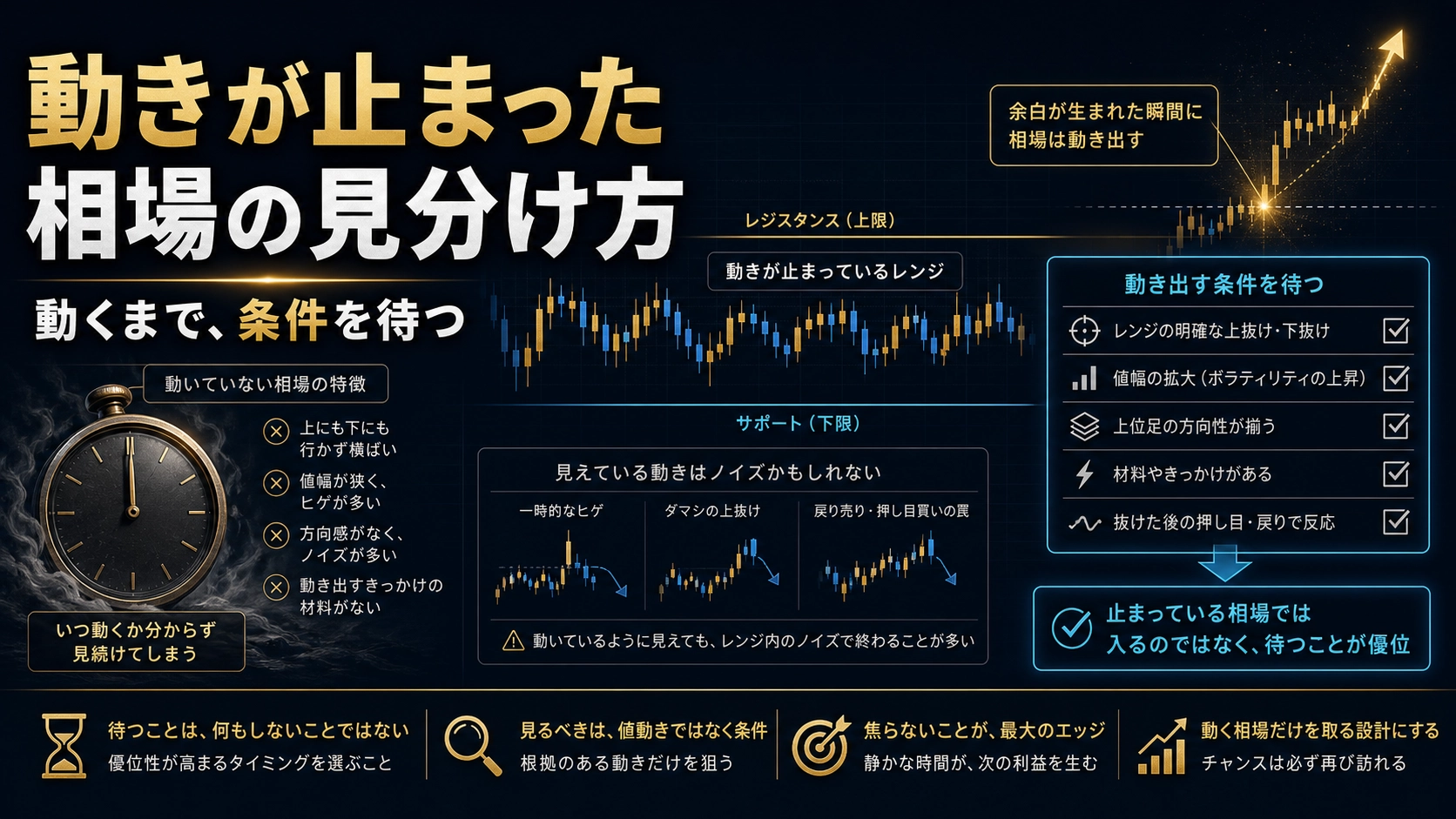
It was a time when price moves were wild and oscillated up and down a lot.
I confirmed the wall position as usual and entered as usual.
But right after entering, the price swung violently and hit the stop.
I entered again, and was stopped out again.
The third time was the same (;'∀')
The width of the stop was within my usual expectations.
Even so, three in a row shook my confidence.
At the time, I closed my notebook and“Has this method stopped working?”I thought.
The following weekend, I stayed up late reading explanations of a new technique.
✅ On the night of three consecutive stop-outs, what I doubted was the method itself.
❌ Right after three consecutive stop-outs, I almost discarded the method entirely.
? When I lined up those three events, there was a common point
After a while I calmly reviewed the night’s records.
There was a common thread among the three stop-outs.
• It was in a time period I don’t usually enter
• It was at a position away from the higher-timeframe wall
• The price movement swung up and down violently
I laid out the records from the three weeks when it went well as well.
Where I had entered was almost the same in terms of time and position.
What differed between the good days and the nights with stop-outs was the scene, not the method.
What changed was not the method, but the context in which it was used.
? What I learned by lining things up: 【Time of day / Position on the higher timeframe / The volatility of price movement】 differed between the good days and the bad nights.
? The breakdown wasn’t the method but the place I used it
In other words, the method didn’t break down.
I was just using the same method outside its effective range.
When I realized this, I felt a bit deflated… w
Before looking for a new technique, I needed to know the range where my method had worked.
What was missing wasn’t a technique, but a column to record that range.
Even in readers’ articles“You’ll lose if you search for a technique”is a phrase I’ve seen.
I too had almost fallen into that trap.
✅ Before re-evaluating the method, confirm the range where it worked.
? When you’re stopped out repeatedly, review the contexts first, before the method’s content.
? Why can’t you notice even if the range expands
So, why can’t you notice you’re outside the range?
Because the note only says “Enter when this happens.”
The entry condition is written.
But where that condition was effective within which range is not written anywhere.
So even if you go outside the range, the notebook gives you no guidance.
Your hands reach for the familiar way of entering.
To be more precise, it’s not that the entry condition is bad.
The problem is that the column for don’t-use contexts isn’t written alongside the entry conditions.
✅ A notebook that only lists entry conditions stays silent when you go outside the range.
⚠ Even if the conditions match, if the contexts you use are different, the same results are unlikely.
? The warning in a medicine's directions about “Precautions for use”
This is somewhat similar to a drug’s instructions.
A label typically includes both effects and “Precautions for use.”
Who should avoid it, and when not to use it.
If you read only the effects and ignore the precautions, you might use it in inappropriate situations.
The same perspective applies to trading methods.
Entry conditions are like the effects; don’t-use contexts are like the precautions.
The precautions are not to doubt the effects; they’re to clarify the range in which the effects apply.
✅ Create a precautions section for your method as well.
? Notebook format: write the “scenes where I use it” and the “scenes where I don’t use it” on the same page.
? Summarizing: Only read the don’t-use column once before trading
What you do is very simple.
At first, the column can be blank. Fill it in gradually from your records.
First, extract the days when you were stopped out consecutively from the records.
A single stop-out is a normal cost and doesn’t need to be tracked.
The scenes for the extracted days are summarized in a single line by three items.
・Time of entry
・Position when viewed on the higher timeframe
・Volatility at that time
When written in one line, it looks like this.
【Late-night, volatile time / position away from the higher-timeframe wall / high fluctuations up and down】
Write only the scene. No long self-reflections are needed.
? Look at days when you were stopped out in a row on the same day and days when you were stopped out multiple times in the same scene.
✔ When three lines align, add to the “don’t use” scene
When the lines accumulate, compare similar scenes.
If three similar scenes line up, add that line to the “don’t use” column.
When entering the column, write only the scene briefly.
【In late-night volatile times, avoid using when away from the higher-timeframe wall】
Until two times, keep it aside for now.
There is one thing to be careful about here.
Right after being stopped out, you may want to immediately add it to the column on the spot.
Because emotions are unsettled right after a loss, you’re likely to overestimate one loss.
To avoid that, decide to add only on weekends when you line up the records.
✅ What you add to the column is not one loss, but the scene that lined up three times.
✔ Only add on weekends. Do not add immediately after a stop-out.
? Read the column once before placing orders
Once the column exists, decide how to use it.
After confirming the entry conditions, read the don’t-use column once.
Check whether the current screen matches any item in the column.
That’s all you need to do.
If it matches, don’t use that scene and pass on it.
If it doesn’t match, proceed as you normally would based on your own judgment.
Entry conditions tell you why you would enter.
The don’t-use column tells you how far that reason extends.
✅ Read the don’t-use section once after the entry conditions.
? If it matches, pass. If not, proceed as usual with your own judgment.
⚠ If you add too many columns, you’ll have nowhere to enter
Let me break down what has been discussed so far.
Don’t-use contexts don’t necessarily improve things the more you add them.
If you continuously add a line for each stop-out, what happens?
In fact, the columns grow long quickly, and almost any scene could fit somewhere.
Then you’ll have no place to enter a trade.
This is the same as treating stop-outs as failures.
Stop-outs are within the expected cost and can occur even with successful methods.
Therefore I keep the number of columns to three.
If you want to add a fourth, replace the one that has become the least used among the current three.
✅ Columns exist to protect the method, not to render it unusable.
⚠ Up to three columns. Do not enter a stop-out for every column.
⭕ Can you tell from the start which contexts you won’t use?
This is a common question when discussing this topic.
Of course you can’t know from the start which contexts you won’t use.
That’s true; almost no one can know from the beginning.
When I first created the column, I couldn’t think of a single don’t-use context.
So at first it’s fine to leave it blank.
If you continue recording, only the scenes that align three times will naturally be added.
Sometimes you’ll even remove a line from the column.
I also“Before a signal, when the price hardly moves, don’t use it”was removed from my notes for weeks because it hadn’t appeared.
Don’t fill in based on guesses; fill it in from the records.
⭕ Market behavior changes with time, so it’s okay to review the column periodically.
? After creating the column, fewer nights of searching for a method
The most noticeable change after creating the column was the shift in mood when stop-outs occurred.
Previously, each successive stop-out caused me to doubt the method itself.
Now, before discarding the method, I check whether the current day’s scene can be added to the column.
If it can be added, the method remains and I simply add a line to the column!
Among the three items, the most time-consuming to write is the position seen on the higher timeframe.
How far it was from the wall requires reopening the chart to write it.
Carrying out this check every time by oneself takes a little effort until you get used to it.
If the wall position is visible on the screen, this item becomes easier to write.
Note, however, that tools don’t replace your judgment.
✅ When you are repeatedly stopped out, check whether you can add it to the column before discarding.
? Decide which scenes to include in the column and whether to use them on the current screen yourself.
? The GOLD Special Drug has a feature article^^
If you want to organize from the foundation of judgment, please check the content and its limits.
? Summary: Look at the don’t-use column before re-evaluating the method
When a previously successful method continues to be stopped out, you want to doubt the method itself.
But in many cases, the reason is that you were using it outside the effective range.
Therefore, in your notes, create a column for the don’t-use contexts alongside the entry conditions.
For days when stop-outs occurred, summarize with three items: time of day, position on the higher timeframe, and price movement volatility.
When the same scene lines up three times, add that one line to the don’t-use column.
Before placing an order, read the entry conditions and then read the don’t-use column once, and if it applies, pass.
Since adding columns too many times reduces the places to enter, limit additions to scenes that line up three times.
This weekend, extract only the days when stop-outs occurred, and summarize them with three items in one line ^^
If you want more material to write the position seen on the higher timeframe, Golden Line Sniper AI is also an option.
It does not decide which scenes to include in the column or whether to enter for you.
Please use it after confirming what it can show and its limitations, assuming you make the final decision yourself.
✅ Next time you have another stop-out, open the column before discarding.
? Weekend single line: 【Extract days with stop-outs / summarize with three items in one line / add to column when three align】
See details of Golden Line Sniper AI
Thank you for reading until the end today as well ^^