

[Steps to wait while leaving the screen] Write the return condition on one line and then close
Before the place you were waiting, didn’t you end up pressing the order button?
After thinking, “I’ll be there soon,” before you know it, thirty minutes, an hour have passed.
Right after you enter, you sometimes see yourself moving back to the waiting spot from the very place you were waiting.
Even though you intend to wait properly, when you enter early, what should you change?
Good evening!
This is Masashi ^^
This time, I’ll talk about how to wait.
It’s not about the feeling of waiting, but the steps of waiting.
What I’ve decided for myself is not to keep waiting in front of the screen.
Write a single line about the waiting spot and the condition to return, then leave the screen for a while.
For example【Return in front of the wall above】like a short one-liner.
✅ A night when the spot you enter shifts as you watch
In the past, when I decided to wait, I wouldn’t move from in front of the screen.
I would check the wall position with a higher timeframe, and when I came that far, I would see whether to enter with the lower timeframe.
I don’t think what I decided was that wrong in itself.
The problem was the time it took to reach the wall.
Whenever the price got a little closer, I leaned forward.
When I stepped back a little, I waited again quietly.
Eventually, just a little before the wall I had been waiting for,“It’s already close enough”I began to feel.
I didn’t think I had changed the original waiting spot, but the spot where I entered kept shifting forward.
✅ Even though I didn’t intend to change the conditions, the spot I entered slowly moved forward.
? Night then: 【Check the wall / Wait in front of the screen / Press in front】
? The misalignment revealed by comparing records
I realized it when I compared my records.
I lined up the conditions I wrote in my notebook with the actual spot I placed the order.
Each instance had only a tiny difference.
Only a difference of exactly in front of the wall or a little further ahead.
When I lined up my records, there were more losses in the cases where I entered before reaching the wall than in those where I confirmed after arriving at the wall.
The arrangement looked different from the cases where I confirmed after coming to the wall and then entered.
Back then, I dismissed it with“The timing was bad.”as a single remark.
But, in reality, it wasn’t timing; my conditions had degraded while I was waiting.
✅ In my case, more losses happened when I entered before reaching the wall.
? Even if each instance had a small difference, when lined up, they all shifted in the same direction.
? The longer you watch, the more your confirmation becomes an expectation
Why do the conditions degrade as you watch?
In my case, simply being in front of the screen for longer nurtured the desire to enter.
After waiting for thirty minutes,“I’ve waited this long, so… ”this feeling starts to rise.
After waiting an hour, you feel like you sat there for this purpose today.
Then your eyes toward the chart change somewhat.
It’s not to check whether you have reached the wall, but to search for reasons to enter.
A slight extension of the lower timeframe appears as a trigger to enter.
Small movements you would normally skip start to look like signals.
✅ It may be that the change is in yourself more than in the market.
⚠ In my case, the longer I waited, the more the “checking” eye turned into a “searching for reasons” eye.
? The same thing happening after lining up as when in a queue
This is somewhat similar to waiting for a place at a crowded store.
After lining up for thirty minutes, even if the target menu is sold out, you feel like ordering something else and going home, right?
In reality, if it’s sold out, you should go home.
But the feeling of not wanting to waste the time you waited changes your criteria for choosing.
I think the same thing happens in front of the chart as well.
The waiting time makes you want to take something home for sure.
✅ The desire to reclaim the waiting time makes it easier to lower your entry criteria.
? I try not to count the time I waited as a reason to enter.
❌ Increasing patience still led me to press in advance
If you can’t wait, you tend to blame yourself.
Lack of patience, weak will, etc.
I also tried to endure more at that time.
But even if you can sit longer with patience, the result doesn’t change much.
As the time you sit increases, the urge of“I’ve waited this long”becomes stronger.
Oh, to be more precise, it’s not that patience itself is bad.
The problem was that the process of waiting involved constantly staring at the screen.
✅ What I corrected was the process during waiting, not the feeling.
❌ In my case, the longer I waited by patience, the more the desire to enter also grew.
? Write the waiting spot in one line and then leave
What to do is incredibly simple.
At the moment you decide to wait, write only one line and then leave the screen.
First, write where you will return to the screen.
Imagine writing the wall position you see on the higher timeframe in words.
If you write it in one line, it could look like this.
【Return in front of the wall above / Observe the wall and decide】
Here you don’t write whether you will enter or not.
Only write where you will return and what you will check after returning.
Also do not write your predicted action for that moment.
If you write it, you’ll end up going back to check whether that prediction was correct.
✅ Writing in one line means only the returning spot and what you will check after returning.
? Keep the line short enough to read at a glance when you return.
✔ Decide the return signal by notification or time
Next, decide how you will know you’ve reached that spot.
The easiest is to place a price alert.
Place it slightly before the wall, not exactly above it.
Because you’ll have time to check after you return.
If you don’t use notifications, you can also segment by time.
For example【Check once after thirty minutes】and look at the watch, then return.
・ Place the alert slightly before the wall
・ If not using alerts, segment by time
・ When you return, check only once
✅ If you decide your return signal in advance, you won’t have to sit in front of the screen forever.
✔ The alert position should be a little before the wall, not exactly at the top.
? Even if the alert rings, read one line before ordering
When the alert rings, you return to the screen.
What’s important here is not to immediately think about ordering.
First, read the one line you wrote.
Then, by alternating between higher and lower timeframes, confirm whether you truly reached the place you wrote.
If you did, only then think about entering.
If not, confirm one more line and leave.
The moment the notification rings, your emotions surge forward.
That’s why I set the order of reading one line before the chart.
✅ Notifications signal that it’s time to return, not that you may enter.
? After returning, read one line before the chart.
? The fewer times you drift away, the less
Since I started leaving the screen, the most noticeable change has been in my records.
In my records, the number of times I entered before the wall because I couldn’t wait decreased!
The total number of trades also decreased.
Days when I entered many times in a night became days with only one or zero entries.
At first, I worried that I wouldn’t be able to do without entering so often.
But when I looked at the records, only the cases where I entered before reaching the wall had decreased.
The cases that came to the wall and checked before entering were hardly reduced.
For people who feel unsettled unless they enter many times a day, this may be a surprise.
✅ The decrease was in the cases where entering was not necessary.
? Even on nights when I don’t enter, I’ve learned to stay calm ^^
⚠ It’s within expectations to miss movements while you’re away
Let me break this part of the discussion momentarily.
When you leave the screen, you will inevitably miss some movements.
Some days, before the alert location comes, you’ll move significantly from another spot.
When you return, you might find you’ve already moved. Those days are honestly painful… w
But if you think“I should have kept watching”you’ll revert to the original procedure.
Movements that happened outside the written line aren’t movements you planned to chase originally.
Missed rounds are recorded with just one line.
【Moved before returning / Outside the written spot】is sufficient.
If the same kind of miss happens repeatedly, that’s when you first revisit how you write one line.
In times when movements are fast, like around news, you might even decide to call it a “no-entry day” in the first place.✅ Missing once does not require you to revert the procedure.
⚠ Whether you withdraw or you don’t enter, both feel easier to decide than continuing to wait in front of the screen.
⭕ Won’t you miss chances if you step away?
When I bring this up, people often ask:
“If you step away, you’ll miss chances in the meantime, right?”
That’s true; there are times you miss them.
However, when I review records from the time when I kept watching, more movements I entered before reaching the wall stand out than those I managed to catch by watching.
People often say they end up opening things on their phone anyway.
In such cases, decide that after opening the app, you will read one line before the chart, and if you haven’t come to the written location yet, simply close it.
Going back to re-search the wall’s position takes time to confirm when you return.
So write the wall’s location in your own words within the one line.
When you return, read that line and confirm only whether you’ve reached the written place.
✅ When you return, read one line before the chart. Start with that and see how it goes.
⭕ It’s up to you to decide where to return and whether to enter as well.
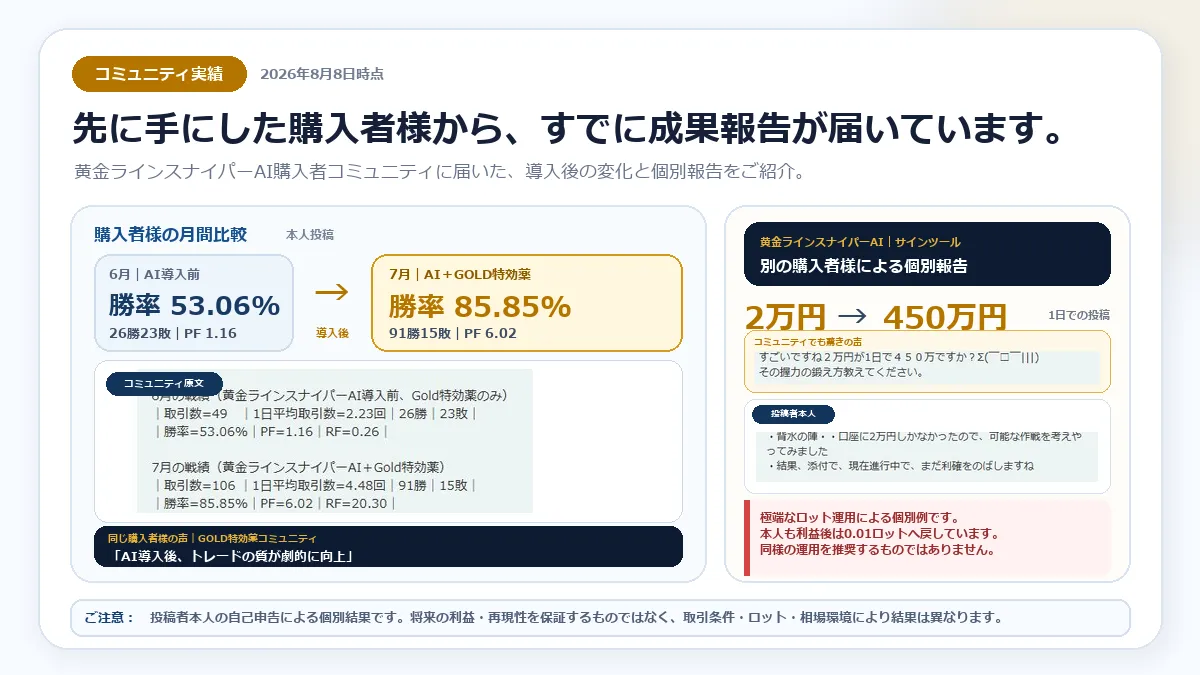
? GOLD-specific medicine has been featured^^
If you want to understand the foundation of judgment, please check the content and its limits.
? Summary: Do not spend waiting time in front of the screen
Entering before the waiting spot does not always mean you lack patience.
Because, while waiting in front of the screen, you may start to look for reasons to enter.
Therefore, once you decide to wait, write only one line and then leave the screen.
What you should write is【Return in front of the wall / Decide after watching to stop】like where to return and what to confirm after returning.
Place the notification a little before the wall and read one line before the chart when it rings.
Then, by alternating between higher and lower timeframes, confirm whether you have reached the written spot.
Movements you missed while you were away should be considered within expectations.
Missed rounds should be recorded with just one line, and you should revisit your writing method when the same type of miss happens repeatedly.
Tonight when you open the chart, try writing one line at the moment you decide to wait and then close the screen once, starting from there ^^
After returning, decide what to look at to enter.
I’ll write about that in another article.
For those who want to reduce the confirmations after returning, the Golden Line Sniper AI is also an option.
It does not decide when to return or whether to enter for you.
Please use it after confirming its display content and limits, with the final decision left to you.
✅ Next time you open the chart, write one line before you wait.
? Tonight’s one line: 【Return in front of the wall / Decide after confirming you’ve stopped】
View details of Golden Line Sniper AI
Thank you for reading to the end today as well ^^