

Learn the basics of investing Dow Theory Part 6: Fractal Structure
Previously, we explained “environment recognition,” which checks the market condition on higher timeframes before entering a position.
The theme of the 6th installment in the Dow Theory series is “fractal structure.” I will explain why higher timeframes are prioritized and where large trend reversals begin, and how the mechanism works.
What is fractal structure
Do you know romanesco (a vegetable in the cauliflower family)? It is light green and densely covered with small cone-shaped clusters that rise like tiny peaks.
If you take one of those small peaks and look closely, you’ll find even smaller peaks densely lined up. And those small peaks are again composed of even smaller peaks. No matter how far you zoom in, you repeatedly see the same shape as the whole.

Thus, a structure where zooming in a part reveals a shape similar to the whole is called“fractal structure”.
Market price movements follow the same pattern. If you take one rise from the 4-hour uptrend and view it on the 15-minute chart, within it there are small upward and downward waves. Looking at the 5-minute chart, within that 15-minute wave there are again similar waves.
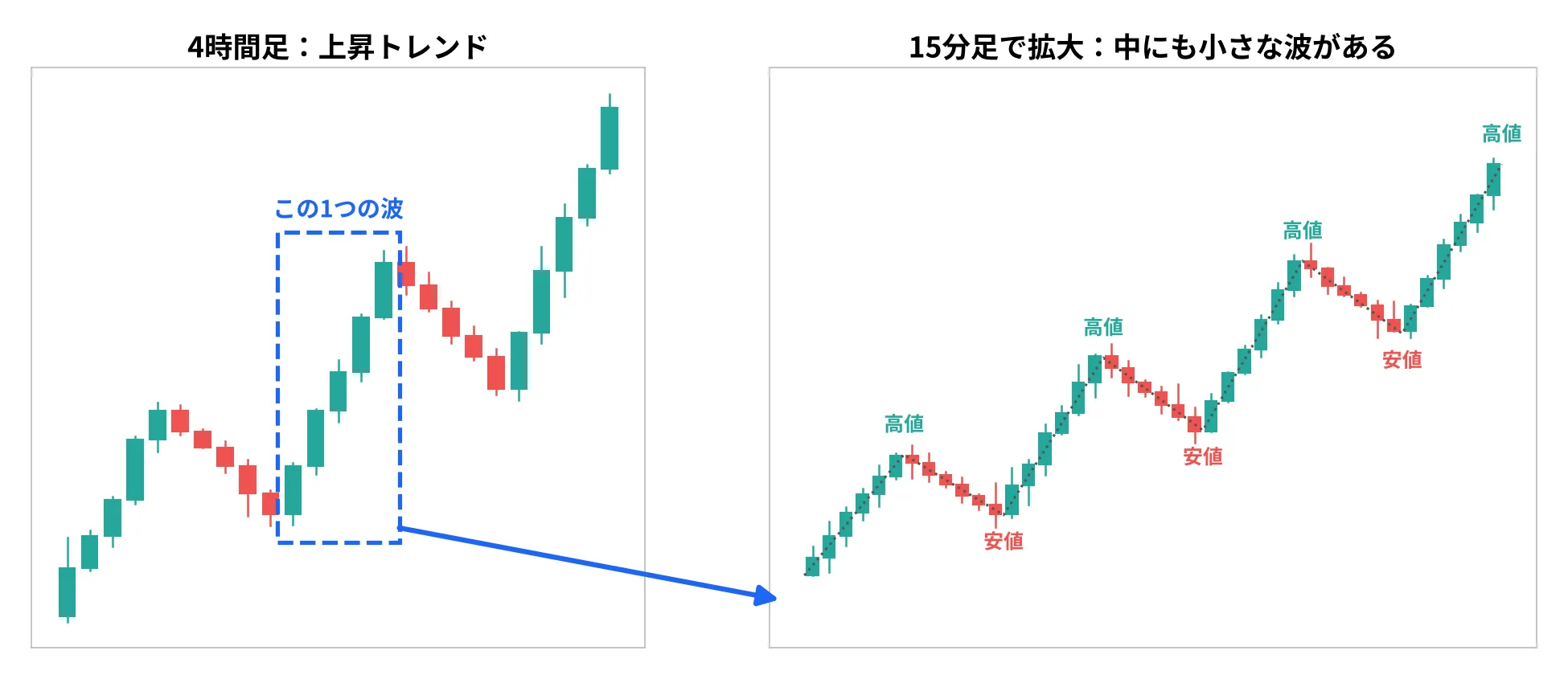
In other words, the big waves on the higher timeframe are composed of many small waves on the lower timeframes.
Why prioritize higher timeframes
One wave on a higher timeframe is made up of many smaller waves on lower timeframes. Even if the 15-minute chart looks like an uptrend, it may be just a small retracement within a large downward wave on the 4-hour chart.
Smaller waves move within the flow of larger waves. Therefore, the trend on higher timeframes is stronger, and it should be observed first. This is also why the previously discussed idea that “breakouts against the higher timeframe trend tend to be false” exists—the mechanism behind it.
Trend reversals start from the lower timeframes
So, will the higher-timeframe trend continue indefinitely? Of course, it will reverse somewhere.
When that happens, it doesn’t suddenly move in the opposite big wave. First, on small timeframes such as 1-minute or 5-minute, higher highs and higher lows begin to form, turning into a 15-minute uptrend, and eventually spreading to the 1-hour and 4-hour charts. Large trend reversals also begin as a reversal of small waves.
However, not every reversal on the lower timeframes leads to a reversal on the higher timeframes. Often it ends as a temporary retracement within the larger flow. Therefore, even if a reversal pattern appears on the lower timeframes,it is important not to deem a trend reversed until the upper timeframe breaks its retrace high or pullback low.
Summary
・Fractal structure means a structure where zooming in on a part reveals a shape similar to the whole
・In markets, many small waves on lower timeframes exist within the large waves of higher timeframes
・Since small waves move within the flow of large waves, observe the higher timeframe first
・Even large trend reversals begin as reversals of small waves on the lower timeframes
・Lower-timeframe reversals often end as temporary retracements, so do not judge a reversal until the higher timeframe breaks its retrace high or pullback low
Just as romanesco’s small clusters combine to form the whole, the market is built from the accumulation of small waves into a large trend. Simply being aware of which timeframe and which wave you are looking at changes how you perceive the chart.
Next episode: Final installment “Aim for Wave 3!”
In trends, the largest and most likely to accelerate is “Wave 3.” By using fractal structure, you can target the Wave 3 of the higher timeframe within the Wave 3 of the lower timeframe, i.e., “Wave 3 within Wave 3.”
In the final installment, I will combine what you’ve learned about Dow Theory, environment recognition, and fractal structure to target the most lucrative part of the trend. Please stay tuned for the final installment as well.