

[Development Record] Implemented eight customer-attraction strategies in six months with zero requests for verification — Results by strategy and current assessment
【Key Points】
Since the LP was opened, more than half a year has passed, and there have been zero requests for logic verification. The root cause is not the quality of the content, but the small size of the audience.
Eight measures were implemented. Only a few have measurable effects; most are in a stage where “measurement methods are insufficient.”
There were two card clicks. The routes were one from note and one from Google search, both small, but it suggests the earlier stage is starting to move.
■ In brief, conclusions
Over six months, updates to the LP and dissemination were continued, but there are zero requests for logic verification at present. This figure does not indicate the superiority of any particular measure. The reality is that, due to the small number of accesses, there isn’t enough data to isolate which measures were effective.
Therefore, this article is not a report of results, but a整理 (inventory) of what was done for each measure, what was seen, and how judgments are being made at this point.
■ Measures and current evaluation
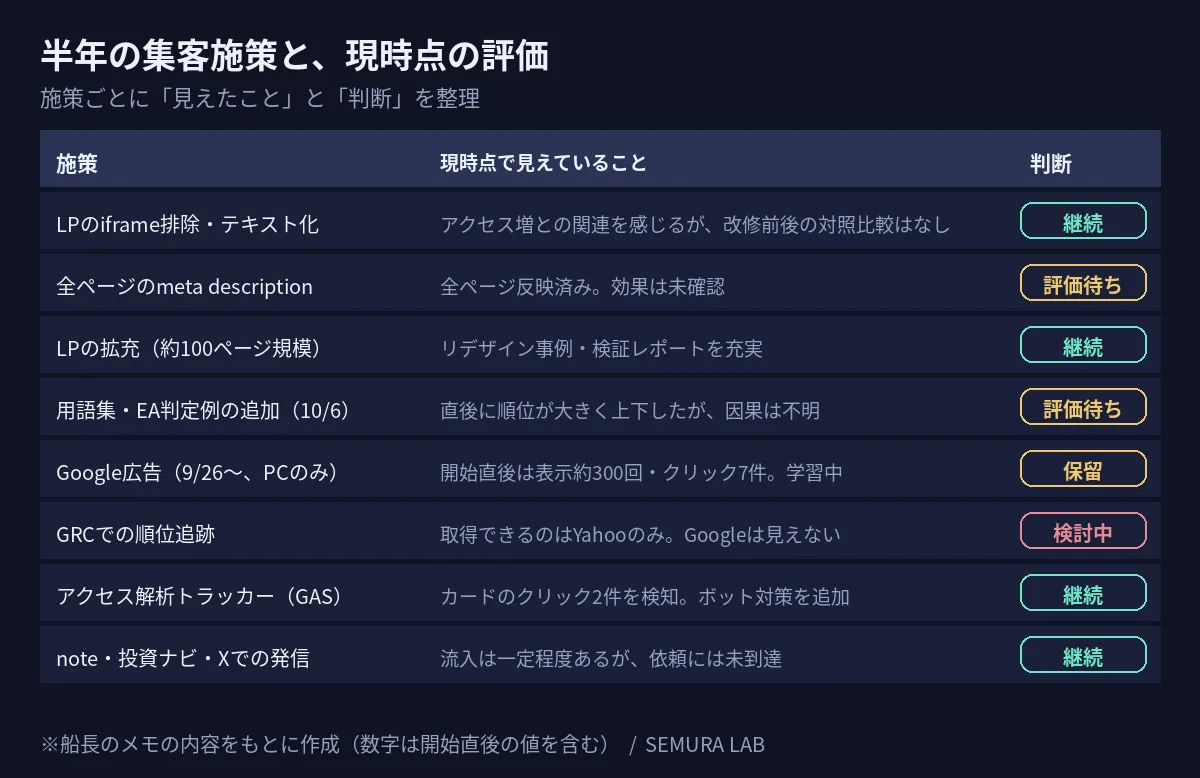 【Image:fig18_measures_table.png】
As the table shows, evaluations are divided into “continue,” “on hold,” and “under consideration.” Below are notes on items that require additional context.
Eliminating the LP iframe is the measure most strongly associated with increased access. However, because there was no before/after comparison in a controlled way, causality remains speculative.
Keyword selection was also a process of trial and error. Phrases that emphasize “pain” often show data as unavailable in Keyword Planner, and some have been deemed invalid due to low search volume on the advertising side. On the other hand, “fx ea not winning” yielded a substantial monthly volume of 100–1000. Furthermore, through operation/how-to terms (such as “MT4 backtest how to”), the actual measured volume appeared for the first time. Phrases describing problems tend to be less searched than those describing actions.
Google Ads are delivered only on PC. The logic-verification application requires uploading a backtest report (.htm) file, so smartphone or tablet traffic is less likely to convert to applications. Early numbers were roughly 300 impressions, 7 clicks, and under 200 yen cost. With a daily budget of 300 yen, the numbers remain small. Bidding strategy is still learning, so the evaluation is on hold.
■ Limitations of measurement
The biggest constraint is ranking measurement. Currently, the only ranking data available in Yahoo via GRC is Yahoo rankings; Google rankings cannot be obtained. In fact, manual Google searches show that even words ranking outside Yahoo’s results can appear on the first or second page for the lab LP. Relying only on Yahoo tables may underestimate the real situation.
From Google Search Console data reviewed earlier, over the past three months, clicks were just under 20, impressions a little over 100, and average position around rank 8. The ranking isn’t bad, but impressions are low, so the pool of people who could click is not sufficient.
Additionally, identifying the cause of any ranking movement is difficult. When pages for glossary terms and EA decision examples were added, certain keywords moved significantly, but causality could not be determined. In a stage with few indicators, it’s safer not to attribute causes.
■ How to read the two card-clicks
The analytics tracker required protection against bot contamination. On October 8, there were sessions that cycled through multiple pages in a short time, so on October 9, criteria were added. If log quality isn’t maintained, a single data point could be misread in a small dataset.
That said, two card-clicks were detected. The first, on October 12, came from note, with about 70% of the page read before moving to the verification page. The second, on October 22, came from Google search, with the user reading to the end and staying for more than two minutes.
The routes being different is notable, but two data points cannot establish a trend. For now, record as “observation” and watch whether similar movements recur. Also, after moving to the verification page, no reports or applications have been submitted yet, which becomes the next topic.
■ What is the current hypothesis for zero requests
The current hypothesis centers on one point: the number of accesses is low and awareness channels are scarce. There is a certain inflow from X and note, but it does not translate into requests.
Of course, there may still be room to improve the LP’s pathways and the application process. However, trying to judge pathway quality with a small number of visits can lead to incorrect conclusions. First, increase the sample size and examine by stage (visits, reads progress, clicks, transitions, applications). Proceed in this order.
■ Plan for the next six months
・Switch to a tool that can obtain Google rankings, or use in combination (try a free trial period if available and judge thereafter)
・Review logs by stage to identify where people drop off
・Continue disseminating on note and 投資ナビ, and observe inbound routes
The plan has shifted once. After LP improvements, it was judged that one person could not focus on SEO alone, so search ads were started as an alternative. However, questions about prioritizing advertising arose, and it was decided that only by actively pursuing SEO would traffic increase. The fact that the plan changed is itself part of the record. In the next six months, verify whether this judgment was valid.
We, Semura Lab., will continue to observe and document what we did and what we saw, even during periods without results.
If you have questions about attracting audiences or verification methods, feel free to ask at the general consultation desk.