About my method, which I was told has no impact
Series 9 | Change Your Life with Trading Side Story 2
About My Method That People Said Had “No Impact”
Hello, this is THE DAYTRADE.
This time, we’re stepping a little away from the main story and into a side tale.
Previously, I spoke with someone who supports the sale of FX and investment-related educational materials, and there’s something that has been nagging me for a while. Please allow me to share that today. It might get a bit heated.
1. “There is no impact, so it’s hard to deal with”
At one point, I suddenly received a message from them: “Would you open an FX course?”
So I talked about what I teach and how I trade.
As a result, they said this:
“There is no impact, so it’s hard to deal with it here.”
They said it would be easier to sell if it focused on indicators or similar tools.
...No, wait a minute.
My method is,
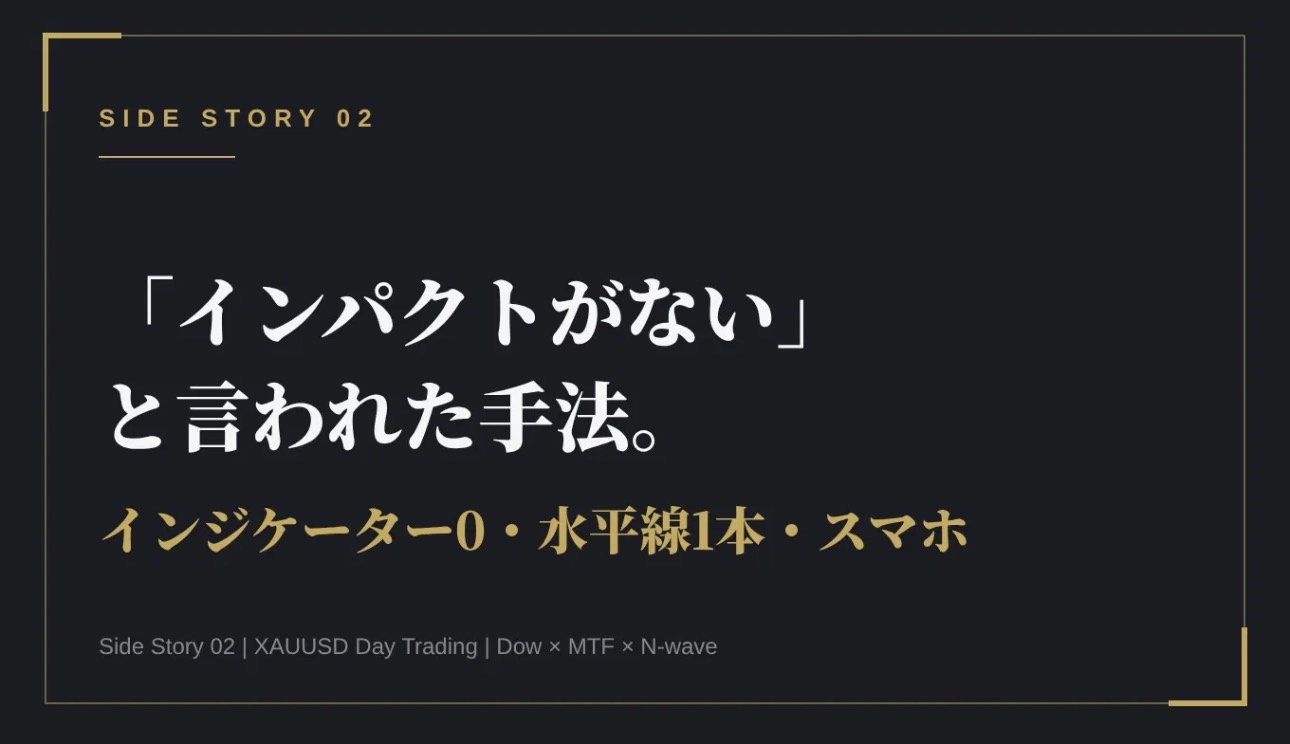
- Indicators zeroed
- Only one horizontal line drawn on each chart
- Can be done on a smartphone
So where is the lack of impact supposed to be, I wondered.
There’s no need to run multiple monitors side by side. There’s no need to fill charts with various displays. Narrow down what you need, look at the charts, and make decisions. You can execute your judgments on your usual smartphone.
I believe there is plenty of distinctive value there.
2. It’s not that “less is easier”
Of course, just because you use fewer tools doesn’t mean anyone can win easily.
Reading charts requires study. Verification is needed. There is also the difficulty of actually adhering to the defined rules.
But is there really a need to make things look complicated just to learn it?
Honestly, at that moment I felt like saying, “Give me a break.”
More than not being able to handle my own materials,the judgment of “no impact”was what drew me in.
3. What is the “impact” you’re seeking?
So, what is the impact you’re seeking?
- A special signal appears
- A name you’ve never heard before
- This instrument alone seems to have some special power
Is that the kind of promotional material you want?
To me, it felt like“what learners need” was less important than “what is easy to promote.”in other words, it seemed to lean toward marketing rather than genuine education.
Of course, when you’re selling, how you convey things matters. I also sell educational materials and need to attract interest.
However, I think it’s wrong to dress up a method just to make it easier to promote.
4. The meaning of learning is in the logic of judgment
What I consider important is here.
- Why enter at that point
- When should you pass on something
- Where to admit a mistake and cut it
First, the explanation should have coherence.
And once you’re convinced by the explanation, you should verify it yourself on past charts. Under what conditions did results occur? How many verifications were done? Not only profits, but what kinds of losses happened. How much capital was wiped out in a losing streak?
After that, test whether you can make the same judgments in real market conditions.
I believe there is learning value in that.
5. Indicators that change with each video
I recently noticed a similar thing while looking at Instagram.
Videos from traders who prominently feature money. To me, the messages felt like “watch my money.”
In the first video, they explained with a chart showing an MA. Yet, in a video a few uploads later, they explained with Bollinger Bands.
Huh? Do you switch between many methods like that?
Of course, some people use both MA and Bollinger Bands, and the switch may have been for explanation. So I can’t say it’s arbitrary just because the display changed.
However, from what I’ve seen,the criteria for when to use what were unclear.
- In what market do you look at MA
- In what market do you look at Bollinger Bands
- If both judgments conflict, what do you do
That is what I want to know. If you present different things in each video, learners won’t know what criteria to base their judgments on.
6. Not “after the fact” but “when the future is not visible yet”
Do you display easy-to-describe things on charts after the fact, or did you actually judge using those tools and criteria before placing orders?
I think there’s a big difference there.
If you only say, “If you bought here, you would have won,” after the fact, you don’t know how to act in the next market.
What do you base decisions on when the future is not yet visible?
That is what I want to learn and what I want to teach. Just showing money doesn’t mean you understand your trading judgment.
7. Not flashy vs. plain, but you want to see the substance
Conversely, even though I work with few tools, I don’t think I should end with “it’s easier to understand because it’s simple.”
- Where do you draw that single line
- Why there
- In what situations does that judgment not apply
That level of explanation is necessary.
Therefore, it’s not about “flashy is bad, subtle is right.”I want to see the substanceand I want you to judge my materials by their substance as well.
8. The place I want to build
From experiences like this, I’ve clarified the place I want to create.
I want to build a community of traders who properly face the market.A community where winning trades are not the only thing shown— where losing trades can be shared too, where questions can be asked, and where you can reflect on what happened when rules weren’t followed.
“What was the basis for that judgment?”
“If the same situation occurs, will you take the same action again?”
That is the kind of place where we can talk. I also want to articulate my own judgments in words and keep validating them.
9. The potential of trading as a profession
I feel immense potential in the profession of trading.
Make your own judgments, take on risk, face the outcomes. Move a portion of profits from trading into long-term investments. For me, that is the financial flow I want to realize.
So I don’t think it’s right to dismiss FX as “dangerous and impossible” from the start.
However, I also think we shouldn’t blanketly say, “those who lose just didn’t study.” If we don’t examine what they learned, what trades they made, and why they lost capital, then it remains only my impression.
Even with study, losses occur. What worked in verification may not hold in the future.
That’s why I want to cultivate the ability to verify for myself and build a place to learn that.
When selling educational material, if there is a difficult market, I’ll tell you. If losses continue, I’ll be frank. I’ll also discuss the difficulty of acting. And I want to work together with people who want to learn.
I don’t want to hype the title and sell with expectations greater than the actual content.
Summary: First, judge after looking at the content
“There is no impact.”
I still remember being told that.
But I don’t think my method lacks distinctive features.
Indicators zero. One horizontal line per chart. Do it on a smartphone.
First, judge after looking at the contents. I will continue to make an effort to present the substance more clearly.
If you’re looking at a教材 or a trader’s messaging and think “that sounds amazing,” please also look at the criteria for judgment that follow. What you look for, how you act, and what would make you admit a mistake.
Including my own messages, I want you to see that far.
Today as well, value your own judgment.
Note: Trading carries a risk of loss. Results vary from person to person and profits are not guaranteed.
INTENSIVE COURSE | Limited to the first 10 people
THE DAYTRADE Intensive Course
Master the method in one month.
¥9,800(From the 11th participant, ¥19,800; content is the same)
- Discipline Textbook: Dow Theory × Multi-Time Frame × Elliott Wave, structured from the basics
- Total 2 hours of one-on-one online lessons
- Lessons are freely usable: A single 2-hour session,4 sessions of 30 minutes are OK
- One month of unlimited questions in the talk room
- Support in the community after the course ends
- Drawing tool “ChartPen” included
Indicators zero, one horizontal line, smartphone. Please verify the contents with your own eyes. If you don’t understand something, you can ask questions anytime for a month.
▶ Details and application for the Intensive Course
https://www.gogojungle.co.jp/tools/rooms/88155
※ If you have already purchased the “Discipline Textbook,” please consult via message before applying.
▼ Drawing Tool “ChartPen”
A drawing tool that allows you to directly draw lines and text on the chart (Windows version MT4/MT5). You can leave analyses and reflections directly on the chart. It’s also included with the intensive course.
https://www.gogojungle.co.jp/tools/indicators/87951
▼ Monthly Series “Chart Reading, Explanation, Comprehension, and Verbalization”
A monthly series by GoGoJungle that compiles short explanatory videos using actual charts.
https://www.gogojungle.co.jp/finance/navi/series/2073