

Reasons you lose even though you bought at the perfect order. The answer lies in "which time frame you looked at."
Hello, I am Ama Papa of FX Craftsman.
After seeing the Perfect Order,
I bought because it looked like a clean upward sequence.
But it fell right away and I cut losses.
Have you ever had a similar experience?
The cause may not be the method itself
“which time frame you looked at”
instead of the method.
■ Quick recap of the Perfect Order
The three moving averages for short, medium, and long term
are aligned in order.
・Uptrend: Short > Medium > Long
・Downtrend: Short < Medium < Long
When all three are arranged in this order,
whether you view it over a short period or a long period,
they are moving in the same direction.
In other words, the trend is clearly visible.
■ The answer can differ by time frame, even at the same time and currency
This is the pitfall.
The Perfect Order is
the arrangement within the time frame you are looking at.
For example, for the same USD/JPY moment,
・5-minute chart: an upward Perfect Order
・1-hour chart: neither
・Daily chart: a downward Perfect Order
This is common.
If you solely look at the 5-minute chart and buy,
you end up buying against the large daily downward flow
and get pushed back when the short rise ends.
When the short rise ends, you get pulled by the larger trend.
■ Check from higher time frames first
What matters is
checking in order from higher time framesfirst.
Procedure
1. Look at the daily chart
Is it upward, downward, or neither?
2. Look at the 4-hour and 1-hour charts
Do they align with the daily direction?
3. If they align, look for entry timing on lower time frames
On 15-minute or 5-minute charts,
enter only in the same direction as the higher time frames.
4. If they do not align, skip
Not forcing an entry is also a valid decision.
If you commit to entering only in the same direction as the higher time frames,
you will greatly reduce moments of indecision about
where to enter.
■ The problem is how many charts to confirm
The procedure is simple.
However, in practice, the number of charts to check increases.
If you check eight commonly watched currencies on daily, 4-hour, 1-hour, 30-minute, 15-minute, and 5-minute time frames
you end up with 8 currencies × 6 time frames = 48 confirmations
Switching to and viewing these every time is honestly tiring.
On busy days, you want to skip higher-time-frame checks.
And on the days you skip, you tend to enter against the trend.
■ How to condense 48 confirmations into 1
When I rushed into an entry and then looked at higher time frames,
the opposite Perfect Order had already been formed,
and I hurriedly cut losses several times.
To keep from this happening, I created
MTF Perfect Order Panel (MT4).
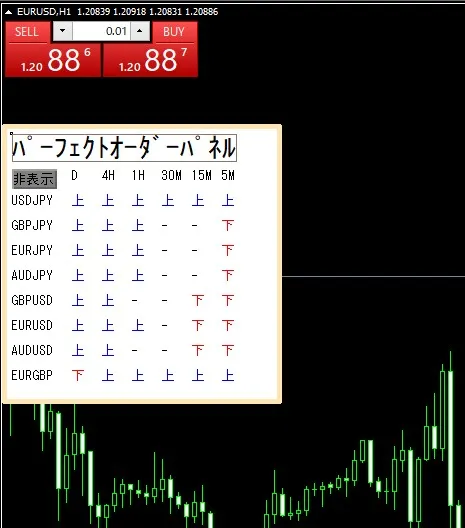
・A list view of Perfect Orders for multiple currencies × 6 time frames
with “Up”, “Down”, “-”
・Clicking a display switches to that currency and time frame chart
・Currency pairs, moving average types and periods are freely adjustable
In the daily column of the panel, look for currencies in the “Up” direction,
and proceed to the right to confirm if the 4-hour and 1-hour also align.
If aligned, click to view the entry timing on the chart.
The steps described in this article can be carried out directly on a single panel.
▼ MTF Perfect Order Panel (MT4)
https://www.gogojungle.co.jp/tools/indicators/29392
Whether it runs in your environment can be checked with the trial version.
▼ Trial version
https://www.gogojungle.co.jp/tools/indicators/55737
■ Summary
・Perfect Order results differ by time frame
・Before entering, confirm from higher time frames in sequence
・Enter only in the same direction as the higher time frames. If not aligned, skip
Whether or not you use the panel,
make it a habit to “look from the higher time frames.”
Please try this starting today.