
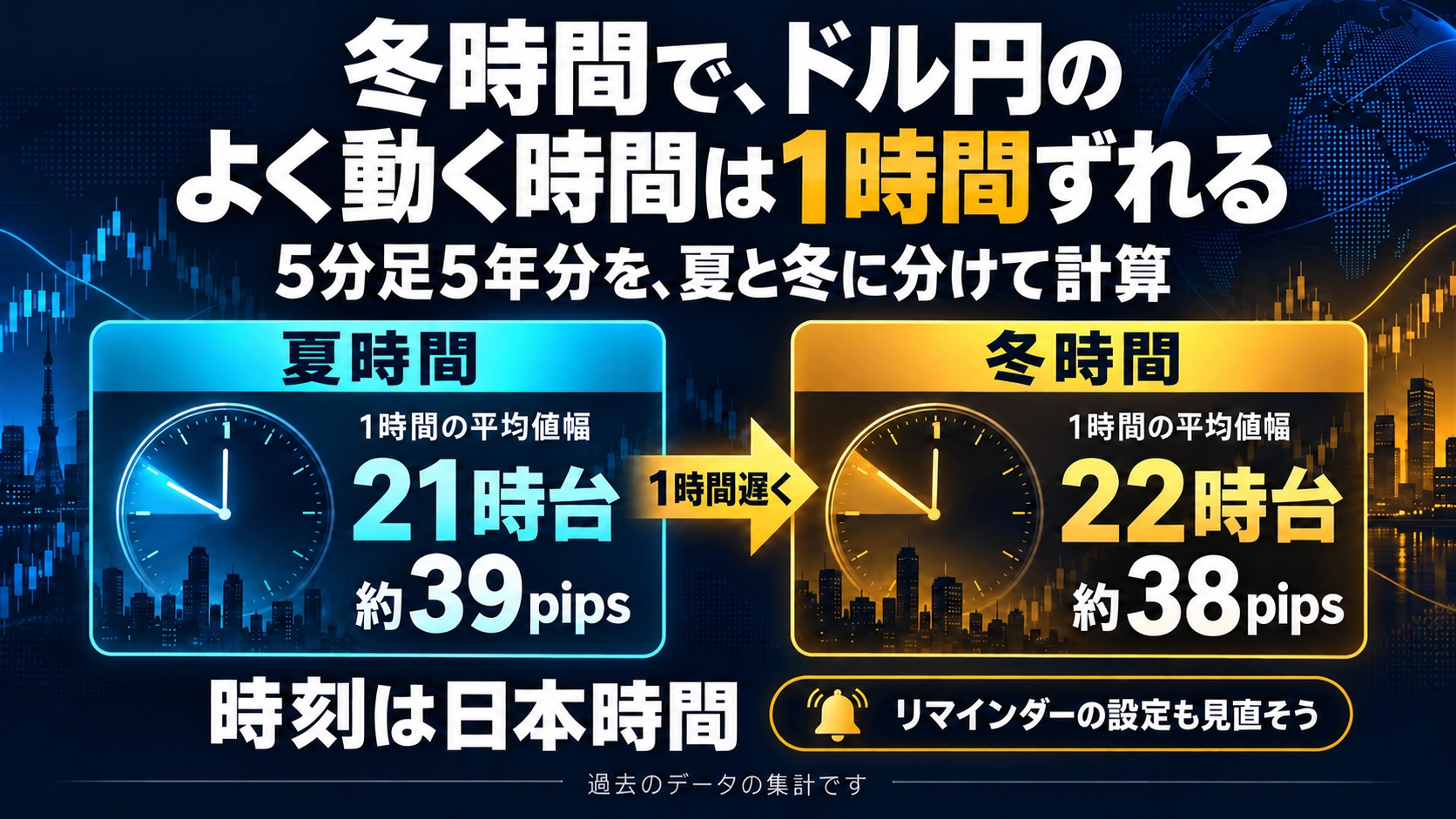
In Daylight Saving Time, the "most active period" for USD/JPY shifts by 1 hour; we calculated five years of 5-minute bars by splitting them into summer and winter.
On October 25 (Sun) in the United Kingdom and on November 1 (Sun) in the United Statesenter standard time (winter time).
The times related to London and New York will be 1 hour later in Japan standard time1 hour laterthan before.
After the switch, I once expected US indicators to be at 21:30, but thought, “Huh? Volatility is low!”
I calculated the one-hour price ranges for 5 minutes of the USD/JPY over five years, split into “days of daylight saving time” and “days of standard time.”
First, the current daylight saving time.
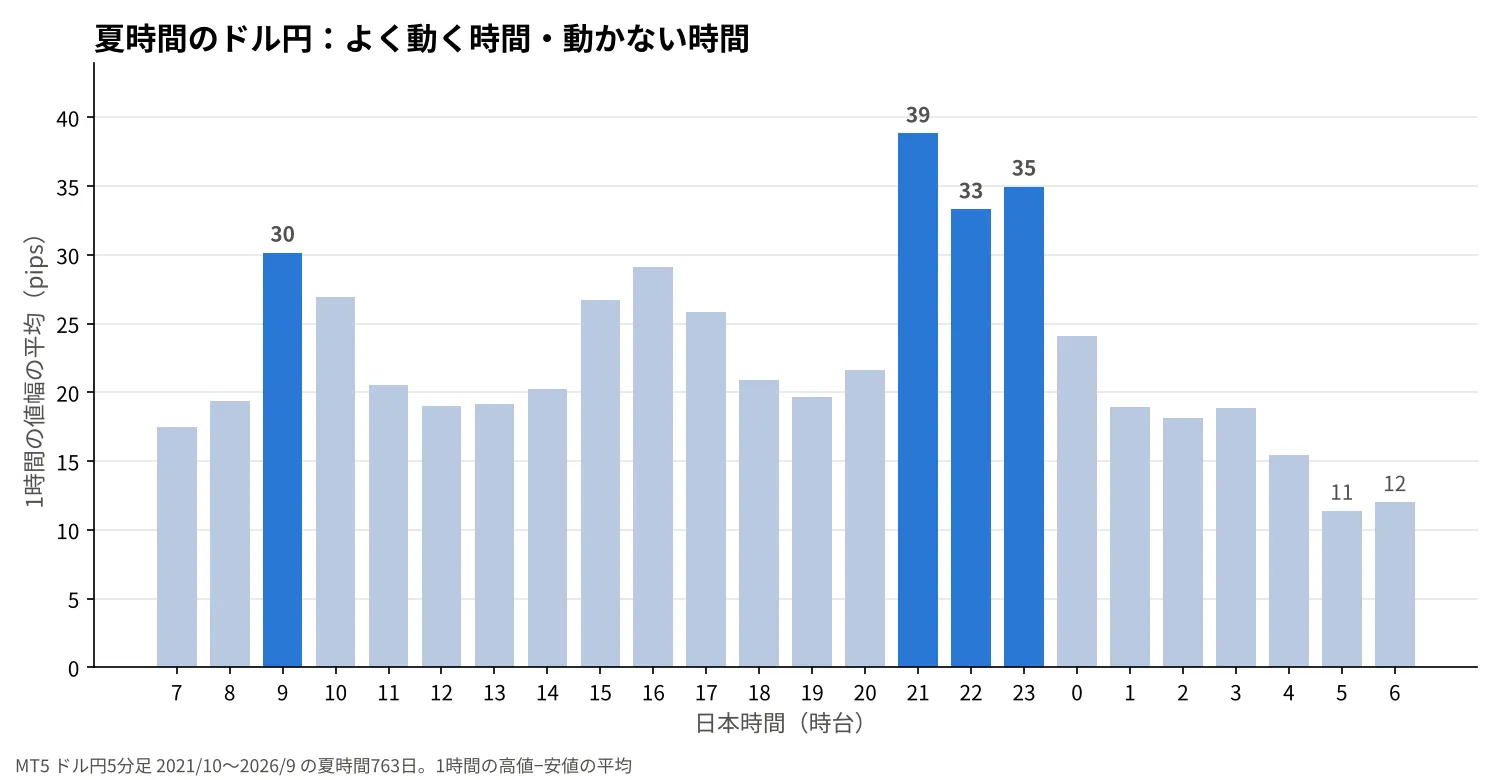
※Average of the one-hour high minus low (1 pip = 0.01 yen). Time is in Japan Standard Time.
Most active: around 21:00 around 39 pips
Less active: around 05:00 around 11 pips
Next largest periods are around 22–23:00 (about 33–35 pips) and at the reference rate 09:00 (about 30 pips).
I read these times aloud with a browser app that announces the time, “FX Voice Reminder” (a product I sell).
Since daylight saving time and standard time do not switch automatically, I adjust the timing every year during this period.
▶ See FX Voice Reminder (980 yen, no installation required)
In winter, the peak around 21:00 shifts to around 22:00
Looking at the five winter average, the 21:00 peak moved from about 39 pips in summer toabout 22 pips in winter. Instead,the 22:00 hour becomes about 38 pipsand is the time with the most movement.
Next,
- A graph comparing summer and winter and a table of comparisons
- The week of October 26–30 with “UK only winter time”
- My reminder’sWinter time settings(a ready-to-use timetable)
is included.