

Various techniques of position management【Capital management and position management edition #5】
Hello! This is SAKU!
In the previous articles, I talked about making not only entries but also cuts and profit-taking with a basis.
This time, let's dive deeper and look at various techniques that can be used for position management! (Previous articles are below)
・Do you cut losses with a basis? [Capital Management / Position Management Part 3]
・Do you take profits with a basis? [Capital Management / Position Management Part 4]
Trailing Stop
There are times when you make a decent profit, it pulls back again, and you end up stopping out...
I think this happens often.
What is effective to prevent such things isTrailing Stop.
A method of gradually shifting the stop position while your profit is running.
By doing this, you can monitor the situation while securing a certain level of profit.
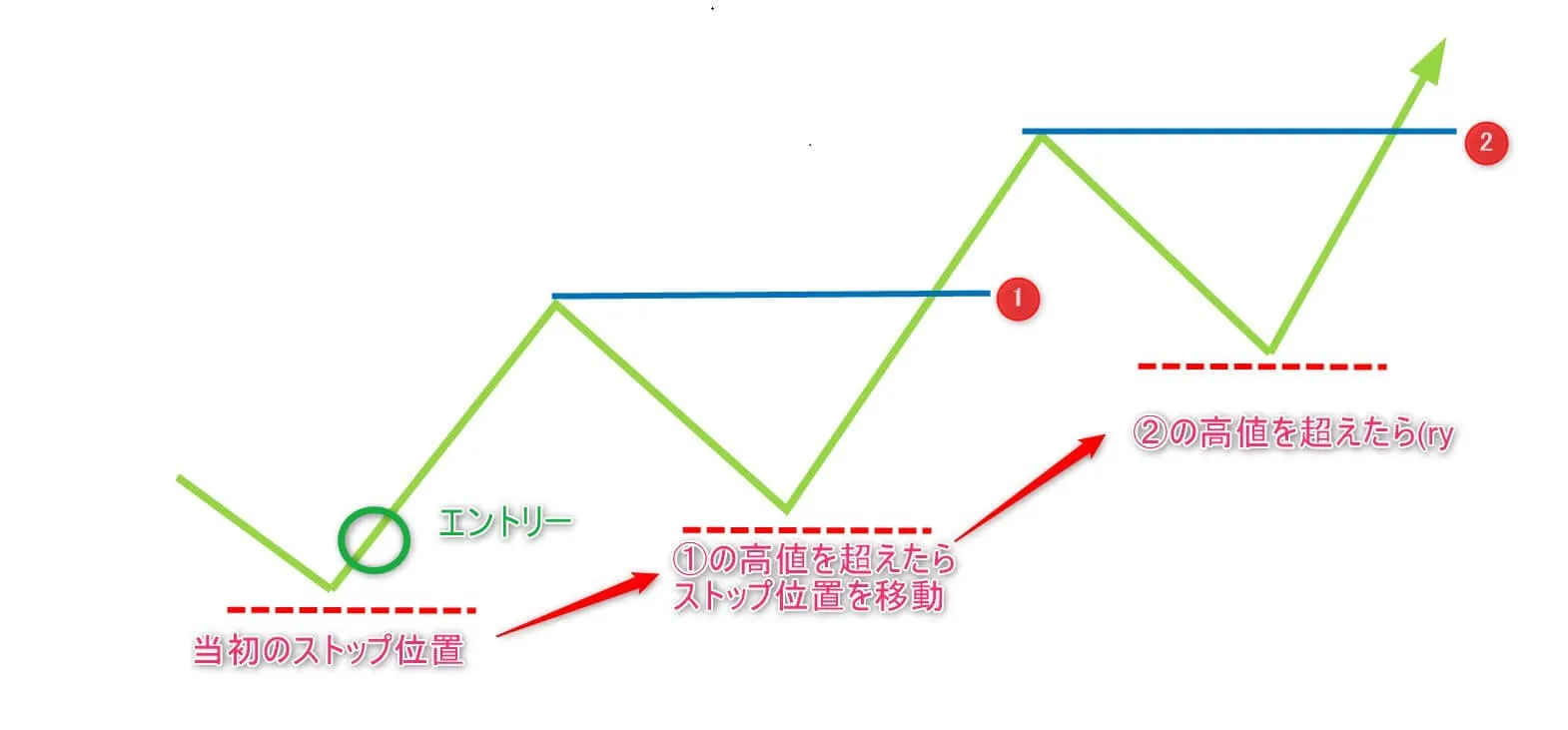
Butwhen using a trailing stop, it's not good to trail the stop based on a gut feeling of value.
If you move the stop from -20 pips to -10 pips just because you have 10 pips of profit, please don't do that.
If there is solid justification, it's fine, but otherwise you should stop.
Raising the stop without justification only increases the risk of being taken out by noise.
So what should you do? For example, let's explain this when you are long in an uptrend.
Suppose you have managed to buy on pullbacks and have gained some profit.
It’s fine to take profits at the previous high or at a level that might be watched, but you might think you want to see if it can go a bit further.
In this case, you should raise the stop after confirming a near-term resistance that seems to be watched, i.e., a breakout of a horizontal line or an update of the swing low (break above the previous high).
In this case,the resistance band that has been broken may function as support (role reversal from resistance to support), increasing the barriers before hitting the initial stop.
In the diagram above, updating the swing low = continuing the trend and trailing.
This example is about extending profits, so of course you can completely close at the most recent high or split the exit and observe the rest.
We will explain split exits later!
Stop trailing for no reason before reaching the first take profit target should be avoided.
That said, as in the diagram above, there are times when the price continues to pull back and the market is a bit choppy in the middle.
To trail the stop in such cases, you should use something other than horizontal lines as justification.
Yes,the ever-popular trendline comes into play.
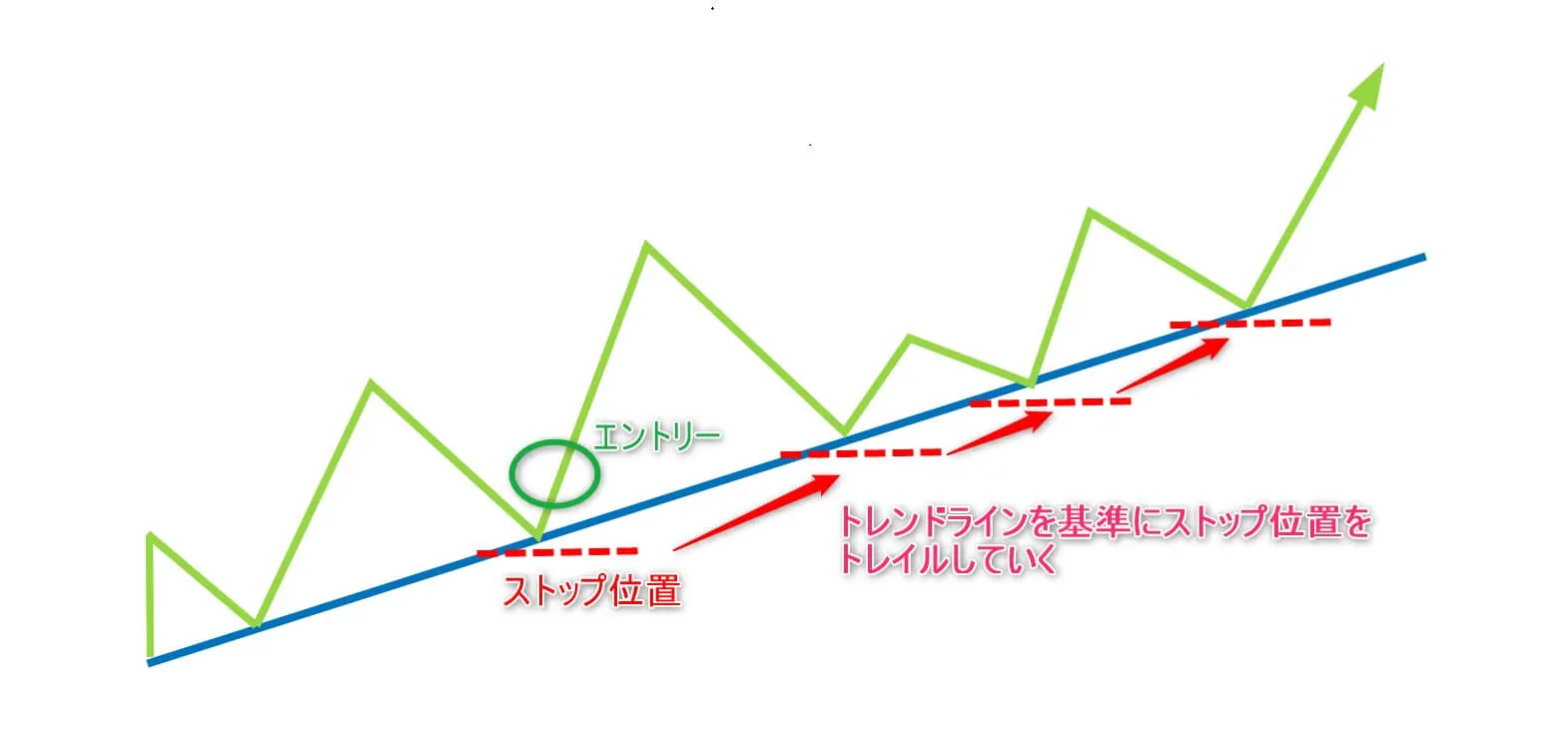
By having the trendline rebound without being broken, you can perform a trailing stop.
Partial Profit-Taking / Scale-Out
Partial profit-taking means taking some of your position off in portions,and scale-out means closing positions at the same price as entry.
If you can use the techniques of partial profit-taking and scale-out as needed, you can avoid losses and secure a certain profit while trading with composure.
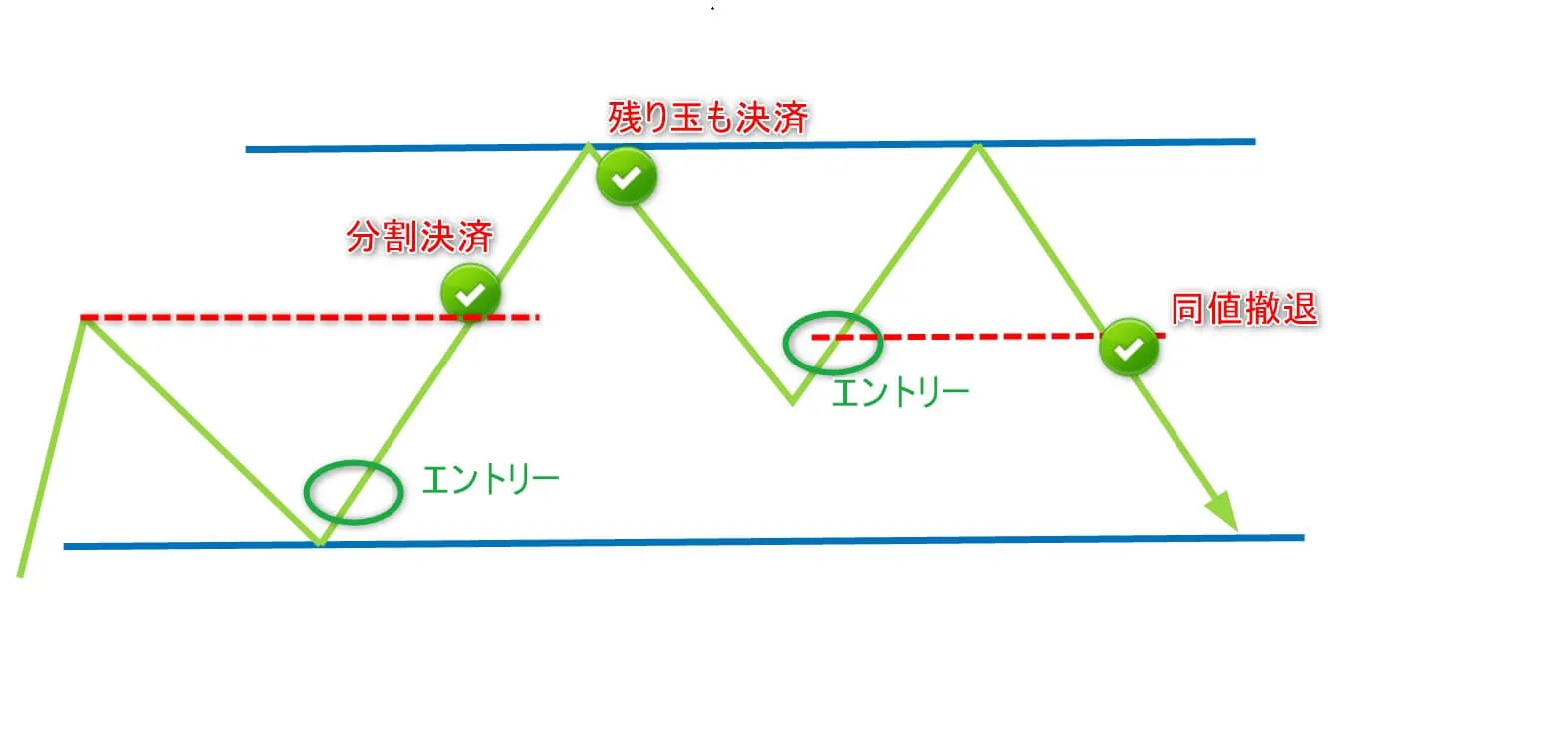
Also, partial profit-taking can be used not only for profit-taking but also for stopping losses.
Refer to the previous article (Do you cut losses with a basis? [Capital Management / Position Management Part 3]) for details.
As for partial profit-taking, as shown in the trailing stop example earlier, it is good to do when you reach an interim take-profit target.
As for scale-out, taking the previous example into account, you can reach the first target, scale out a portion, and move the remaining positions' stops to the entry price..
By doing so, you can secure at least the profit from the scaled-out portion, while letting the remaining positions run as far as possible.
You can also use trailing stops on the remaining positions to gradually increase profits.
A note on scale-out: even if you place a stop at the entry price, the spread may cause a slight loss, so if you're concerned, consider shifting the stop a few pips from the entry price.
Nampin (Average Down)
Nampin means, for example, after a long entry, when the price falls, you buy more to lower the average purchase price per position.
Meaningless averaging down is self-destructive, so if you do it, plan ahead the lot sizes carefully.
Especially for beginners, averaging down is generally not recommended. It is often referred to as “sticking your neck out with a bad averaging down.”
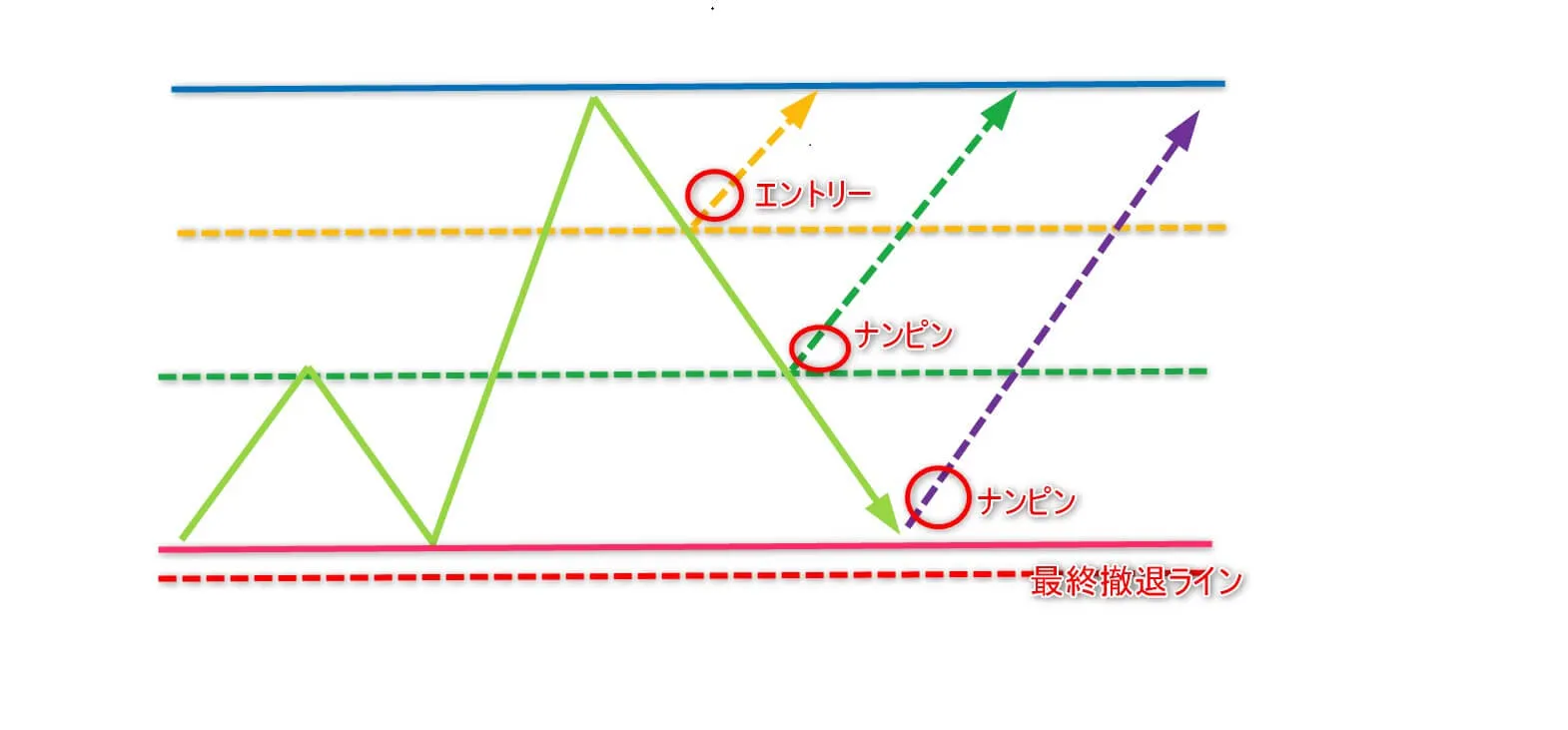
Premise for the diagram
You react at the orange line assuming a rise is coming, but since there are other lines that might react, you divide the lot into three and enter while observing.
If the final exit line is broken to the downside, cut losses.
Even if all lots are stopped out, divide the lots so that the loss stays within the allowable loss amount.
① One-third of the maximum lot size is placed as a probing long entry
② Another one-third is averaged down (position ① is negative)
③ Another one-third is averaged down (positions ① and ② are negative)
④ Later, when the take-profit target is reached, positions ①–③ end positively
That’s how it goes!
When averaging down, never enter with full force every time; divide your lots planfully!
So this time we looked at various techniques that can be used for position management!
By refining position control methods, you can trade while combining defense and offense.
Even if you enter poorly, good position control can still make things work.
Position control is difficult to practice unless you do it in a real trading environment, so it’s good to try many things in a demo and refine them!
For those who want to learn more practical capital management and position management, check this out as well! ↓

→MTF Multi-Timeframe Analysis Essentials (There is also a free trial version)
【Until 11/1 (Sun)! Limited-time campaign】

【First-come, first-served Public Release Campaign!】 → MMS Trading Encyclopedia—The Truth Behind the “Structural Traps” that Individual Investors Fall Into and the Market Microstructure Analysis to See Through Big Players’ Footsteps— (There is also a free trial version)