
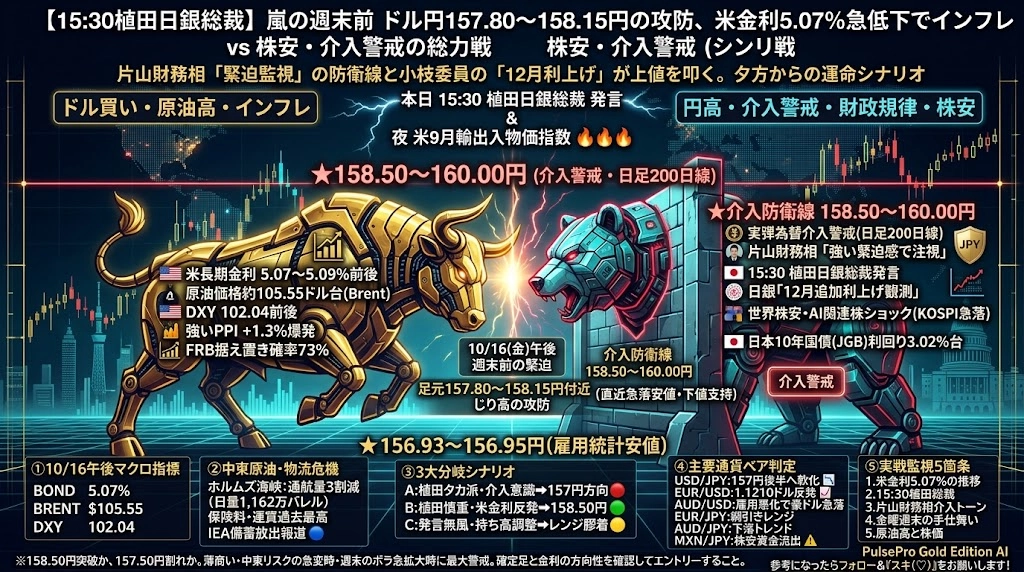
【Market-wide Review】Dollar-Yen in the low 158s, stalemate and Brent crude re-flaring at $110 — Bank of Japan poised to remain in October amid 2.8 trillion yen trade deficit vs. RBA hawkish remarks crossing the next "ignition point"
On the afternoon of Wednesday, October 21, 2026, in the Tokyo foreign exchange market, the USD/JPY pair has remained stuck in a narrow range that began earlier in the day, around 158.15–158.39 yen.158.15〜158.39円in a tight range, continuing to be at a standstill.
While the 200-day moving average on the daily chart around 158.50 yen is being watched as a strong upside resistance, on the downside there is genuine demand from real buyers supporting the dollar, and time is passing without a clear breakout materializing.
However, beneath the surface of the seemingly small moves, important energy is steadily accumulating that could propel the market: “Brent crude returns to around $110 per barrel,” “Japan’s fiscal year 2026 first-half trade deficit expanding to 2.81 trillion yen,” “hawkish remarks by RBA Deputy Governor Lowe causing the Australian dollar to surge,” and “the historic slowdown in the US housing market and the tug-of-war around the US 10-year yield at 5.12%.”
“Why is the USD/JPY completely pausing in the mid-158s?”
“Which will lead the yen—oil highs or the BOJ’s policy hold?”
“For today’s 15:00 UK September CPI and next week’s Japan-US policy meetings, which currency pair holds the winning edge?”
Based on confirmed data and latest reports in the Tokyo afternoon, we will dissect the global macro framework and tonight’s practical scenarios in detail.
Chapter 1: The 5 Major Macro Drivers Moving the Market Now
These are the core factors currently shaping price formation across major assets.
【October 21, 2026, Afternoon: Key Indicators and Materials】
・USD/JPY :
158.15–158.39 yen (stuck near the 200-day line)
・US 10-year yield :
Approximately 5.12% (between a weak housing data and higher oil)
・North Sea Brent crude futures :
About $110.03 per barrel (reaching back toward the $110 level as peace expectations wane)
・Japan September trade statistics :
Exports +16.7% YoY; first-half trade deficit 2.81 trillion yen (direct hit from higher oil)
・AUD (AUD/USD) :
Around $0.7013 (sharp rise on hawkish remarks by RBA Deputy Governor Lowe)
① USD/JPY: Nervous Consolidation in the Lower 158s
The Tokyo morning trading range is 158.15–158.39 yen. While the daily 200-day moving average in the mid-158s and authorities’ intervention warnings cap the upside, the structure continues to be supported by US long-term yields around 5.1% and genuine demand from importers on the downside.
② BOJ: October Meeting Consensus is for “Hold”
Market expectations are leaning toward a policy rate hold at the October 29–30 BOJ meeting. At the same time, reports say the Outlook Report may consider raising the inflation forecast for fiscal year 2027, shifting market focus from the hold itself to a possible framework for additional rate hikes in December or January next year.
③ US long-term yields: Weak housing data and 5.12% on the 10-year
US September housing starts fell 5.2% month-on-month to 1.221 million units, far short of expectations (1.305 million). The existing home sales index also hit a record low. The cooling effect on the real economy from high rates keeps the US 10-year yield around 5.12% on the upside.
④ Middle East tension and oil: Brent back to the $110s
Excessive expectations about US-Iran diplomacy have waned. Fears of shipping risks around the Hormuz Strait and attacks by pro-Iranian Houthi groups on Saudi facilities have resurfaced, sending Brent crude up temporarily to110.03 dollarsper barrel. Higher crude prices widen Japan’s trade deficit as an oil importer and directly press yen selling.
⑤ AUD: Inflation vigilance from RBA Lowe
RBA Deputy Governor, Michelle Bullock? (Note: text says Lowe) Lowe signaled that Australia’s inflation outlook has deteriorated versus prior expectations. “The need for further rate hikes is not yet clear,” but the strong inflation vigilance revived expectations for a November move, helping AUD/USD reclaim the 0.70 level.
Chapter 2: DomesticJapan Factors—
The Shock of a 2.8 trillion yen Trade Deficit and the BOJ’s Dilemma
This morning’s release of Japan’s trade statistics highlighted the structural causes of the yen’s weakness.
1. Trade Statistics: Oil’s high cost cannot be offset even with rising semiconductor exports
Exports in September:YoY+16.7%// semiconductors and AI products led growth but fell short of market expectations
First-half FY2026 trade balance (Apr-Sep): deficit of 2,818.4 billion yen(deficit widened 98.8% YoY)
September monthly trade balance: a deficit of 536.5 billion yen(five straight months of deficits)
While yen weakness benefits exporters by lifting yen-denominated sales, the re-emergence of Brent at around 110 dollars pushes up import costs in yen terms, directly hitting the currency.
The fact that a trade deficit of about 2.8 trillion yen has occurred over six months means that, independent of speculative trading, there is enormous real demand for selling yen and buying foreign currencies in the market. This is the primary reason the USD/JPY does not fall even when US rates decline.
【Transmission channels of crude oil around $110 to the exchange rate】
Oil price staying high ↓
Importers’ dollar funding for settlements (structural real demand for yen selling) ↓
Widening trade deficit (first half −2.8 trillion) ➔ firm support for USD/JPY’s downside
2. Scenario analysis for BOJ October Meeting
According to reporters close to BOJ, the probability of a rate hike at October meeting is almost priced in. The focus is on the statement and Governor Ueda’s press conference tone.
Dollar-yen bears scenario (toward the upper 158s):
If they emphasize “global economy uncertainty” and “considerations of US housing slowdown,” signaling a dove-dovish hold.
Dollar-buying back scenario (toward the 157s):
Holding the policy rate but “lifting the 2027 inflation outlook” and signaling strong caution about inflation persistence and pass-through to prices, paving the way for a December hike.
Also, yesterday’s 20-year JGB auction saw bids at 5.84x, the highest since 1987. Domestic rates have raised domestic institutions’ demand for government bonds, and there is capital returning from overseas bonds (yen-buying factor) beneath the surface.
Chapter 3: US Situation—Housing Slowdown and the Fed’s Outlook
Chapter 4: Major Currency Pairs
The US economy is in a tug-of-war between “robust inflation and high oil” and “the real economy cooling due to high rates.”
1. Sharp slowdown in housing-related indicators
US September housing starts (-5.2% MoM to 1.221 million) and existing home sales index (-7.3%, record low) show households and real estate struggling in a high-rate environment.
2. Positioning of US yields
US 10-year yield about 5.12%
US 2-year yield about 4.79%
US 30-year yield about 5.43%
CME FedWatch shows probability of holding rates at the October 28 FOMC meeting reaching 83%.
A US 10-year yield near 5.1% supports the downside for USD/JPY, but if housing indicators worsen and yields slip below 5.10%, the downward momentum for dollar buying will quickly fade.
Chapter 4: Major Currency Pairs
USD Crosses and Yen Crosses—Power Map
Based on afternoon Tokyo levels, we lay out the relative strength of each currency.
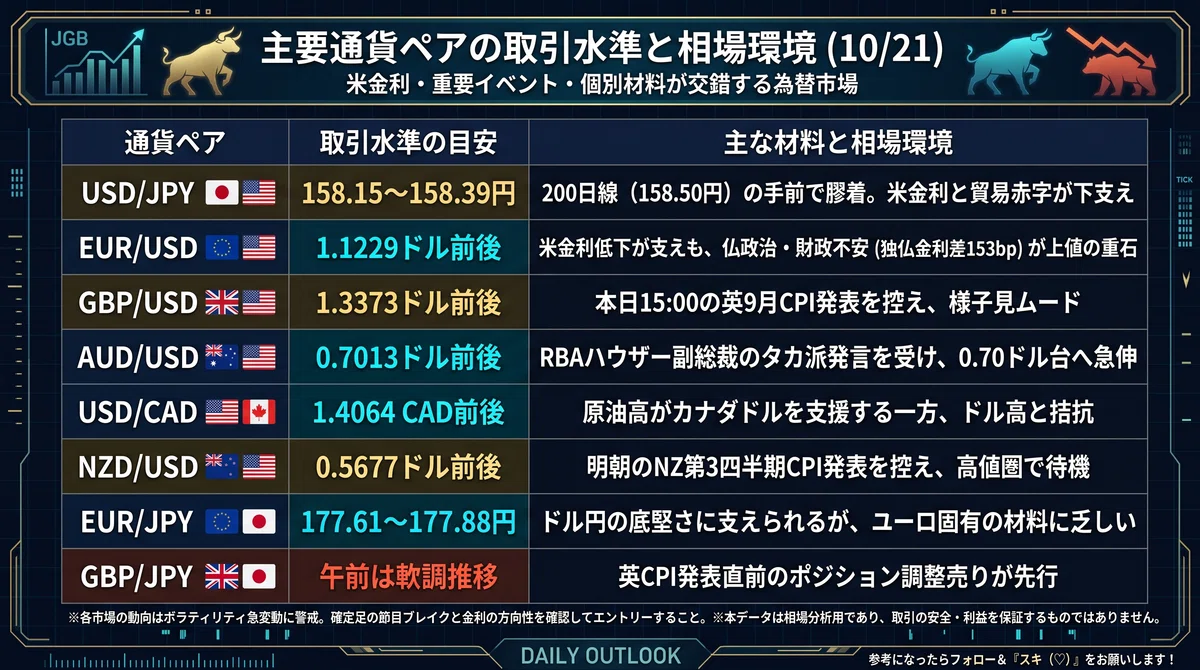
AUD’s Standout Strength—Can it Break Free from Pure Short-C covering?
The strongest mover in today’s FX market is the Australian dollar.
Having suffered from employment data disappointment last week (−37,300 jobs), the AUD got a boost from China’s stronger-than-expected GDP (+4.5%) on Monday and Lowe’s hawkish inflation remarks today, making it a strong buy.
AUD/USD and AUD/JPY rising in tandem:This is not just yen weakness; there is genuine demand from both real and speculative buyers for the AUD itself.
Outlook:Whether the AUD can hold the psychological 0.7000 level on a daily close will be a litmus test for the persistence of the uptrend.
Chapter 5: Today’s (10/21) Afternoon Important Time Schedule
This afternoon, volatility will surge around European currencies.
【Important Schedule for today (10/21, Wednesday) in Japan Time】
・15:00 ?? UK September CPI ???
【Europe's biggest focus】 ➔ Market expectations: YoY +3.4%, Core YoY +2.8% ➔ If the data tops expectations, pound soars (easing bets change); if misses, pound sinks.
・15:00 ?? UK September Retail Price Index (RPI) / Producer Price Index (PPI)
・20:00 ?? US MBA mortgage applications
・21:00 ?? BOE Governor Bailey speaking ★★★★
・Next 06:45 ?? NZ Q3 CPI (forecast QoQ +0.9%, YoY +3.8%)
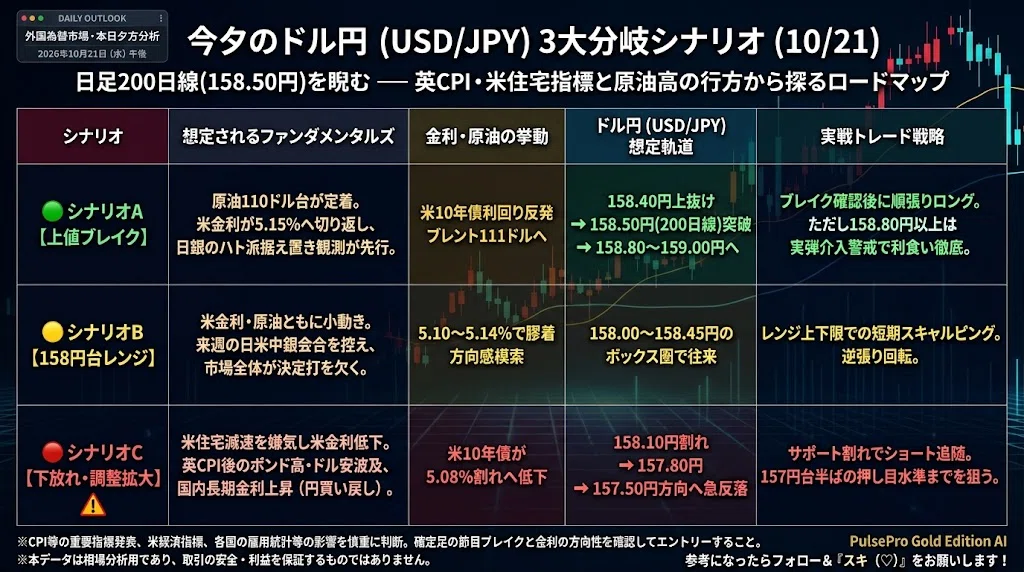
Chapter 6: USD/JPY and 3 Major Battle Scenarios
Assumed scenarios for USD/JPY during Europe to NY hours.
Market environment assumptions for scenarios: US rates and oil behavior / USD/JPY projected path / Practical trading strategies
Chapter 7: Practical Chart Analysis and “Defense Lines”
Crucial technical levels for executing trades.
【Upper Resistance Layers】
160.00 yen: psychological absolute defense line (max alert for cross-border intervention) ↑
159.00 yen: major level ↑ ★
158.50–158.55 yen: daily 200-day moving average & structural iron-clad resistance ↑ ★ 158.39–158.40 yen: today’s Tokyo high & immediate resistance
――――――
Current level: around 158.20–158.35 yen (central range)
――――――
【Lower Support Layers】
★ 158.00–158.15 yen: today’s Tokyo low zone and psychological round-number ↓
★ 157.70–157.80 yen: late last week to early this week’s pullback support ↓
★ 157.50–157.52 yen: near-term structural defense line ↓ 157.00 yen: round-number
Summary: Tonight’s Trading Takeaways
If I were to sum up the current market in one line: “There is no lack of material; rather, strong catalysts and weak catalysts are fully cancelling each other out, leaving the market motionless.”
US rate declines and domestic 20-year JGB demand (yen-buying factors)
Oil at $110 and a 2.8 trillion yen trade deficit and the BOJ holding in October (yen-selling factors)
Because these two forces are in balance, a narrow range around 158.20 yen is formed.
Therefore, it is safest to wait for a confirmed breakout — either a breakout above resistance of 158.40–158.50 or a break below 158.10 — rather than positioning in the middle of the range.
First, after15:00 UK CPIis released, observe the initial reaction from European participants and, while watching the oil and US rates linkage, maintain disciplined trading.
If you find this helpful at all, please follow and press the “heart” at the bottom of the screen to support updates!

“TrendPulse Pro” free trial:https://www.gogojungle.co.jp/tools/indicators/86532?via=users
“TrendPulse Pro AI” free trial:https://www.gogojungle.co.jp/tools/indicators/86529?via=users
“QuickScalp AI” free trial:https://www.gogojungle.co.jp/tools/indicators/86523?via=users

A unique indicator that eliminates emotion and captures the market with clear fundamentals and rules.
Details of functions and design logic are published on each product page
? [GogoJungle product page]