
How to approach USD/JPY today
2026 Latest Edition!!
You can watch the interview VTR with GoGoジャン President Hayakawa and me here
Announcement of new products!!
↓↓↓
By the way, knowing this method
New Billionaire Trader Scalping: Volume Positive
FX Trading Unlike Ordinary Long and Short
If you tackle it, I believe your mind will clear up on the turning points I write about daily in Investment Navigator and you can trade with focus.
We hope all readers will take a look at the product page as well.
Good morning, everyone.
Yesterday’s USD/JPY price range was about 80 pips overall.
It moved in a fairly easy-to-understand way, and rose.
In hindsight, the low just after Tokyo start became yesterday’s low, which means the high/low of Tokyo is a key point for USD/JPY.
Yesterday, the low after Tokyo start was not revisited during overseas hours, but this sense is always necessary.
However, the question remains: is that low here? Now? At that momentNew Billionaire Trader Scalping: Volume Positive
Watch the buy/sell reversal signals there, and if yesterday’s market occurs, I would go long.
It's important to narrow entries to some extent, but where to apply the Billionaire Trader signals is, again, the “reversal location.”
The initial reversal location is the “support/resistance switching moment” and the day’s valleys and peaks such as Tokyo highs/lows.
By just being conscious of this, you can naturally limit positions, and whether you fail or succeed, you can obtain fairly accurate data and review your trade results later to improve.
Don’t worry too much about win rate.
Most important is whether you can act in the same situation every time.
We aren’t FX super traders who can make 100 million yen per month, so constant clicking trades are not good.
Once you’ve come this far, it’s wise to adopt a long position stance to a certain extent and wait with focus.
There will be several such moments each day, so stay calm and just watch the chart.
USD/JPY 1-hour chart
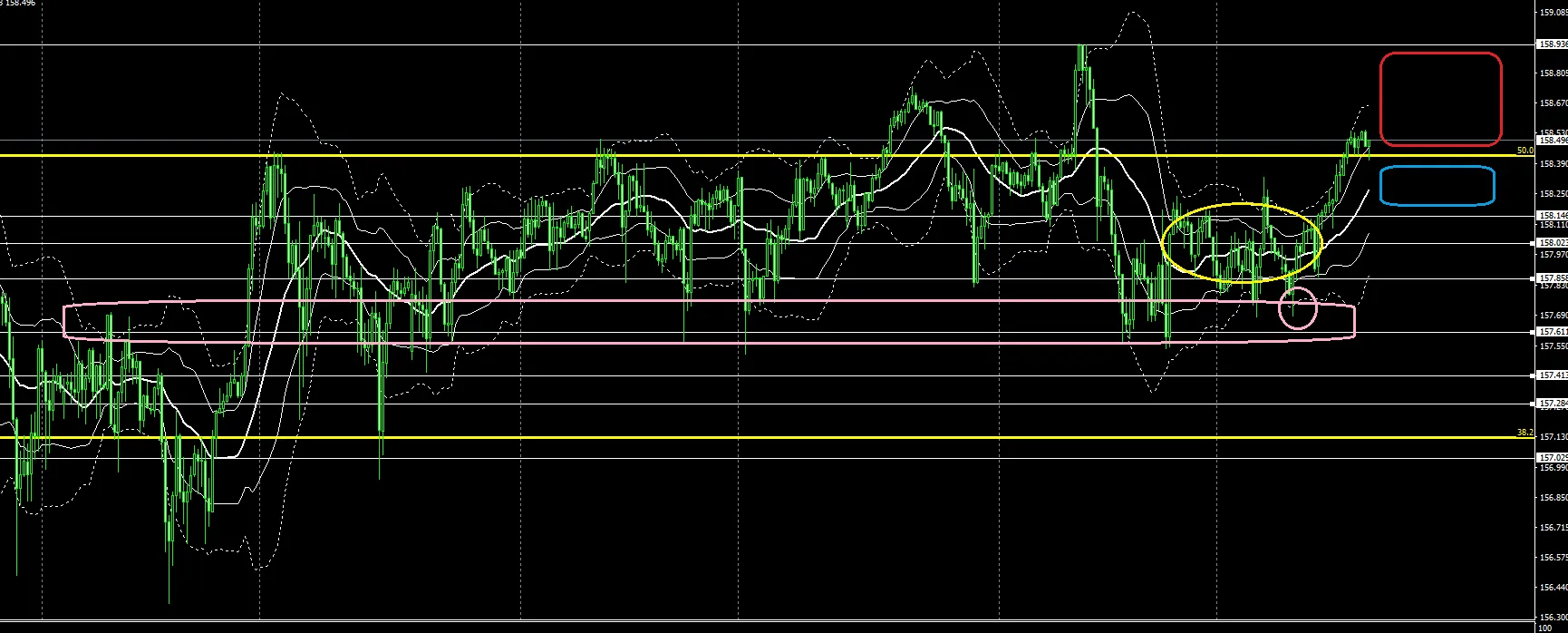
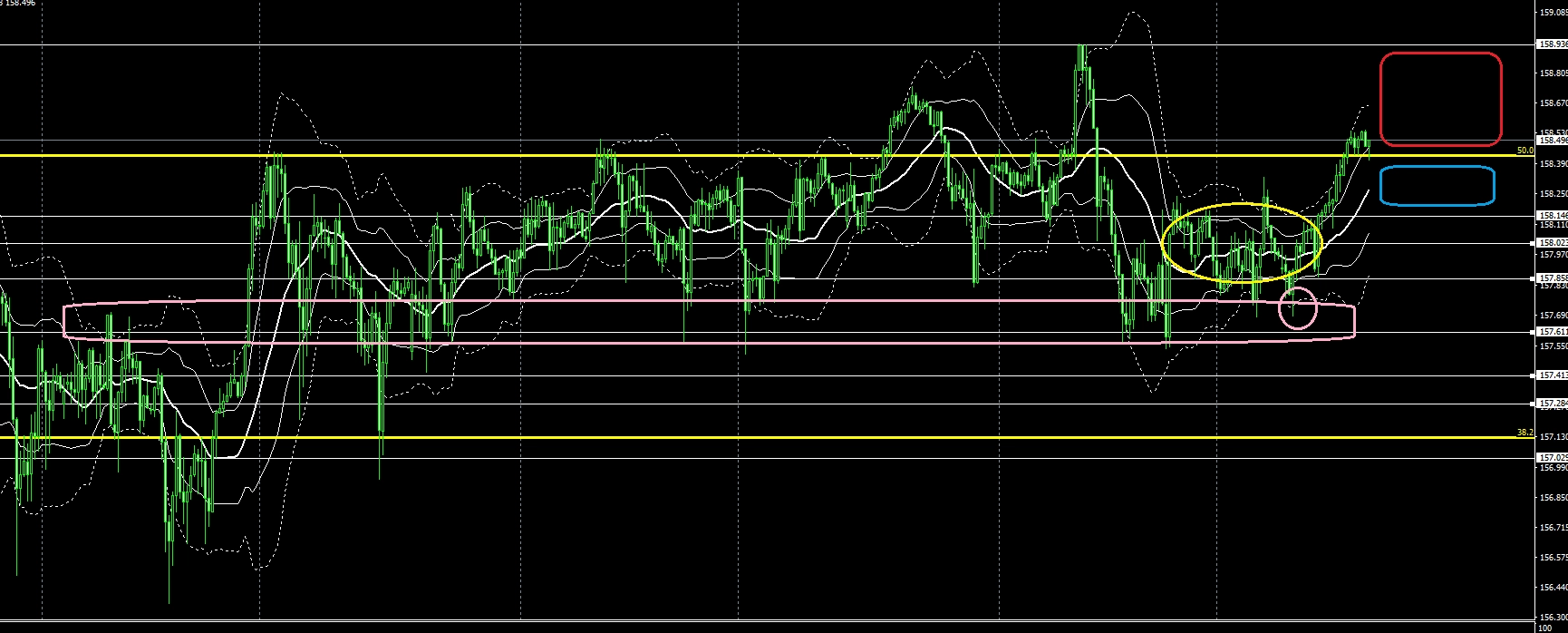
Yesterday’s low became the Tokyo-starter low indicated by the pink circle.
Where was that? It’s in the pink square zone.
As you can see, it’s also a historically watched support area.
Looking further back, it’s become a resistance ground.
In short, it’s a horizontal line with support/resistance switching.
Yesterday I was chasing the Tokyo-start drop on the 1-minute chart, waiting to buy up to 157611, and even if it didn’t reach 611, I imagined buying at the sideways lower wick and stopping for a 611 break.
I set this strategy because I wanted to capture the initial move, but if you follow the Billionaire Trader, you would buy on the pullback around 9:38 and exit if it falls below 15769.
Buying there has the merit of the “Tokyo fixing” so there’s an expectation of a rise.
As a result, the day rose from there.
In my feel, USD/JPY trading is roughly 70% long to 30% short.
If you narrow further, for those who trade after returning home, you can limit positions to long only.
In Billionaire Trader charts, this is trading to buy with a long signal from around 21:00 last night.
There are such moments every day, so after you get home, if it’s down, look for a buying opportunity with this stance.
Fewer options mean less confusion, and even failures can be data that’s properly recorded.
After all, it’s impossible to win every position, so losses and drawdowns are necessary as costs.
That is why winning trades have meaning and data becomes valuable.
“One’s own perspective and fixation”
I think it’s okay to share this with me.
Changing topic: the Nikkei Average.
Yesterday it was around 65,000 yen.
The index briefly touched 70,000 yen and then fell about 5,000 yen; comparing to the post-Lehman era where it fell from 7,000 to 5,000 yen, the Nikkei would be at 2,000 yen now.
Times are different, so the comparison is nonsensical, but as numbers, that’s how it would be.
It’s possible it will continue to fall, or it may hit 70,000 again.
In other words, it’s unpredictable.
I live near JR Shin-Okubo Station, and Kabukicho is a cosmopolitan district.
Every night, is this Japan?
That’s how it looks on TV as inbound tourism.
Recently, ward and Tokyo regulations have become stricter, but there are still many foreigners.
The DJ bars I frequent are full of foreigners.
I don’t drink much, but I love music, so I go there.
In conversations with Japanese staff, they say, “If foreigners disappear, the shop will close.” My favorite large DJ bar and club was aimed at Japanese customers, so it closed this year.
If foreigners don’t come, it closes.
Well, this isn’t limited to Kabukicho; when the Yen depreciation ends, restaurants and bars will struggle.
Considering rents are high, closures happen quickly.
Looking calmly at inbound tourism, it reminds me of Japan’s bubble era in the late Showa to early Heisei 1990s when Japanese rushed to travel abroad, bought Louis Vuitton and Chanel in Hawaii and Europe, and were buoyant.
I’ve been to Hawaii in those days; it was almost entirely Japanese.
But that later ended, and Japan has stagnated for about 30 years since then.
Looking at current Kabukicho, I worry another bubble could burst and repeat the same thing.
I can’t help but think so.
Well, people’s positions and environments differ, though.
But if that isn’t the case, it could be a big problem.
As you can see, long-term interest rates are rising.
If the yen strengthens further or becomes even weaker, inflation will intensify and prices will keep rising.
Money will become scarce.
Earlier I wrote about this: in Italy, buying a large bottle of Kikkoman soy sauce costs a little over 1,000 yen.
If you think Max Value prices, the total will shock you.
But this is the current global standard, so Japan too will...
Just thinking about it is frightening.
Even if the company’s performance doesn’t rise and stays flat or declines, employees’ salaries will not go up.
I feel a future where crime increases and Japan becomes hard to live in.
People with a lot of money are fine, but those who aren’t will face a rather harsh development.
To avoid that, many want to maintain some margin in FX trading as a common wish.
You don’t have to be greedy.
A daily profit of 5,000 yen compounds to 50,000 yen in 10 days.
That 50,000 yen is significant.
Since you’re not bound to a part-time job to earn, time itself has value.
Stay calm and not in a rush,
Today’s top reversal spot is what you should seek.
then, it’s even easier to “wait” and start with a small capital.
Increasing your 10,000 yen capital to 15,000 yen is easy.
Everyone tries to make a fortune and ends up failing.
Use your brain to face the market; if that isn’t your strength, buy a trading logic.
Then your “head” will be capable.
Whether you were good at studying in school or not doesn’t matter for trading.
Trading is simply about being good or bad at it.
Chopping cabbage with a knife becomes possible with practice; trading is the same feel.
Don’t overthink it; take positions where the expected value is highest.
That is the pattern.
Knowing where that high-expected-value moment is the key to trading success, I believe.
This cannot be learned from some indicator or some buy/sell signal.
The answer has been out there for a long time.
Thank you for your continued support today as well.
For traders who simply want to succeed in trading and be able to make a living from trading, I recommend my product—this is a trading technique that you can learn on your own: ↓
FX method revealed by verifying the trading history of top traders