From "Try selling this pen to me" to think about it

"Try selling me this pen"
A famous scene from the movie The Wolf of Wall Street.
A pen is offered,
"Try selling me this pen"
and he asks.
Most people start describing the pen.
Easy to write with.
Nice design.
Ink lasts long.
In other words, they try to explain the product's features.
But one of them was different.
Instead of explaining the pen,he offers a noteand says this.
"Write your name here."
"There is no pen."
So he offers the pen.
"Exactly. It’s about supply and demand."
What was described initially was not the pen's performance.
What was created first was a
"situation where a pen is needed."
That is what matters.
The key is not to list product features, but to understand what the other person needs.
Think from there.
So, what do traders truly need?
Do we also need an entry signal?
A more complex indicator?
A method with presumably higher win rate?
Of course, searching for those isn't inherently bad.
But when you look back at actual trades,
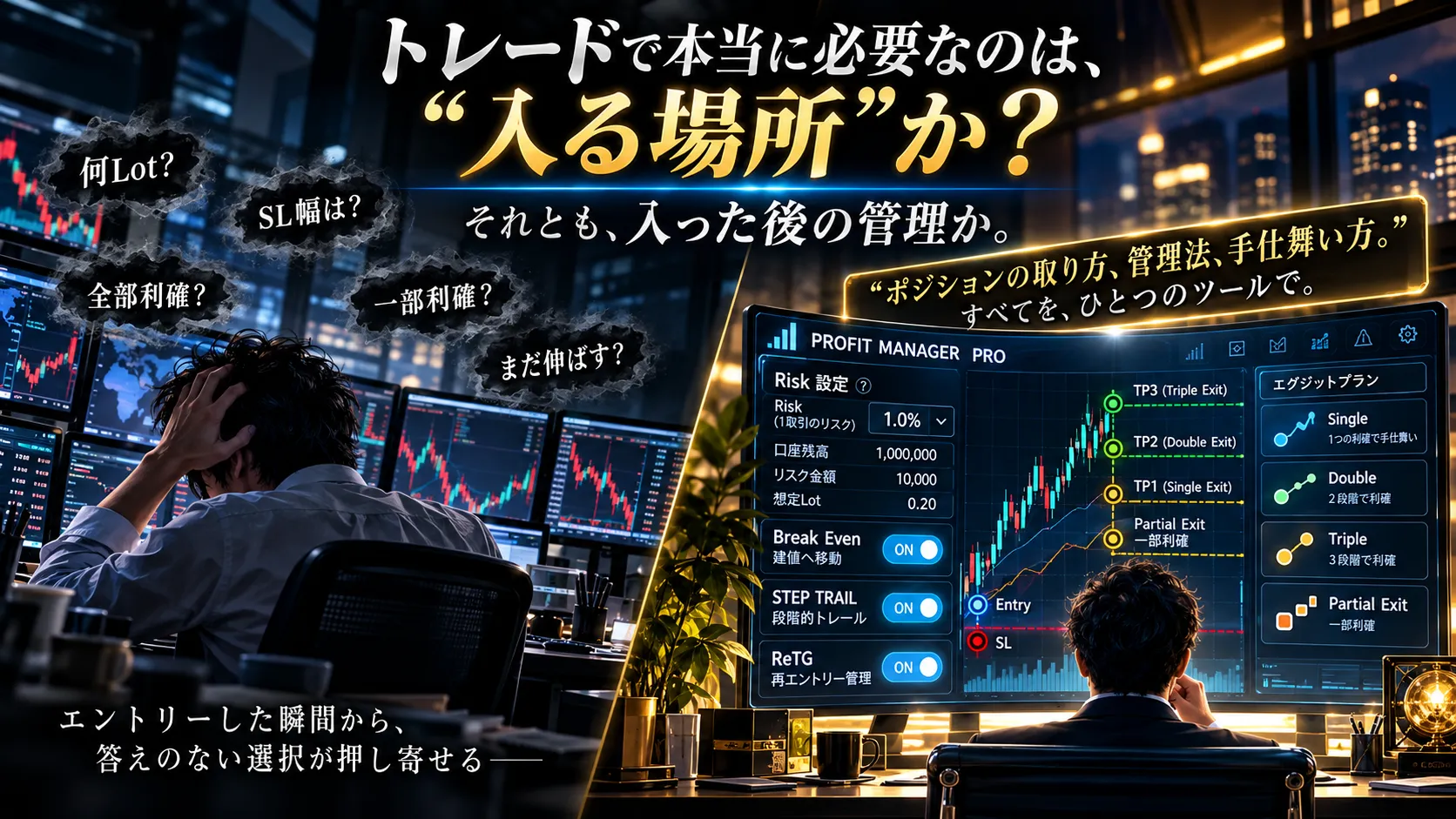
what wears you down the most and truly needs solving is
"the place to enter."
Or, "the stomach-churning stress after entering."
The entry point arrives.
The stop loss is set.
Then,
"With this SL width, what Lot should I enter with?"
Have you ever started calculating like that?
Or,
"It's always about this much, so I enter with the same Lot,"
but the distance to SL is wider than usual, and you only realize the loss was bigger than expected after you lose.
Conversely, the entry itself went well.
There was an unrealized profit.
Then again,
do I take all profits?
or take only part?
Should I let it ride further?
Move the SL to break-even?
How much profit should I protect?
After entry, there are still many decisions.
Trading is not only about the "place to enter."
A long-read among traders, titled Day Trading,
contains a passage like this.
--------------------------------------------------------------①How to take a position appropriately,
②How to manage a position appropriately,
and, of course,
③How to close a position appropriately is relied upon entirely.
--------------------------------------------------------------Reading these words, Profit Manager Pro’s philosophy feels very close to it.
What PMP aims for is
to let traders focus on the fundamental judgment of how to construct this trade.
How much risk to take on the position.
After entry, how to protect that position.
And finally, how to exit.
Entry is, of course, important.
However, a good entry alone does not complete a trade.
Profit Manager Pro
is not a tool that tells you to "buy here"
or to "sell here."
The trader decides where to enter.
Instead,
it helps from the moment you decide to enter until you close the position.
① How to take a position.
Even with the same 1 Lot,
if SL is 10 pips away versus 50 pips away,
the amount you lose is entirely different.
Yet,
you keep Lot constant.
Or,
you decide Lot based on the feeling of the moment.
This makes risk vary trade by trade.
PMP’s approach is different.
What is decided first is not the Lot.
"What percentage of capital to risk on this trade"
is what to decide.
For example, Risk 2%.
If you set the distance to SL, that distance and the chosen risk determine the appropriate Lot.
If SL is close, Lot becomes larger.
If SL is far, Lot becomes smaller.
In short,
Instead of fixing the Lot, base it on risk.
What traders should consider is
not "how many lots to enter," but
"how much can you lose in this trade."
.
② How to manage a position.
Entering is not the end of the job.
When the market moves favorably,
do you leave the initial SL in place to the end,
or reduce risk?
PMP includes
Break Even (BE)
.
After price moves a certain way, move the SL toward the entry price.
Furthermore,
STEP TRAIL
tracks the SL progressively as the price advances.
If the market seems to extend beyond expectations,
ReTG
allows you to reassess the target.
What’s important here is
not just "take profits now because there’s profit."
nor
"do nothing with the initial settings."
Either option is not the goal.
If you keep holding, how should you hold?③ How to close a position.
That too is part of trading.
③ How to close a position.
And finally comes the inevitable exit.
Here PMP’s
Single / Double / Triple
concept appears.
Single
Close in one target simply.
If there is no need to hesitate, this is fine.
Double
Secure a part and move the remainder to the next target.
Don’t close everything at once; separate the portion to secure from the portion to ride.
Triple
Divide the exit further,
securing profits in stages.
You don’t need to hit the ceiling in one shot.
If needed, you can also use partial exits, such as 25%, 30%, 50%,
to adjust position size along the way.
Markets differ each time, so exits don’t have to be one single method.
There are markets that surge vigorously,
some that move forward and then retrace a bit.
Even if there is unrealized profit, there are markets that wipe it all out.
Still,
is it necessary to always use the exact same exit method?
What PMP provides is not "this is the one correct exit."
Single。
Double。
Triple。
Break Even.
STEP TRAIL.
Partial exits.
ReTG.
As the market moves,
secure.
protect.
extend.
From there, allow traders to choose for themselves.
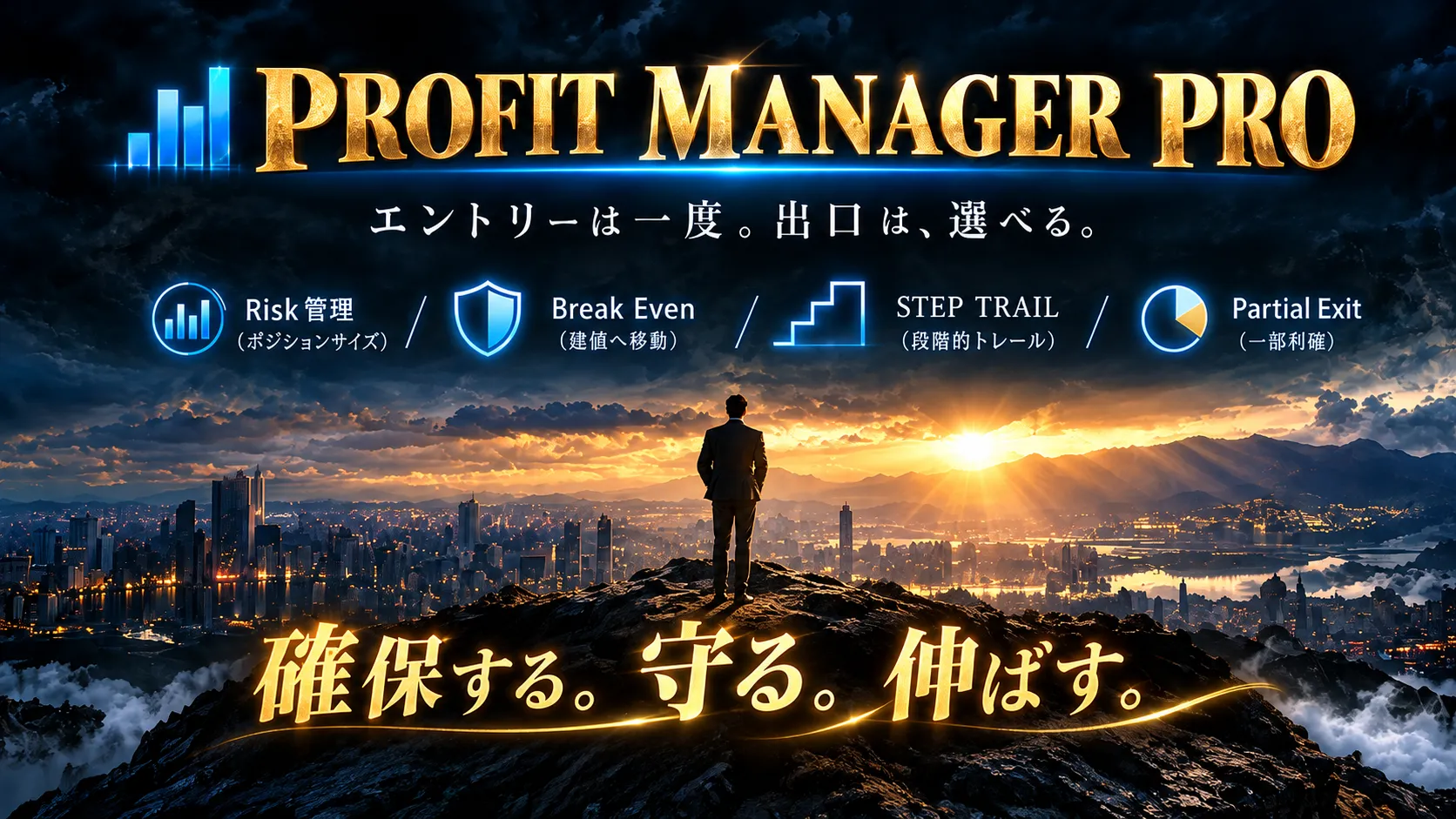
Entry once.
Exit selectable.
Profit Manager Pro is not
an EA that tells you where to win.
nor a tool that predicts future price movements.
A trader decides the entry themselves,
how much risk to carry that position with.
That position,
how to manage it.
And,
how to close it.
This is a tool to execute that as simply as possible.
Secure. Protect. Extend.
PROFIT MANAGER PRO v5.00
https://www.gogojungle.co.jp/tools/indicators/74511?via=users