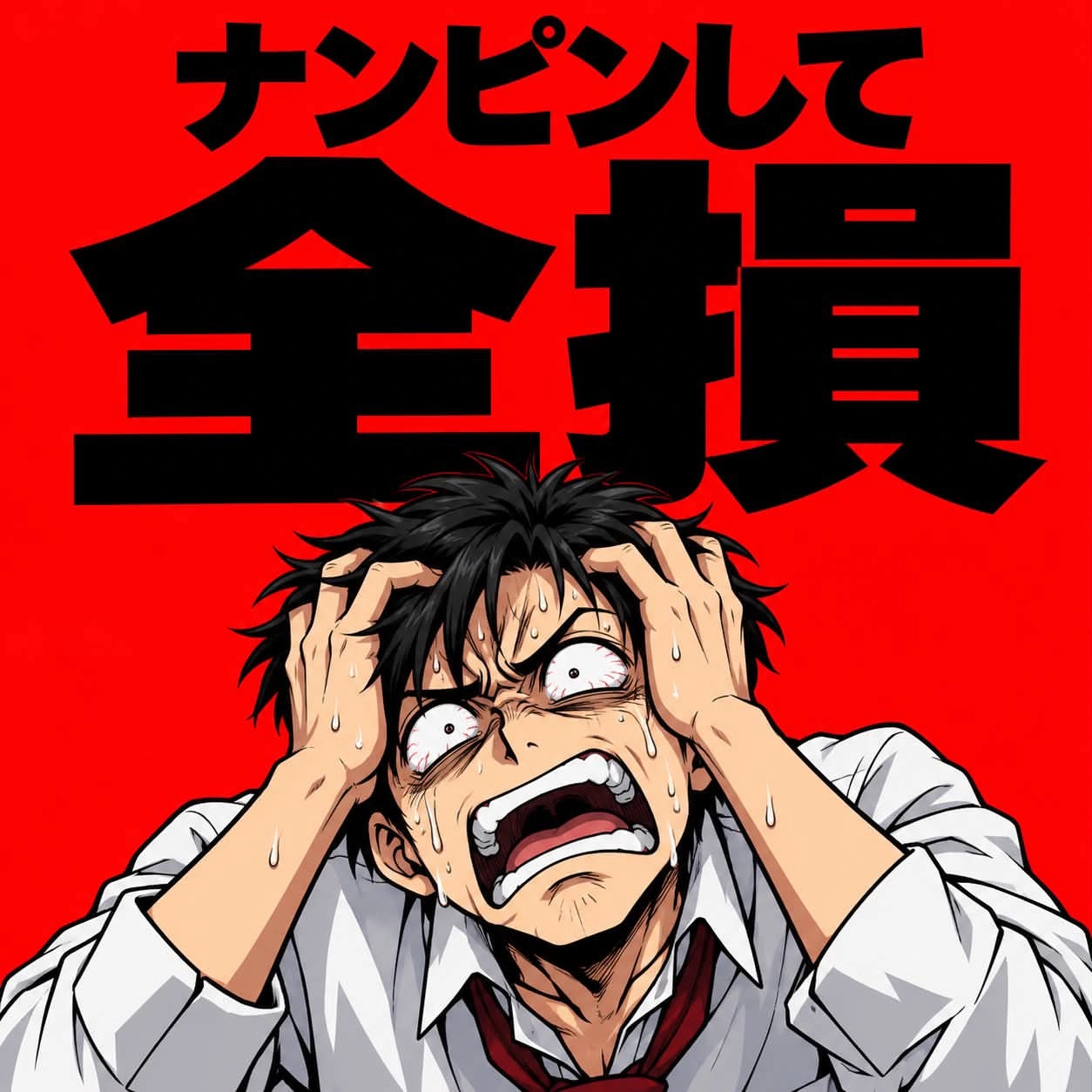
Ponied up and total loss. In trying to recover, I ended up losing everything.
At first, it was just a little retrograde.
“Well, this should come back from this level.”
With that in mind, I enter again.
And it retraces further.
“If I add here, the profit will increase when it returns.”
More averaging down.
Before I knew it, I was carrying a position far larger than the initial entry.
The unrealized loss continued to grow.
Even so, I couldn’t cut my losses.
“If I cut here, I’ll confirm a loss.”
“If I wait a little longer, it might come back.”
“Please come back to break-even at least…”
And yet, the market moved in the opposite direction, as if in mercy.
Maintenance margin dropped, and forced liquidation occurred.
My account balance was almost drained.
Haven’t you had a similar experience?
The fear of averaging down is that you can’t admit defeat.
I don’t want you to misunderstand, but averaging down itself isn’t bad in every situation.
There are strategies that set in advance the price or size to add, and the maximum loss, to manage risk.
The problem is, you end up adding positions after the fact, out of fear of mounting losses.
What started with a valid basis becomes a change in judgment as soon as the market moves against you.
The desire to “see it come back” takes precedence over the original reason for entry.
In situations where you should be considering retreat, you pour in more funds.
Repeating this can turn a single misjudgment into an irreversible loss.
And truly scary is the experience of narrowly avoiding ruin by luck and surviving.
“If you average down, you’ll be saved after all.”
Once you think that, you’ll repeat the same thing next time.
But no one knows when the market will recover.
Before it returns, you may run out of funds.
Why can’t you cut losses?
One reason is that you don’t want to lock in the loss.
If you cut, you admit your judgment was wrong.
Your money also decreases.
That’s why you can’t press the close/settle button.
But, please consider this.
Cutting losses does not negate all trades’ outcomes.
No matter how solid the basis, the market may not move as expected.
Therefore, before entering, you must decide “how far you will allow it to retrace before retreating.”
Cutting losses is a decision to protect capital and participate in the next opportunity.
It’s better to manage losses within a set range than bear a huge risk from a single loss.
That is essential thinking for sustaining trading over the long term.
Better to avoid a fatal blow than to win.
In FX, you don’t need to win every time.
There will be losses.
What matters is not losing too much capital when you lose.
If you lose most of your capital on one trade, it will be hard to recover even if better opportunities come later.
So, in trading, I want you to value not only where to enter but also the following:
- Decide where to cut losses before entering
- Determine position size from acceptable loss
- Don’t add emotionally just because the price moves against you
- Don’t take risks that exceed your preplanned limits
- Don’t engage in reckless trades trying to recover losses
And one more thing.
First, don’t enter at a place without a basis.
If the entry point remains vague, judgments become vague when the price moves against you.
What are you aiming for?
Why enter there?
Where do you determine the assumption has failed?
Thinking about these points before entry is essential.
Therefore, trade with a basis.
In my material, I build the foundation of “what to aim for” at the first level, and at the maximum level, I delve into the specific judgment of “where to enter.”
It’s not just about memorizing entry points; you will learn a way of thinking to judge for yourself while looking at actual charts.
Of course, studying the material doesn’t guarantee you win every trade.
Still, if you’re just entering vaguely, averaging down when it retraces, and finally facing forced liquidation,
If you’re repeating such trades, please pause and review your method.
For those who are currently suffering from averaging down repeatedly.
For those who can’t cut losses and feel anxious every time you carry an unrealized loss.
If you’re anxious about the material’s contents or what to learn from it, please send a message even before purchasing.
Before worrying alone further, start by reviewing your own trading.
So that a single loss does not end it. I want you to learn not only how to win but also how not to lose.
※ FX carries the risk of capital loss if the principal falls below, and losses can exceed deposited margin during rapid market changes. The material does not guarantee profits.