

[Start of the Week・Tokyo Market Total Check] Prime Minister Takaichi: "Issuing government bonds will not be ruled out as a source of funds for tax cuts," yet the yen falls to a standalone weakness—US 10-year yield falls to 5.06% vs GDP upgrade in China; c
On the evening of October 19, 2026 (Monday), the Tokyo foreign exchange market at the start of the week kicked off with a volatile tone, beginning from a “strong domestic factor” that broke the weekend stalemate.
In the Tokyo market, the USD/JPY pair moved from around 157.70 yen in the morning and gradually rose, brieflyto around 158.09–158.13 yenbefore climbing further. Despite the decline in the U.S. 10-year Treasury yield since last week (briefly5.05–5.06% range), the dollar was not deterred and the 158-yen level was reclaimed.
What underpins this is not a surge in the dollar alone. It is the result of: concerns about fiscal deterioration following Prime Minister Takai’s statements on issuing more government bonds to fund a consumption tax cut, and the cross-yen led rise in the yen’s weakness driven by China’s stronger-than-expected economic indicators.This combination pushed the market by force, resulting in a broad weakening of the yen.
Meanwhile, in the commodity markets, crude oil retreated from about $100 for WTI and around $108 for Brent due to expectations of Russia energy sanctions relief and peace hopes associated with President Trump’s actions. Inflation concerns eased, and U.S. stock futures rebounded; however, in the Middle East, there were reports of tanker mine incidents in the Hormuz Strait, indicating that risk remains flaring beneath the surface.
“Why is the USD/JPY being bought past 158 yen when U.S. rates are falling to 5.06%?”
“Will Prime Minister Takai’s tax cut and bond issuance remarks decide the downtrend in the yen?”
“For tonight’s European and American markets, how far can USD/JPY push higher from the 158.13 high?”
We will dissect in detail today’s five major important factors and the asymmetric power relations by currency.
Chapter 1: What ruled the Tokyo market today
The “Five Major Macro Factors”
The core factors that form the price at this evening of October 19.
【Major indicators and factors as of the evening of October 19, 2026】
・USD/JPY :
around 158.05–158.13 yen (yen weakness led by cross-yen, recovering to the 158 level)
・U.S. 10-year yield :
5.05–5.06% (continues to ease on the back of crude oil retreat)
・DXY (Dollar Index): around 101.8 (support from euro weakness vs tug-of-war with U.S. rates)
・WTI crude oil futures :
around $100 per barrel (decline due to expectations of easing Russia sanctions)
・China Q3–Q3 GDP:
+4.5% year-on-year (beat expectations; retail and industry strong)
・Domestic political factor:
Prime Minister Takai’s remark: “Issuing bonds as fiscal funding for consumption tax cuts cannot be ruled out”
① Most important: Prime Minister Takai does not rule out issuing bonds as funding for tax cuts
The Prime Minister stated that for the planned two-year consumption tax cut from April 2027 (including lowering the reduced tax rate on groceries), if necessary, “financing through government bond issuance is not excluded as an option.”
While the debt-to-GDP ratio target remains, the market immediately associates with potential future bond issuance and lax fiscal discipline. Incorporating fiscal deterioration risks, a “yen selling (dollar selling)” switch is triggered.
② U.S. 10-year yield moves further toward 5.06%
From last week’s 5.10% to around 5.05–5.06%, while U.S. 2-year yields softened. The easing of inflationary fears due to lower oil prices and safe-haven demand after last week’s tech stock declines support Treasuries. By textbook logic this should be a “dollar bearish” factor, but currently the yen’s depreciation pressure prevails.
③ China’s major stats beat market expectations
Morning Chinese data surprised, rebutting the pessimistic view.
China Q3 GDP:YoY+4.5%(above market expectations)
China September retail sales:YoY+1.1%
China September industrial production:YoY+5.5%
With China’s economy showing resilience as the largest trading partner, commodity currencies like the Australian dollar surged, lifting cross-yen broadly.
④ U.S. easing of sanctions on Russian energy and the oil $100 battle
Trump’s consideration of easing sanctions and tariffs on Russian energy, along with hopes for peace in Ukraine, pushed WTI to around $100 and Brent to around $108. Inflation fears eased, and U.S. stock futures (e.g., NASDAQ futures +1.3%) rebounded.
⑤ Commentary by Bank of Japan Governor Ueda: Core price trends and long-term rates
Governor Ueda noted that core inflation is gradually rising and approaching 2%, re-evaluating wage-price positive cycles. However, on how to respond when long-term rates rise sharply, he said that ahead of time signaling timing or specific measures is not appropriate, and thus it did not provide the market the immediate tightening signal that would curb yen selling.
Chapter 2: Domestic Japan —“Fiscal deterioration and yen depreciation”
and “Bank of Japan rate hikes and yen appreciation” clash
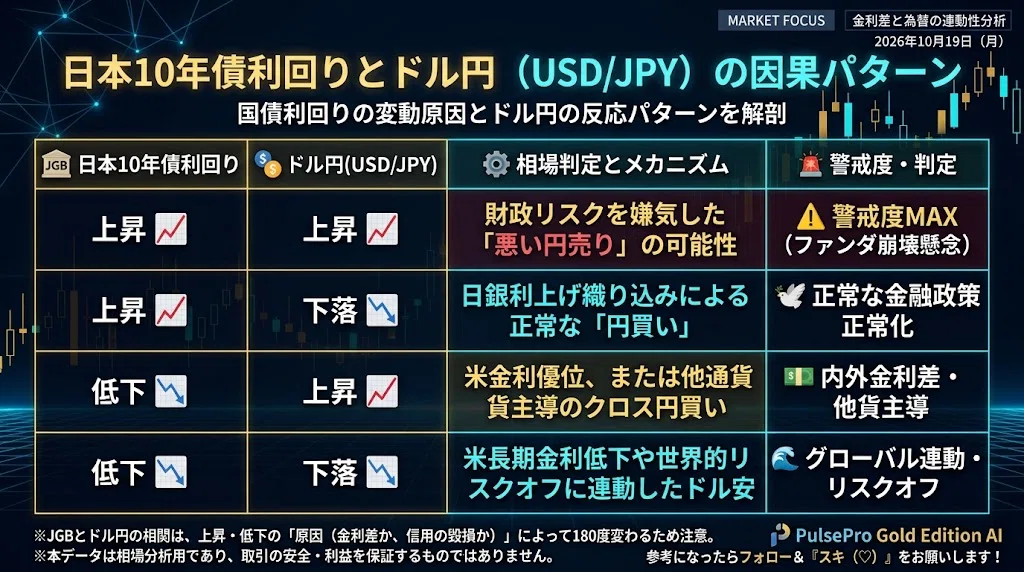
The most decisive element for interpreting today’s market is the two-faced nature of rising Japanese long-term rates.
【Two possible forks caused by rising Japanese government bond yields】
Pattern A:
BOJ rate hike expectations → monetary tightening and narrowing U.S.-Japan rate gap →
【yen buying and USD/JPY falling】
Pattern B:
Fiscal discipline loosening and debt issuance concerns causing rising yields (current worry) → sharp drop in bond prices and loss of fiscal confidence → bad rate hikes → 【yen selling and USD/JPY rising】
Prime Minister Takai’s tax cut remarks carry a positive side for the economy, but for the bond market they directly threaten the risk of worsening supply-demand for government bonds.
Today, the BOJ government bond futures held firm against a stock market decline, so a crash was avoided; but if debt issuance concerns intensify and rates rise, the risk of entering a phase where the yen is sold despite higher rates—“Japan sell-off”—emerges. From tonight onward, please compare Japan's long-term rates and USD/JPY using the following matrix.
Chapter 3: U.S. markets — U.S. rates at about 5.05% and
“AI earnings week” caution
The U.S. market remains nervously tugging ahead of this week’s earnings announcements.
1. The true cause of lower U.S. long-term rates
The decline of the U.S. 10-year yield to 5.05–5.06% is primarily due to the retreat in inflation expectations following crude oil futures retreat. Yet, the U.S. real economy (September retail sales and industrial production) has not slowed, and inflation remains sticky.
This is not a “recession-driven rate cut” but a temporary relief from an oil price drop; thus, a scenario where U.S. rates uniformly fall to the 4% range should be approached with caution.
2. This week’s tech earnings and AI bubble verification
Asian time, Asia-Pacific stocks (Japanese stocks, semiconductors) weakened due to concerns about monetizing huge AI investments.
This week features major results from Meta, Tesla, Netflix, and more. If market disappointment over capex burdens grows, the domino effect of “global stock decline → safe assets (U.S. Treasuries) buying → U.S. rates lower → USD/JPY down” could recur, echoing late last week.
Chapter 4: Geopolitical risk — Even with oil retreat
The undiminished risk in the Hormuz
Be mindful that the surface commodity market figures can diverge from the physical risk on the ground.
【Dual nature of energy markets】
・Downside factors (current):
With Trump’s stance on easing sanctions on Russia and hopes for Ukraine peace, WTI around $100 and Brent around $108 have retreated.
・Undersurface supply disruption factors (under the surface):
Iranian Revolutionary Guard announced that a tanker in the southern Persian Gulf hit a mine and caught fire. Increases in marine insurance costs, avoidance of shipping, and transport delays continue.
Even though futures prices fell temporarily, the Middle East supply crisis is not resolved. If further reports of tanker damage or breakdown in negotiations with Iran emerge, crude could spike back to the $110s in an instant.
Chapter 5: Major Currency Pairs
(Dollar-street and Cross-Yen) Power Structure
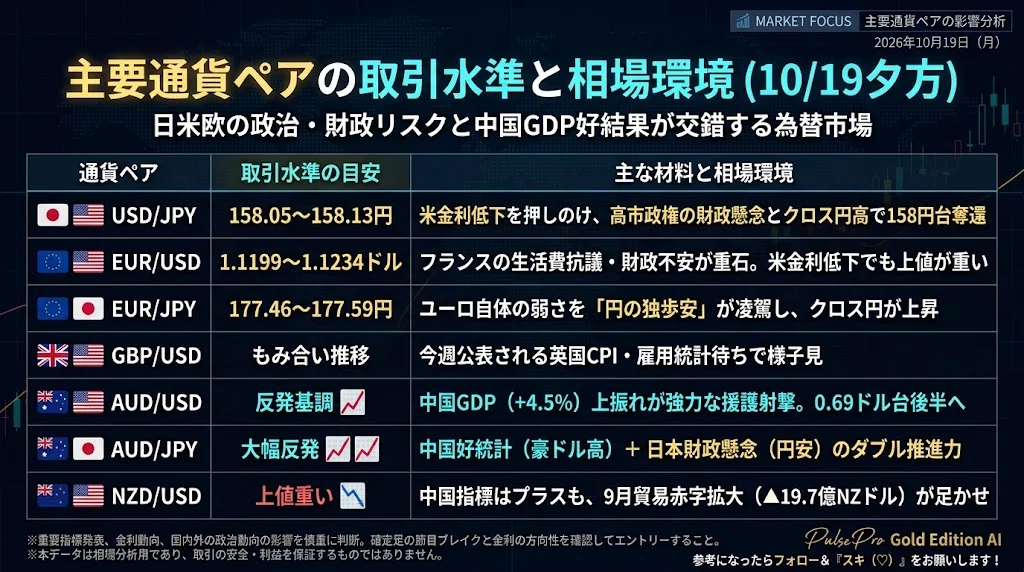
Based on confirmed price action during Tokyo time, we clarify the relative strength of each currency pair.
AUD’s standout strength and cross-yen leadership
Today's clear leader was certainly the Australian dollar.
The prior week’s employment shock (−3.93 million) was fully erased by China’s major statistics (GDP +4.5%, industrial +5.5%), driving a rebound in AUD/USD and the yen’s broad weakness, which together pulled USD/JPY into the 158 range—this was the primary driver.AUD/JPY vertical reboundthat pulled USD/JPY into the 158 handle.
Chapter 6: Tonight (10/19) to midweek — Focused Schedule
Schedule to Watch
Tonight’s focus will be European politics and U.S. housing data.
【Important schedules tonight and going forward (Japan time)】
・10/19 (Mon) Europe time:
?? France protests intensify; fiscal concerns
(Reaction of the euro and European sovereign yields)
21:30 ?? Canada September CPI
23:00 ?? U.S. October NAHB housing market index
・10/20 (Tue):
10:00 ?? China 1-year and 5-year Loan Prime Rate (LPR)
15:00 ?? U.K. September unemployment rate and employment data
21:30 ?? U.S. September housing starts and building permits
・10/21 (Wed):
08:50 ?? Japan September trade statistics (extent of trade deficit due to high oil prices)
09:00 approx ?? Hausr RBA Deputy Governor speech
15:00 ?? U.K. September CPI
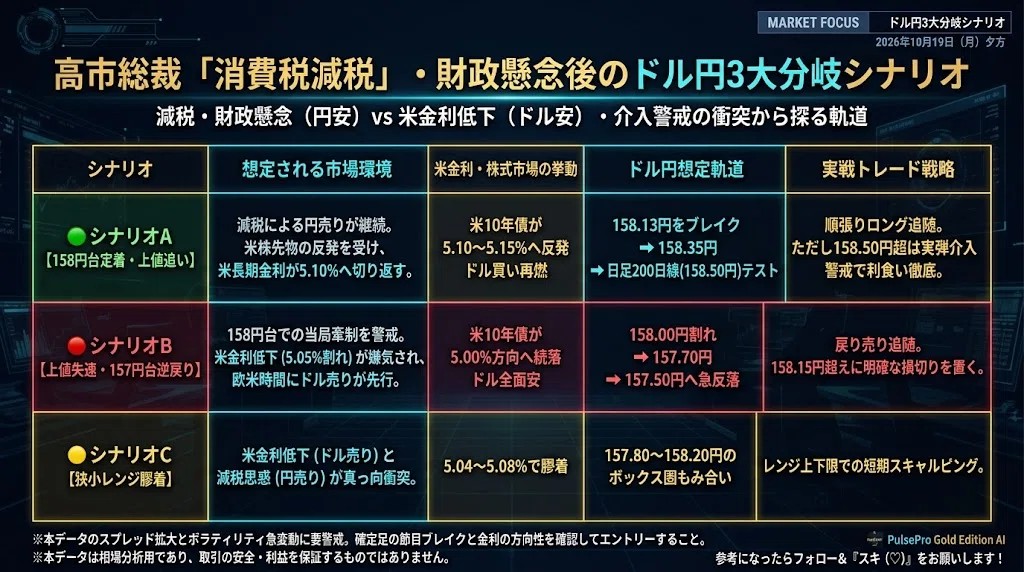
Chapter 7: Tonight’s USD/JPY — Three Practical Divergence Scenarios
Practical trading scenarios for Europe to New York time.
Chapter 8: Practical Chart Analysis and “Defense Lines”
Technical checkpoints to monitor during trade execution.
【Upper Resistance Levels】
160.00 yen: Psychological absolute defense line (maximum alert for FX intervention) ↑
★ 158.50–158.55 yen: 200-day moving average on the daily chart & structural ironclad resistance
↑ 158.30–158.36 yen: previous week high zone ↑
★ 158.10–158.15 yen: today’s Tokyo high & rebound consolidation threshold
――――――
Current value: around 158.05–158.13 yen (in a high-range range)
――――――
【Lower Support Levels】
★ 157.70–157.80 yen: today’s Tokyo low range; support line
★ 157.50–157.52 yen: recent structural defense line (Friday’s sharp drop low)
157.00 yen: milestone line ↓
★ 156.93–156.95 yen: [low of Oct 2 U.S. employment data shock]
Summary: Tonight’s trading mindset
The key to surviving tonight’s market isto abandon the simplistic thinking of “short USD/JPY because U.S. rates are falling.”.
The leadership today lies not with the “U.S. dollar” but with the weakness of the yen triggered by fiscal concerns.
Confirming the high today (158.13) as a stable high:When London and New York players participate, will they push the price down from this high, or will it break through to target 158.35–158.50?
U.S. 10-year yield’s rebound power:Whether it can rebound from the 5.05% range. If U.S. rates turn around, the upside momentum for USD/JPY will gain traction.
Warnings from Finance Minister Katayama and domestic authorities:If 158 yen starts to stabilize, will their rhetoric become even more aggressive?
While respecting the selling pressure on the yen, stay aware of the daily 200-day moving average around 158.50 and the intervention alert line, and practice disciplined trading with strict profit-taking and stop-loss rules.
If this was at all helpful, a follow and a click on the heart icon at the bottom of the screen would be greatly encouraging for updates!

TrendPulse Pro free trial:https://www.gogojungle.co.jp/tools/indicators/86532?via=users
TrendPulse Pro AI free trial:https://www.gogojungle.co.jp/tools/indicators/86529?via=users
QuickScalp AI free trial:https://www.gogojungle.co.jp/tools/indicators/86523?via=users

An independent indicator that removes emotion and captures the market with clear reasoning and rules.
Function details and design logic are published on each product page
? [GogoJungle product page]