

[Weekly Market Outlook] The difficulty of resuming talks with Iran over the Hormuz Strait and the mystery of falling U.S. rates vs the realistic possibility of Bank of Japan December rate hike — China GDP, global PMIs, and Japan CPI guiding the dollar-yen
On the night of October 18, 2026 (Sunday), the foreign exchange market is poised to open a new trading week (October 19–23) amid a tense atmosphere.
Last week, the USD/JPY fell victim to a selloff in U.S. Treasuries driven by AI-related stock jitters, despite a strong upside surprise in the U.S. September CPI (year over year of 3.7%) and the U.S. September PPI (month over month +1.3%),around 157.90–158.00 yenas the week closed.
Over the weekend, headlines that shake the market continued: a US–Iran standoff over reopening conditions for the Strait of Hormuz, up to a 60-day delay in Trump’s decision on Russia sanctions, and domestic support fluctuations for the Takashi Cabinet in Japan.
Next week’s market focus is clear.
“Will long-term U.S. interest rates rise again and push the dollar higher?”
“How far will the Hormuz oil crisis press inflation and the global economy?”
“With Japan’s nationwide CPI due on October 23, how much will the Bank of Japan’s December rate hike expectations and actual currency intervention deterrence push the yen higher?”
We will integrate the dynamics of FX, government bonds, equities, commodities, and cryptocurrencies and provide a detailed week-ahead trading scenario.
Chapter 1: What Was Revealed Over the Weekend
“Four Major Important News items” and Their Market Impact
We will整理 the factual basis of the weekend’s material and the transmission channels to Monday’s markets.
① Middle East Situation: Iran’s “about 6 days to reopen Hormuz” proposal and U.S. stalemate
On October 18, Iran’s Foreign Minister Araghchi reiterated a proposal that if the United States accepts conditions such as “lifting the naval blockade on Iran,” “lifting oil sanctions,” and “a ceasefire agreement,” the Strait of Hormuz could be reopened in about six days. However, talks with the U.S. premised on nuclear restraint have remained deadlocked on condition details, and the physical traffic through the strait remains drastically reduced.
Market impact:
If diplomatic concessions progress, crude may plummet and inflation concerns retreat, shifting toward risk-on (rising equities, lower U.S. yields). However, if talks break down or attacks on tankers and ships around the strait escalate, crude could surge above $110, reviving stagnation fears and accelerating safe-haven dollar buying and equities weakness.
② United States: Decision on Russia-related sanctions “postponed up to 60 days”
President Trump decided to set a maximum 60-day review period for sanctions and tariffs related to energy from Russia. The aim is to avoid further fueling global energy price spikes from Middle East tensions and to ease the inflation burden on the United States and its allies.
Market impact:
The temporary easing of a sudden disruption in supply of Russian diesel and crude acts as a mitigating factor that helps cap energy price surges. However, the physical bottleneck in Hormuz is not resolved, so there is limited room for crude to fall.
③ United States: Even strong inflation data won’t sustain a dollar rally—a “currency yield curve twist”
Last week’s inflation readings (CPI and PPI) showed renewed inflation, yet the dollar index (DXY) fell back to the 101.8 area due to dovish hints from Federal Reserve officials and safe-haven bidding into U.S. Treasuries amid AI credit risk concerns.
Market impact:
The simple “strong inflation means dollar buy” narrative is breaking down. Next week, it will be crucial whether U.S. 10-year yields return to around 5.20% or continue declining toward 5.00%, which will determine the dollar’s direction.
④ Japan: Support for the Takashi Cabinet falls to 49.1%
In a latest Kyodo News poll, support for the Takashi administration fell below 50% for the first time since taking office, recording 49.1%. It is reported that delays in responding to the resignation of the agriculture minister contributed to this decline.
Market impact:
Political instability could affect economic policy, supplementary budgets, and tax-reduction plans. However, direct FX impact is limited, with market attention turning to “Finance Minister Katayama’s FX intervention warnings” and “BOJ policy normalization pace.”
Chapter 2: The Mechanics of FX and Interest Rate Markets—
Three Major Vectors Surrounding USD/JPY
Next week’s USD/JPY starts with three vectors fighting for dominance in a complex balance.
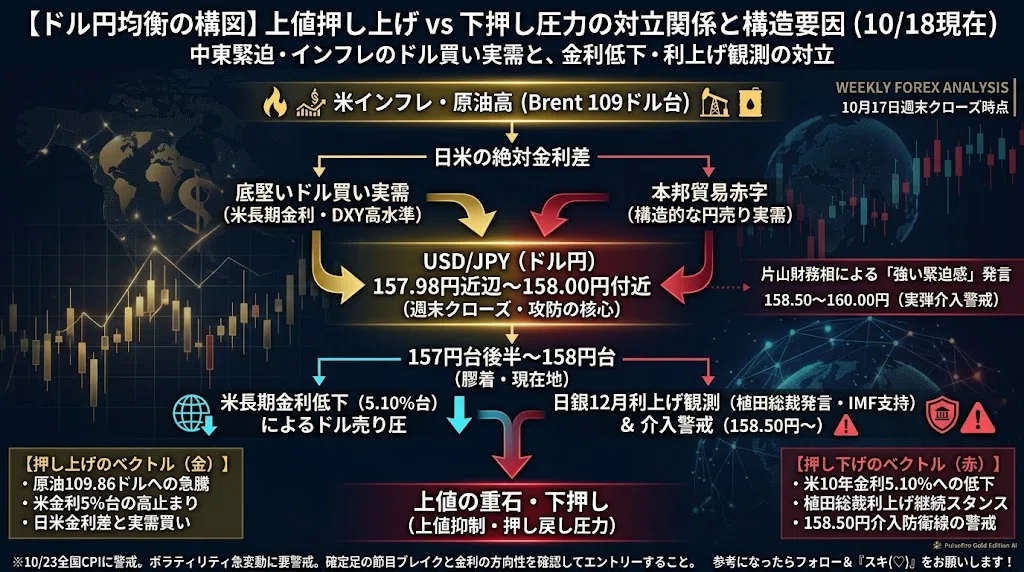
Last Friday, the U.S. 10-year yield briefly fell toaround 5.10–5.12%.
With long-term U.S. yields falling, the USD/JPY staying in the 158 area is supported by a) Japan’s current account deficit driven by higher crude oil prices (dollar selling by importers) and b) the still sizable 4%+ yield gap between Japan and the U.S.
However, if U.S. yields clearly dip below 5.10% and domestic drivers (BOJ rate hike expectations and possible intervene) intensify, there is a risk of breaking through the mid-157s and accelerating a corrective drop.
Chapter 3: The BOJ and Yen Market Core—
Reality of October 23 “Nationwide CPI” and December Rate Hike
Last week, BoJ Governor Ueda reaffirmed the stance to continue raising rates to reach the price stability target, and IMF officials also urged “if inflation overshoots, accelerated rate hikes are necessary.”
Domestic Checkpoints That May Affect the Yen
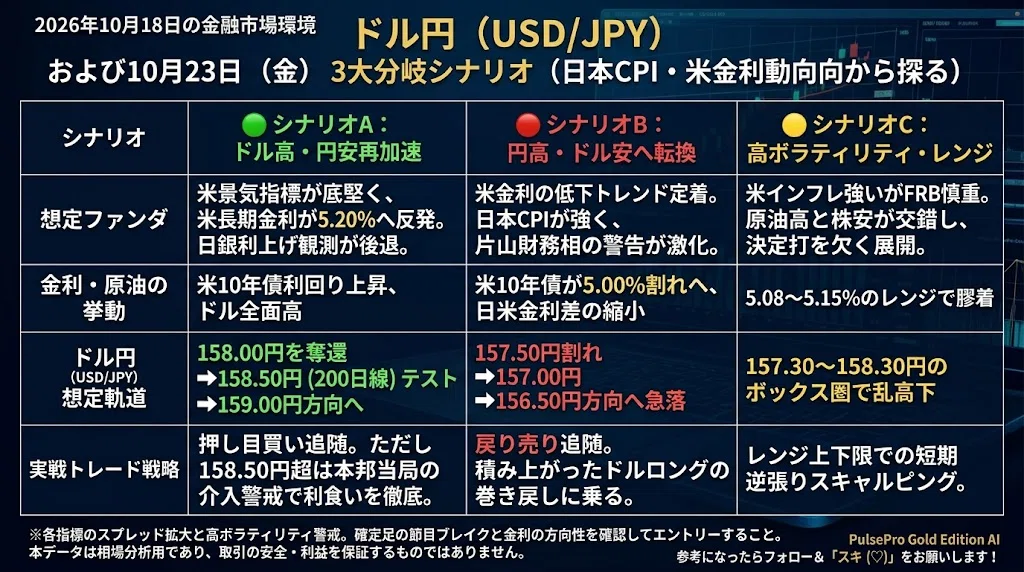
① 10/23 (Fri) Release: Japan’s September nationwide CPI (core excluding fresh food) ➔ Market expectation: year-over-year around +2.1% (Tokyo core indices ahead at +2.7%), beating expectations would dramatically raise the market’s probability of a December rate hike.
② Katayama Finance Minister and Government FX stance: ➔ At the G20, adopt a tougher posture with verbal warnings. ➔ Risk of actual intervention when the USD/JPY spikes into the high 158 to 159 area.
Three Key Scenarios for USD/JPY
Chapter 4: Cross-Yen and Dollar-Weakness Dynamics
Key upcoming catalysts and decision criteria for major currency pairs in the coming week.
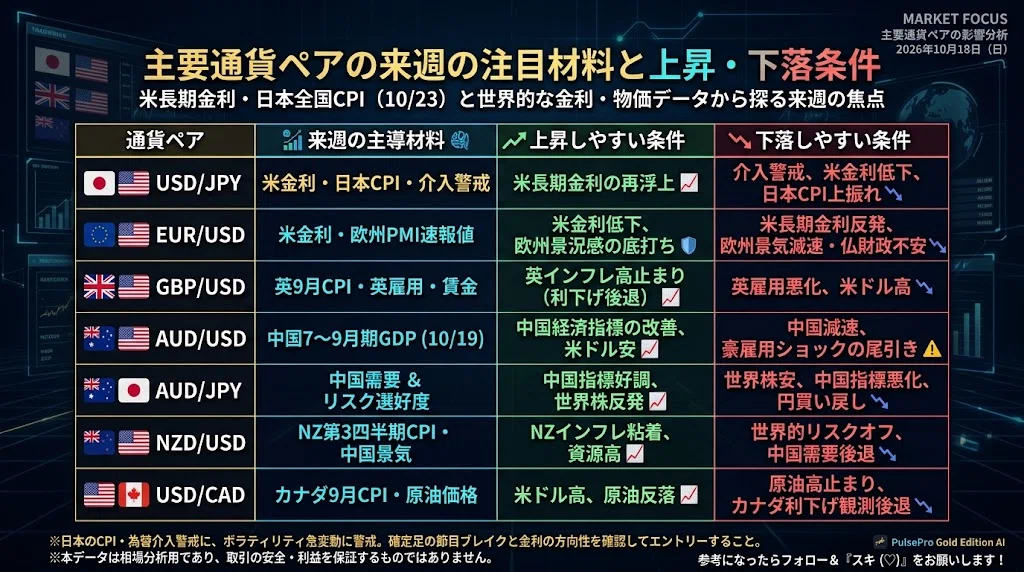
Australian Dollar (AUD): Determining Three Barriers to Authentic Rebound
Late last week, the AUD rebounded from a sharp decline driven by a drop in payrolls of 39,300 due to negative data. To deem a medium- to long-term trend reversal, we must confirm the following three points.
Are AUD/USD and AUD/JPY rising together?A rise in AUD/JPY alone is likely to be a misperception of yen weakness.
Will China’s Monday morning GDP and retail sales surpass expectations (GDP YoY 4.4%)?A recovery in Chinese demand, the largest trading partner, is essential.
Can price retreat through the 0.6978–0.6989 support band and hold on pullbacks?If not, selling rallies will resume.
Emerging Market Currencies (MXN/JPY, TRY/JPY, ZAR/JPY)
In a environment of persistent oil price rises due to Middle East tensions and high U.S. rates, capital outflows from EMs remain a risk.
MXN/JPY: If U.S. stocks stabilize, you may see some yield pickup and a solid floor, but be wary of a sharp drop in risk-off scenarios.
TRY/JPY: High-yield swaps exist, but rising Turkish energy import deficits and currency depreciation pressures will need to be weighed.
ZAR/JPY: Close attention to Chinese growth and commodity prices, and capital outflows during global stock market declines.
Chapter 5: Oil, Gold, U.S. Stocks, and Bitcoin Correlations
Correlation Analysis
Cross-asset trends in other markets serve as a leading indicator for forex markets.
Oil (Brent around $109):Negotiations to reopen Hormuz are faltering, and the physical supply risk supports the downside floor. If oil breaks through $110, global stagflation fears will intensify and weigh on equities.
Gold (XAU/USD around $4,167):Safe-haven demand amid Middle East tensions, combined with falling U.S. long rates and a weaker dollar, supports higher prices. However, if U.S. real yields rise again, downside risk should be monitored.
U.S. equities and AI-related stocks:With concerns about monetization of massive AI data-center spending, semiconductor stocks (SOX) have faced sharp corrections. A global stock decline could spur Treasuries buying (yields fall) and a return to yen buying.
Bitcoin (BTC around $83,000):In times of high rates and stock weakness, risk assets tend to be sold, yet Bitcoin is also seen as an inflation hedge by some. Monitor flows into NASDAQ and spot ETFs.
Chapter 6: Next Week (Oct 19–24) Important Economic Indicators and Events
Overview of Key Economic Indicators and Events
From the start of the week through the end, an unmissable set of important schedules awaits.
【Important Schedule Next Week (Japan Time)】
・10/19 (Mon)
Around 11:00: China Q3-Q4 GDP (YoY +4.4% expected) ★★★★
Around 11:00: China September Retail Sales and Industrial Production
21:30: Canada September CPI
・10/20 (Tue):
10:00: China 1-year and 5-year Loan Prime Rate (LPR)
15:00: UK September Unemployment Rate and Employment
18:00: Germany September PPI / Eurozone October ZEW Sentiment
21:30: U.S. September Housing Starts and Building Permits
・10/21 (Wed):
08:50: Japan September Trade Statistics (extent of trade deficit due to higher oil prices)
09:00 approximately: Hawser RBA Deputy Governor speaks
06:45: New Zealand Q3 CPI
15:00: UK September CPI ★★★★
・10/22 (Thu):
07:00: Australia October PMI flash
21:30: U.S. Initial Jobless Claims (TBD)
Korea Bank and Turkish Central Bank Monetary Policy Meetings
・10/23 (Fri):
???【This Week’s Biggest Event】
08:30: Japan September Nationwide Consumer Price Index (CPI)
(Market expectation: Core YoY around +2.1%)
16:30–: Euro area and Germany October PMI flash
17:30: UK September Retail Sales
22:45: U.S. October PMI Flash (Manufacturing & Services)
Summary: Surviving Next Week’s Markets
“Priority in Active Monitoring”
The most important thing for next week’s trading is not to reflexively react to headlines, but to verify whether market rates, currencies, and crude oil are moving in the same direction together.
【Priority in Active Monitoring】
1. Middle East tensions and oil (Brent around $109):
Whether there is progress in reopening negotiations at Hormuz, or whether supply disruptions persist for longer.
2. U.S. 10-year yield (around 5.10%):
Whether the decline accelerates toward 5.00%, or rebounds toward 5.20% due to renewed inflation concerns.
3. Japan’s September nationwide CPI (October 23) and intervention risk:
Whether price overshoot prompts the Bank of Japan to price in a December rate hike, triggering yen buying.
4. China’s Q3 GDP (Oct 19) and AUD:
Whether China’s economy stabilizes, enabling AUD to fend off selling pressure on rallies.
5. October PMI Flash for world economies (Oct 23):
To what extent do high rates and high energy suppress the real economy globally.
From Monday morning China GDP to Friday morning Japan CPI, in scenarios where risk-reward isn’t favorable, refrain from entries and execute disciplined trades after confirming actual figures and trend direction.
If this was at all helpful, a follow and the “Like (♡)” button at the bottom of the screen would be greatly appreciated for updates!

TrendPulse Pro free trial:https://www.gogojungle.co.jp/tools/indicators/86532?via=users
TrendPulse Pro AI free trial:https://www.gogojungle.co.jp/tools/indicators/86529?via=users
QuickScalp AI free trial:https://www.gogojungle.co.jp/tools/indicators/86523?via=users

An independent indicator that eliminates emotion and captures the market with clear fundamentals and rules.
Details of features and design logic are published on each product page
? [GogoJungle Product Page]