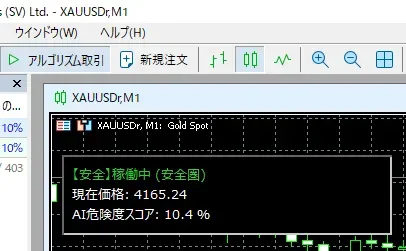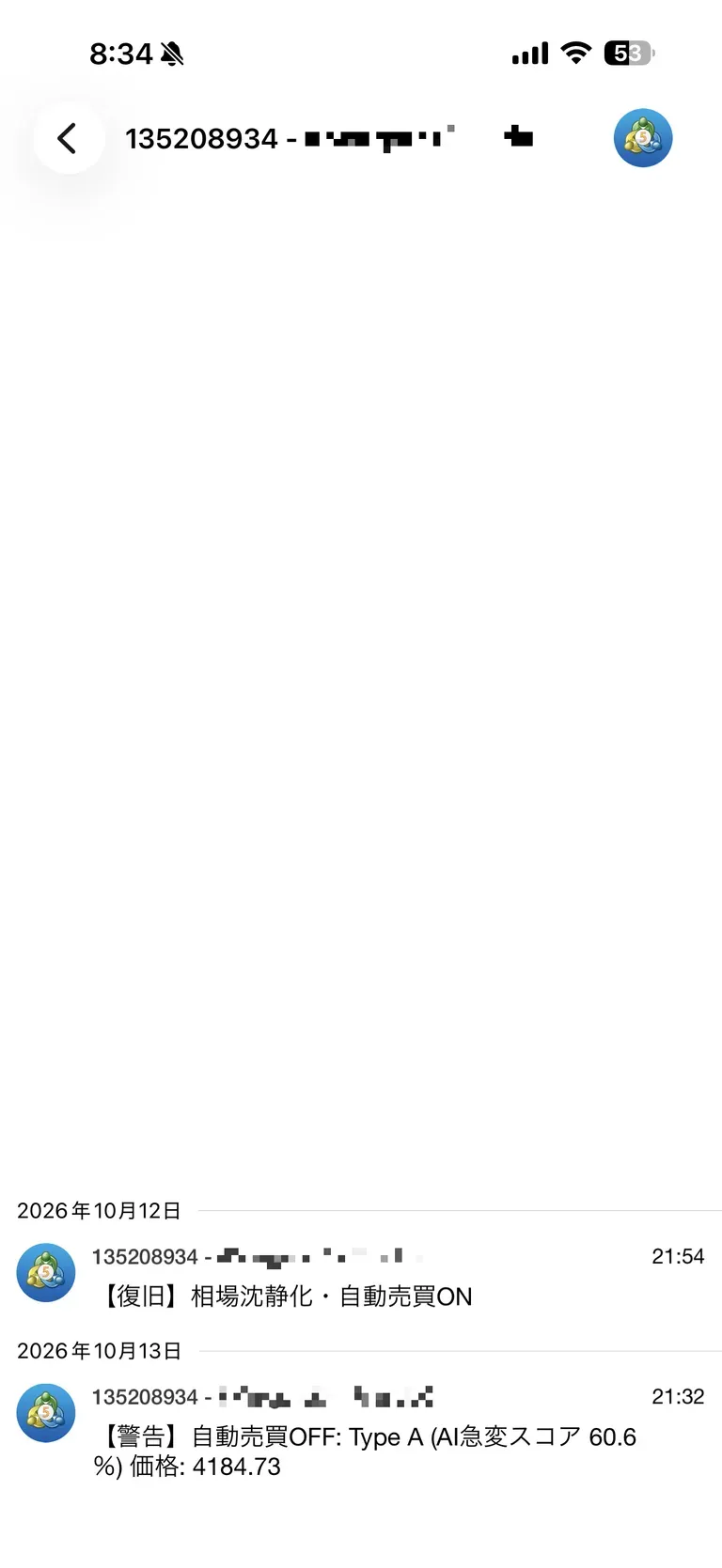
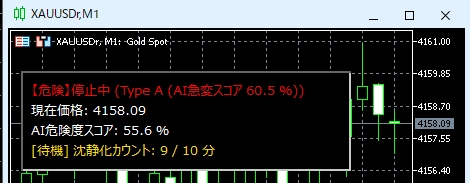
Put an end to Nanpin EA's "Kotsukotsu Dokan" and thank you for your questions about the MT5 built-in AI defense system "Guardian Monitor AI".
We have received questions about Guardian Monitor AI! Thank you!
Below, we will transcribe the reply content we answered!
1. 【Definition and criteria of the 'danger waveform'】
The correct labels (Danger = 1) used for training the LSTM model are applied by labeling based on primarily the following three conditions (OR conditions) to quantify market conditions where averaging martingale EA tends to blow up.
① Extreme change: price movement of $30 or more within the next 30 minutes
② Fall/rocket market (short term): there is a movement of $15 or more within the next 30 minutes, and the "Efficiency Ratio (ER: difference between start and end divided by the high-low range within the period)" is 0.8 or higher (a nearly straight waveform with hardly any pullbacks or retracements)
③ Slow trend (long term): there is a movement of $20 or more within the next 120 minutes, and the Efficiency Ratio is 0.7 or higher
This model's feature is not just measuring the range of movement as a simple 'pips moved', but also using Efficiency Ratio to mathematically define the absence of retracement (whether unrealized losses are resolved) and train the model accordingly.
2. 【About the problem setting and validation of the 'AI + rule-based ironclad quadruple monitoring logic'】
At the initial development stage, we also tested the AI (LSTM) alone, but in actual operation we faced the following challenges (limits).
• AI is good at reading context from the most recent time series data (in this model, the last 60 bars), but it can be slow to react (or get used to) in trends spanning monitoring windows, such as a very gradual decline over several days.
• AI can sense 'danger' but lacks flexible position management features, such as waiting for currently held positions to be closed before stopping, which are characteristic of martingale average strategies.
To solve this, we added physical stop mechanisms (Type B, C) based on pure price movement and retracement rate to cover AI's blind spots, and we included a 'no-position settlement wait reservation' feature via BB-attachment detection (Type BB). We employ an ensemble approach with rule-based fail-safes instead of relying on a single model.
3. 【Regarding overfitting prevention methods and validation】
In building the LSTM network (using PyTorch), we set dropout between layers to prevent overfitting, and since the data is imbalanced (danger labels constitute only a few percent), we adjust class weights accordingly.
Also, this tool is not an 'entry signal to profit' but a 'defensive signal to prevent crippling losses,' so when evaluating the model, we focus more on Recall (minimizing missed detections of dangerous markets) than Precision (fewer false alarms). (Note: to prioritize safety, the AI threshold is adjustable by the user as a parameter.)
4. 【Backtesting data before and after system deployment】
We apologize, but it is structurally impossible to provide backtest data comparing this system with other EAs using MT5 Strategy Tester (reports).
The reason is that this tool stops other EAs by forcibly turning OFF the MT5 terminal's 'Algorithmic Trading' button using Windows API (user32.dll).
In MT5's backtesting environment, simulations that involve manipulating Windows UI buttons to interfere with other EAs are not permitted by the specifications, so we cannot perform integration tests.
Therefore, we cannot provide a quantitative report, and we apologize for that.
We regret that backtest data cannot meet your expectations, but this system is built by myself to protect precious funds in real operation and is a tool packed with uncompromising practical defensive logic.
We hope the above content helps you in your consideration of adopting it.
The details of Guardian Monitor AI follow!
Put an end to the 'dollar-cost averaging then crash' approach of martingale EAs. MT5-internal AI defense system 'Guardian Monitor AI'