

[Weekly Summary] Even with renewed U.S. inflation, the dollar falls and yields decline—AI credit risk spillover, Governor Ueda's continued rate hikes, and oil breaking through $109 threaten a full dissection of the "New Market Dynamics"
On the night of October 17, 2026 (Saturday), after a turbulent week, world financial markets are facing a historic seismic shift where traditional theories have completely collapsed.
The biggest distortion this week is summarized by the fact that both U.S. CPI and PPI showed inflationary resurgence, yet U.S. Treasuries were aggressively bought, yields fell sharply, and the U.S. dollar index (DXY) turned to a weekly decline (-0.35%).
Dollar/yen (USD/JPY) rose to the mid-158s at one point, but was pressured by a decline in U.S. long-term interest rates and vigilance over intervention by Japanese authorities,around 157.98 yento end the week around the level.
Meanwhile, against the backdrop of intensified tanker attacks in the Middle East's Strait of Hormuz,North Sea Brent crude rose to as high as $109.86, and furtherconcerns about AI and semiconductor-related companies’ massive investments and debt burdens led Asian and U.S. tech stocks to plunge, with the Philadelphia Semiconductor Index (SOX) tumbling 11.4% for the week..
“Why did U.S. Treasuries rally and the dollar weaken in an inflation-accelerating environment?”
“How will the BoJ and Governor Ueda’s continued rate-hike stance and IMF support affect the yen?”
“With Japan’s September CPI on Oct 23 and the BoJ meeting at the end of the month, how will the markets move?”
From October 12 (Mon) to October 17 (Sat), we will trace the full market trajectory and summarize in detail the funding flows among major assets (FX, government bonds, equities, crude oil, gold) and outline practical trading strategies for the coming week.
Chapter 1: The Week’s Market Dominance
“Five Major Macro Themes”
We will organize the core factors that determined this week's market moves.
【Key Market Data for Oct 12–17, 2026】
・U.S. Dollar Index (DXY): 101.87 (week -0.35%, fifth consecutive weekly decline)
・Dollar/Yen (USD/JPY): around 157.98 (week close)
・U.S. 10-year yield: about 5.10% (down sharply from about 5.24% at the prior week)
・U.S. 2-year yield: 4.734% (easing expectations for additional hikes)
・Brent crude oil futures: 109.86 dollars (weekly +4.7% rebound)
・Philadelphia Semiconductor: weekly -11.4% (NASDAQ week -4.5%)
・Gold (XAU/USD): about $4,167 per ounce (holding near highs)
① Massive U.S. Treasuries buyback and shift to dollar weakness
U.S. CPI (headline +3.7% YoY) and PPI (monthly +1.3%) accelerated, but the market priced in “credit crunch risk” rather than a “hawkish Fed.” Flight to quality drove massive flows into U.S. Treasuries, pushing yields down and the dollar index to 101.87.
② BoJ/ Governor Ueda’s continued rate-hike stance and IMF support
On the 16th, BoJ Governor Ueda reaffirmed that if the economy and prices align with the 2% inflation target, the policy rate would be raised. On the 17th, IMF Asia-Pacific chief stated that if inflation accelerates, the BoJ may need to pace up hikes, reinforcing normalization expectations.
③ Escalation in Hormuz and Brent at $109
Attacks on ships around the Hormuz Strait, ongoing U.S. naval measures, and concerns about Russian refining facilities and Saudi-related sites contributed to a 4.7% weekly rise in Brent to $109.86. Supply constraints are hitting the global economy with inflationary pressure.
④ The AI bubble reverses — doubts over massive debt and funding
Questions about whether profits from AI-related investments and data centers can cover borrowing costs led to sharp position unwinds in semiconductors. Korea’s KOSPI circuit breaker activated, Nikkei fell about 5% intraday, and SOX slid 11.4% for the week.
⑤ IMF warning: three “double burdens” facing the world economy
The IMF slightly raised its global growth forecast to 3.1% at its annual meetings, but identified AI investment slowdown, energy supply shocks, and astronomically high public debt in major economies as three major risks, urging a return to fiscal discipline.
Chapter 2: The Turbulent Week Timeline
(Oct 12–17)
We review how market sentiment changed day by day in chronological order.
【1-Week Market Trajectory】
・10/12 (Mon): Japanese and U.S. bond markets closed. RBI introduced measures to curb dollar demand, rupiah rebounded sharply. In a world with crude above $100, defense measures by emerging markets took center stage.
・10/13 (Tue): Ahead of U.S. banks’ results, tech and semiconductors corrected. U.S. long-term rates fell to 5.19%.
・10/14 (Wed): U.S. September CPI rose to 3.7% YoY. Immediately U.S. rates jumped to 5.33%, but reports of tanker attacks in Hormuz raised stagflation concerns.
・10/15 (Thu): U.S. September PPI jumped +1.3% MoM in four-and-a-half years; Asian equities fell broadly on AI credit risk. Nikkei down 4.9%, KOSPI trading halted. U.S. Treasuries drew funds, with U.S. 10-year plunging to the 5.09% area. Finance Minister Katayama noted at the G20 to monitor FX with heightened vigilance.
・10/16 (Fri): Following Governor Ueda’s pledge to continue tightening, yen recovered; Wheeler Fed Chair denied a fixed policy stance. Brent crude surged to $109.86. USD/JPY closed around 157.98.
・10/17 (Sat): IMF officials mentioned the need for BoJ to accelerate rate hikes. They highlighted the importance of Japan’s medium-term fiscal framework.
Chapter 3: FX Market Mechanics —
Why was USD/JPY pulled back to the 157 handle?
This week, the force shaping USD/JPY was the breakdown of the textbook interest-rate differential model.
【Conflicting forces surrounding USD/JPY】
Dollar-sell and Yen-buy pressure (dominant):
① AI credit risk prompting U.S. Treasuries buyback → U.S. long-term rates fell sharply (5.33% → 5.10%)
② Governor Ueda’s hawkish comments & IMF support → perceived narrowing of the U.S.-Japan rate gap
③ Katayama’s comments on “strong vigilance” → readiness for intervention in the upper 158s to 159s
VS
Dollar-buying and Yen-selling pressure (downside support):
① Brent oil rising to around $109 → Japan’s large energy import gap (structural yen selling)
② U.S. economy’s solid underpinnings (U.S. September industrial output +0.7%, unemployment claims 199k)
Under normal circumstances, a CPI/PPI upside would push past 159 yen. However, the combination of “lower U.S. rates” and “intervention vigilance + BoJ normalization” acted as a shield, keeping the upper bound around the mid-158s firmly capped.
Nevertheless,the structural trade deficit driven by Brent at $109 and dollar-denominated import needs keeps the pace of decline moderated, so this is not a one-way move to a stronger yen.Be mindful of this point.
Chapter 4: Cross-Yen Fortunes —
Aussie slide and Euro-pivot
There was a clear strength-weakness gap among major currencies this week.
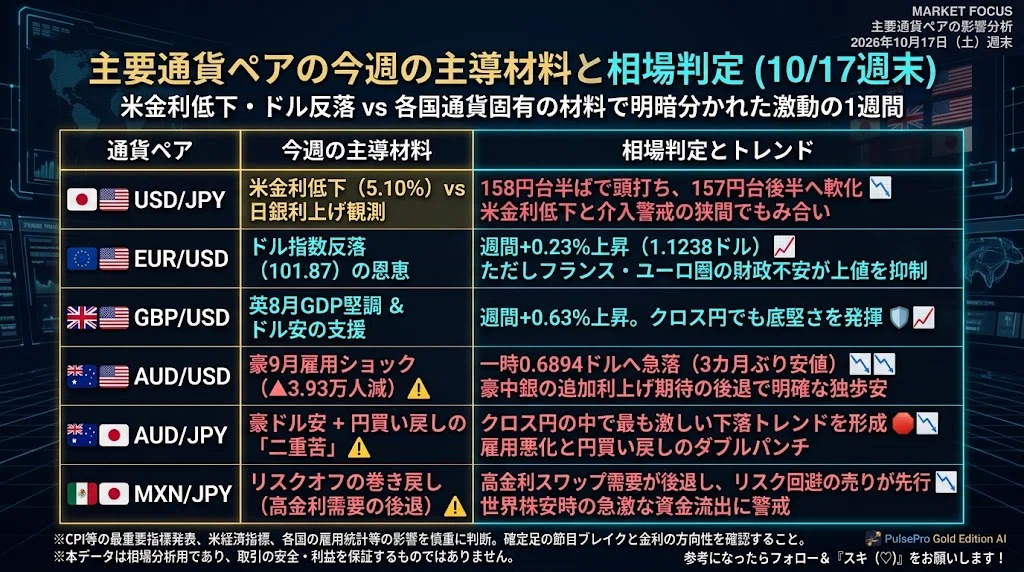
Structural slowdown of AUD
Australia’s September unemployment rose to 4.7%, while payrolls fell by about 40,000, causingRBA’s probability of a November rate hike to collapse from about 1/3 to roughly 1/10.
Even in a dollar-soft environment, AUD was sold off alone, and AUD/JPY became the heaviest cross among the crosses. When trading cross-yen pairs, it is essential to examine not only yen strength/weakness but also the fundamental outlook of the counterpart currency.
Chapter 5: Stock Market Seismic Shifts —
Funding stress in the AI boom
In equities, the market’s “internal dispersion” reached extreme levels.
【Weekly performance of major U.S. indices (vs 10/9 close)】
・Dow Jones: +0.7% (defensive and value stocks steady)
・S&P 500: -1.9%
・NASDAQ Composite: -4.5% (covering tech growth losses)
・Philadelphia Semiconductor: -11.4% (severe corrective selling)
Despite strong results from semiconductor giants like TSMC and ASML, the fact that semiconductors were heavily sold is crucial. Market concerns have shifted from recent sales to credit risk: can AI data-center capex and debt be recovered in an environment with rates above 5%?
Diminishing risk tolerance in equities has continued to distort the FX trend through bond-buying (lower yields) and safe-haven demand (yen, Swiss franc).
Chapter 6: Brent $109 and
Gold $4,167 — “Flight to War”
In commodities, geopolitics and currency distrust are pushing prices higher.
Oil (Brent $109.86):Hormuz traffic has fallen from 17.15 million barrels per day to 11.62 million, even with IEA stock releases, leaving physical supply disruption risks unmitigated.
Gold (XAU/USD ~$4,167):A sharp decline in U.S. long-term rates and a weak dollar have provided strong tailwinds, keeping gold near highs. Safe-haven demand amid Middle East tensions and demand for inflation hedges in fiat currencies aligned perfectly.
Chapter 7: Next Week (Oct 19–23) —
Key Events and Roadmap
Next week features PMI preliminaries from various countries, plus Japan’s price data at the weekend.
【Important Schedule for Next Week (Japan time)】
・10/20 (Tue): US Treasuries auction (to observe supply/demand and long-term rates)
・10/21 (Wed) 08:50: Japan September trade data (extent of trade deficit due to higher crude prices)
・10/21 (Wed): Haushy RBA Deputy Governor speech
・10/22 (Thu): Eurozone and Germany October PMI prelims / U.S. October PMI prelims
・10/23 (Fri) 08:30: Japan September nationwide CPI
【Big Showdown】 → Core CPI YoY +2.1% (if upside surprises, December BoJ rate hike becomes highly likely)
・10/28 (Wed) 09:30: Australia Q3 CPI
Chapter 8: Practical Chart Analysis and “Defense Lines”
Technical checkpoints to be mindful of when placing trades next week.
【Resistance Levels】
160.00 yen: psychological hard defense line (max alert for FX intervention) ↑
★ 158.50–158.55 yen: 【200-day moving average on the daily chart & structurally robust resistance】 ↑
158.20–158.30 yen: recent high for a pullback ↑
★ 158.00 yen: psychological milestone (watershed for rebound trend)
――――――
Current level: around 157.98 yen (weekend close)
――――――
【Support Levels】
★ 157.50–157.52 yen: recent structural pullback line (last weekend’s low) ↓ 157.00: big figure ↓
★ 156.93–156.95 yen: 【low from U.S. jobs data on 10/2】 ↓
156.50 yen: strong daily-chart support
Summary: The 3 Major Points to Watch Next Week
The core to navigate next week lies in three points.
U.S. 10-year yield (5.10%):Will the downtrend to 5.00% solidify, or will it rebound toward 5.20% on inflationary concerns?
Japan September CPI (Oct 23) and BoJ rate-hike expectations:Will core CPI exceed 2.1%, triggering a robust yen-buyback rally?
Hormuz Strait and oil (Brent around $109):Will surging Brent into the $110s broaden global stagflation fears?
Ignore headlines’ noise,assess calmly how “bond market capital flight (U.S. rates)” and “BoJ policy normalization” are pressuring exchange ratesand approach the week with disciplined money management.
If you found this helpful, please follow and hit the heart at the bottom of the screen to encourage updates!

TrendPulse Pro free trial:https://www.gogojungle.co.jp/tools/indicators/86532?via=users
TrendPulse Pro AI free trial:https://www.gogojungle.co.jp/tools/indicators/86529?via=users
QuickScalp AI free trial:https://www.gogojungle.co.jp/tools/indicators/86523?via=users

Eliminate emotion, capture the market with clear evidence and rules using our unique indicators.
Functional details and design logic are published on each product page
? [GogoJungle Product Page]