
Are you making profits with a solid basis? [Capital management and position management part #4]
Hello! This is SAKU.
Previous article(Are you cutting losses with a solid rationale?)Now, let's look at the rationale for cutting losses!
In this continuation, we will look at several examples of the rationale for taking profits.
About the rationale for taking profits
Regarding taking profits, similar to stop-losses,take profits with a basisand so on!
Whether you reach a psychological horizontal level, or price range theory, or when the price breaks below moving averages or trendlines, profit-taking rules vary by person. Simply because you gained a bit of profit and feel like taking profits without a solid reason can lead to repeated chicken profit-taking.
Stop-loss and take-profit are two sides of the same coin.
When there is no longer a reason to hold the position for a stop-loss,when there is no longer a reason to hold the position to extend profits for taking profits,do it!
Examples of buying on pullbacks
Regarding the rationale for taking profits after entry, I summarized pullback buying as an example in the diagram below.
Let's go through them one by one.
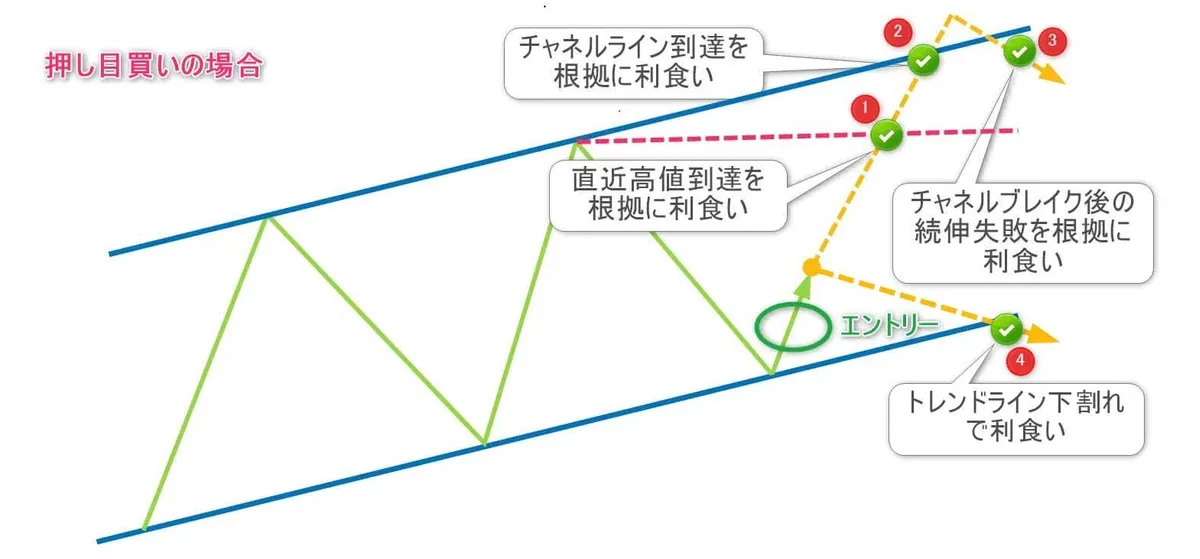
①about this, this isa pattern to take profits at the most recent high.
If you surpass this recent high, the uptrend continues, but around this area there is often a struggle between bears who don’t want to cross the horizontal line and bulls who want to continue the uptrend beyond it.
Because there is a realistic possibility that the upside momentum may stall due to insufficient bullish power, the idea is to take profits.
It is the most conservative take-profit, but if the price reaches the channel line, you miss out on part of the move.
②about this,a pattern to take profits with the channel line as a guide.
Because a channel line drawn parallel to the trendline can also be a take-profit guide, this is the idea that profits may come in when the price action within the channel pauses or reaches the range within the channel.and.
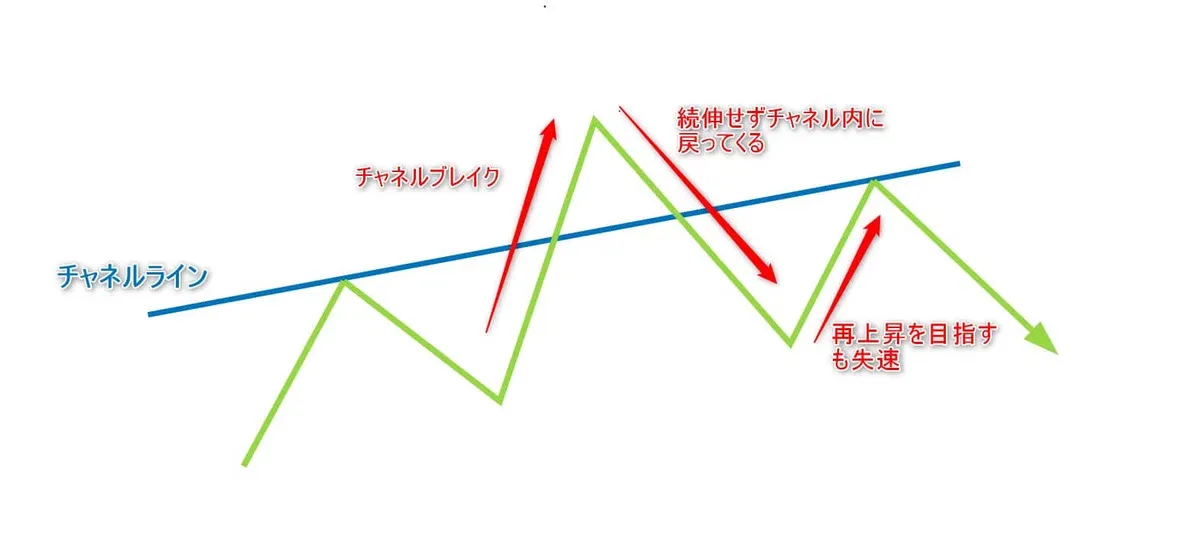
③about this,After the second option, although the channel line is broken, there isn't enough bullish momentum to extend the rise, so the price returns within the channel and the rise stalls, so taking profits is considered.
In this case, prices often fall back soon after returning to the channel, so it is good to take profits.
After this move, a decline may occur, followed by another rise near the channel line, but since it often fails to surpass the previous high and falls again, it is prudent not to be greedy. (Refer to the diagram below. It may connect to the left shoulder of a head-and-shoulders or to wave C in wave theory.)
④is,a pattern to take profits when the trendline is broken to the downside.
After entry, prices may rise but fail to reach a high or a channel line, and breaking below the trendline indicatesthe trend line’s momentum is changing and the upswing is weakening, so take profits.
Entry on a return move after a trendline break
Next, consider cases where you short on a return move after breaking an upward trendline and think about several take-profit patterns.
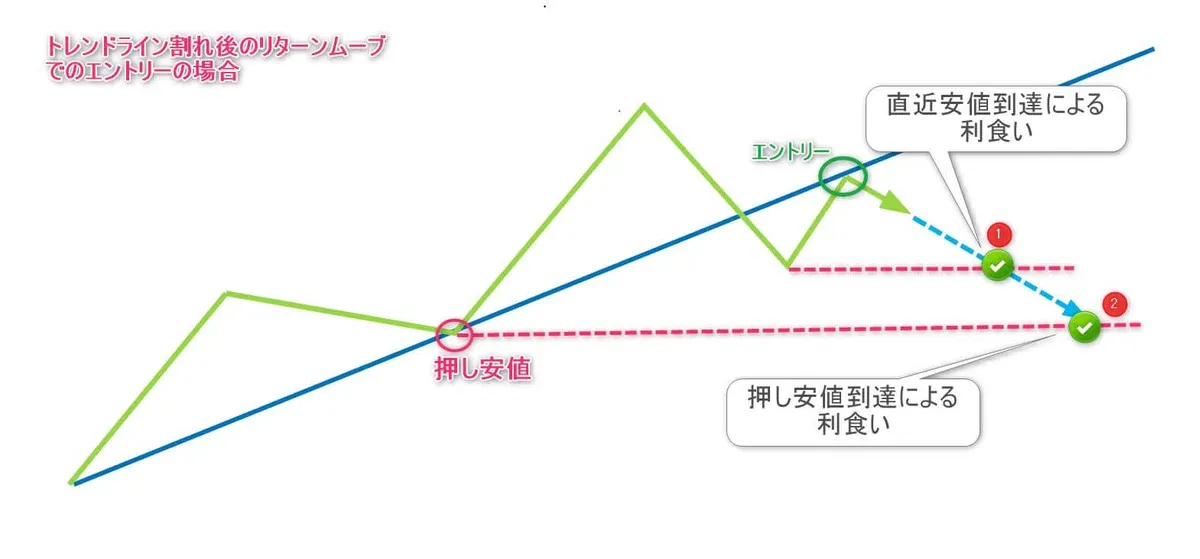
①is,a pattern to take profits at the low formed when a return move occurs.
Because there is often a period of consolidation between this low and the broken trendline, taking profits once is commonin this way.
However, in this diagram, the low is not a pullback low, so it is not a price level relevant to trend determination.
②is,a pattern to take profits at a pullback low.
Because the bulls who don’t want to break below the pullback low and bears who want to end the uptrend may clash, the idea is to take profits once.
If this level breaks, the uptrend may end and a downtrend may begin.
Which take-profit is best?
As with the previous, it goes without saying, right?
Any is fine!
Each take-profit has advantages and disadvantages.
Take profits where you are satisfied!
Of course, you can choose to scale out at different times!
Take-profit is really difficult, and often prices extend further after you take profits.
However, since you haven’t lost, that’s fine!
Let the head and the tail go.
In the previous and this article, we looked at the basis for stop-loss and take-profit. How did you find it?
Don’t just decide at a fixed pip count; think about what the line represents and how it functions to determine when you should settle.
For the previous and current articles, please also refer to the earlier writtenSetup examples using trendlinesto deepen your understanding!
If you want to learn more practical profit-taking techniques, check this out too ↓

【Limited-time early access campaign!】→ MMS Trading Encyclopedia— Understanding the “structural traps” investors fall into and the Market Microstructure analysis that reveals the footprints of big players — (There is also a free trial edition)

→The Essentials of MTF Multi-Time-Frame Analysis (There is also a free trial edition)