
Are you making profits with a solid basis? [Capital management and position management part #4]
Hello! This is SAKU!
In the previous article (Are you cutting losses with a solid basis? [Fund management and position management #3]), we looked at the foundations of cutting losses!
In this follow-up, let’s look at several examples of the basis for taking profits.
On the Basis for Taking Profits
Regarding taking profits, just like cutting lossesdo it with a basis for taking profits.
Whether it’s because we’ve reached a seemingly significant horizontal level, or based on price range theory, or because a move below a moving average or a trend line would lead to profit-taking, the rules for taking profits vary from person to person. However, simply wanting to take profits because you’ve earned a bit of profit can lead to repeated “chicken-feet” taking profits.
Cutting losses and taking profits are two sides of the same coin.
When there is no longer a reason to hold the position for cutting losses,when there is no longer a reason to hold the position to extend profits,do it.
Examples of Buy-the-Dip
For the rationale of taking profits after entry, we’ve summarized an example of buy-the-dip in the diagram below.
Let’s go through them one by one.
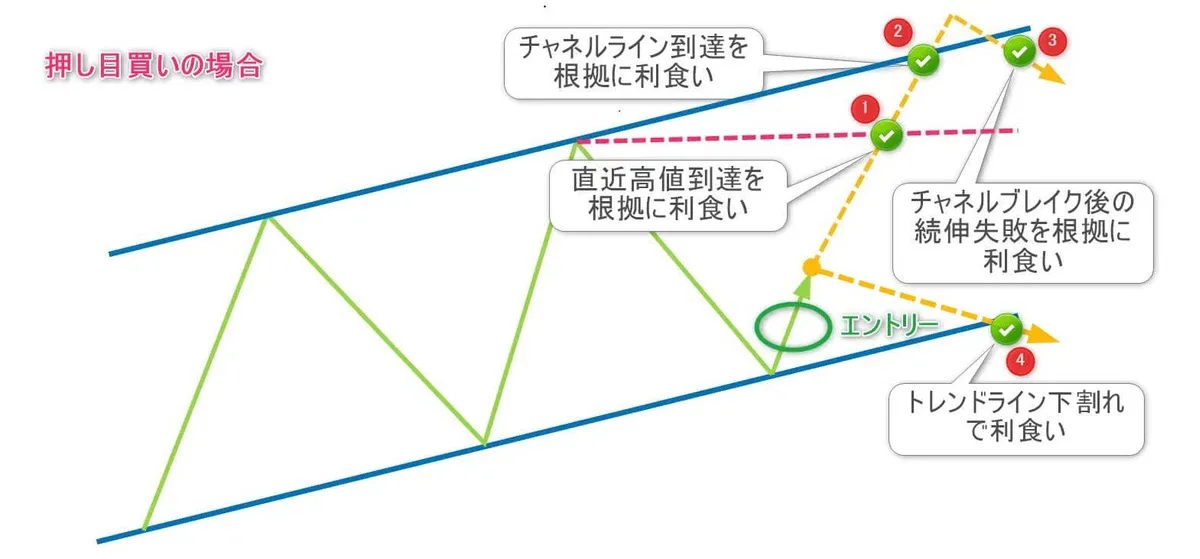
①Regarding this,it’s a pattern of taking profits at the most recent high.
If you surpass this most recent high, the uptrend continues, but around here there is often consolidation due to the bear side wanting to stay below the horizontal line and the bull side wanting to push above it to continue the uptrend.
There is also a real possibility that the upward momentum slows due to a lack of bullish power, so the idea is to take profits..
It is the safest take-profit, but if the price reaches the channel line, you will miss out on part of the swing.
②Regarding this,a take-profit pattern based on the channel line as a guide.
A line drawn parallel to the trend line, i.e., the channel line, is also used as a guideline for taking profits, so the idea is that profits may come if the move within the channel pauses or if the price movement within the channel reaches a certain range, prompting selling to take profits..
③Regarding this,after ②, a channel line was broken, but there isn’t enough bullish momentum to continue the rise, and since the price returned into the channel and the rise slowed, take profits..
In this case, it’s common to return to the channel and then fall, so taking profits is advisable.
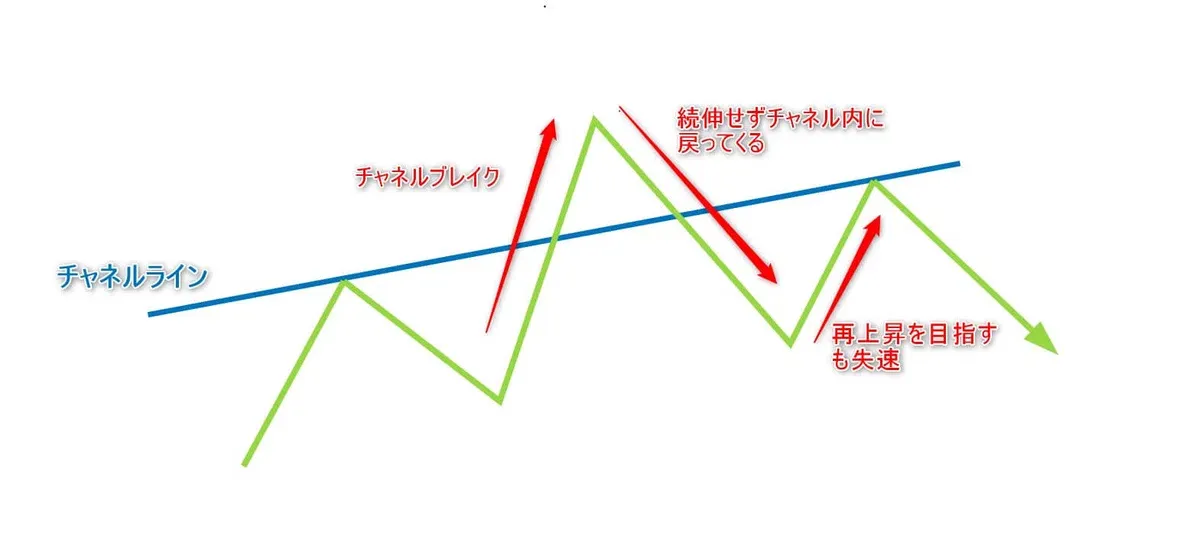
After this move, there may be a brief drop followed by another rise toward the channel line, but since it often cannot surpass the previous high and falls again, it’s prudent not to be greedy. (Refer to the diagram below. It could connect to the left shoulder of a head-and-shoulders pattern or to Wave C in wave theory.)
④Regarding this,a pattern of taking profits when the trend line is broken to the downside.
After entry, the price may rise, but if it fails to reach a high or a channel line and breaks the trend line to the downside, it indicates thatthe trend line momentum is changing, the upward momentum is weakening, so take profits.
Entry on Return Moves After Trend Line Break
Next, let’s consider several profit-taking patterns for a short entry after an uptrend line break, using a return move as an example.
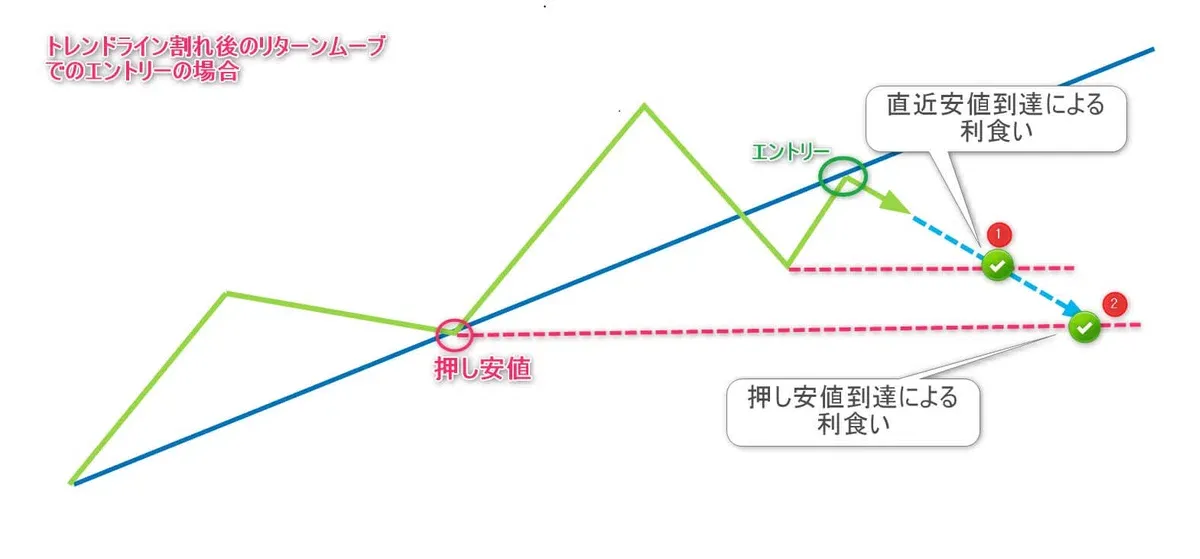
①is a pattern of taking profits at the low created when a return move occurs..
Because there is often consolidation between this low and the broken trend line, it’s common to take profits at first..
However, in this diagram, that low is not a swing low, so it is not relevant for trend judgment.
②is a pattern of taking profits at the push-low..
This reflects the idea that there may be fierce battles between bulls who don’t want to break the pull-back low and bears who want to end the uptrend and push it down, so take profits once..
If this level breaks to the downside, the uptrend may end and a downtrend could begin.
Which Take-Profit is Best?
As with the previous article, you probably know the answer without me saying it.
Any of them is fine!
Each take-profit has its own advantages and disadvantages.
Take profits at a level you can be satisfied with!
Of course, you can also stagger your take-profits at different times!
Taking profits is really difficult, and sometimes prices move further after you take profits.
But since you’re not losing, that’s fine!
Let the head and tail go.
In the previous and this article, we’ve looked at the bases for cutting losses and taking profits. How did you find it?
When you decide a pips amount yourself, don’t cut losses or take profits just because the line is there or it seems convenient; think about what that line represents and how it is expected to function, and decide the settlement accordingly!
For the articles from last time and this time, please also refer to the previously writtenExample setups using trendlinesto deepen your understanding!
If you want to learn more practical profit-taking techniques, check this out too ↓

→MTF Multi-Timeframe Analysis Essentials (There is also a free sample edition)
【Campaign limited to 11/1 (Sun)! Limited-time offer!】

【Early access campaign in progress!】 → MMS Trading Encyclopedia– The Truth of the “Structural Traps” that Individual Investors Fall into and Market Microstructure Analysis to See Through the Footprints of the Big Players – (There is also a free sample edition)