

[Laboratory Development Logic Introduction] GBPJPY Anomaly v04 — Design and empirical results of an indicatorless EA composed of 110 cells by day of week × time of day
【Image:GBPJPY_Anomaly_v04_banner.jpg】
Semura Lab. presents the laboratory development logic. This time, we focus on the GBPJPY EA "GBPJPY Anomaly v04," which uses only the day of the week and the time of day as inputs. We will sequentially organize the design philosophy, ten years of actual data, and the challenging scenarios.
【Key Points】
・Inputs are only the day of the week and the time of day. No indicators are used
・Only entries defined by 110 cells defined as "Day × Time × Minute (5-minute intervals)" are considered
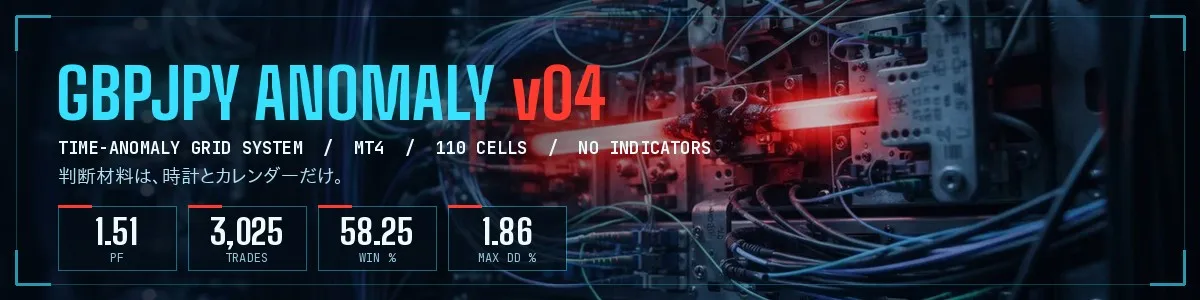
・Ten years of actual data (including fees): PF 1.51, win rate 58.25%, number of trades 3,025, maximum drawdown 1.86%
・Forward testing across 10 cycles all yielded positive results
・2016 and 2018 were negative for the year. Profits are concentrated in the most recent three years
・Dependent on the server time of the account
1. Design Assumptions: Do not guess direction; watch participants’ schedules
v04 does not include any indicators such as moving averages, RSI, or Bollinger Bands. It references only the day of the week and the time of day.. The basis is the structural bias arising from the schedules of market participants. Specifically, it assumes flows of real demand toward the Tokyo fixing, month-end settlement demand at five-ten-fifteen-twenty days of the month, and liquidity at the start of the week. None of these are forecasts of whether the market will rise or fall; they describe who trades when and under what circumstances.
v04 slices the observed biased time zones into a five-minute grid and uses only the statistically retained cells. Please consider this as an expansion from v03 (which traded only at 01:30 every Monday) to 110 cells with a one-point position.
2. Logic Specifications
 【Image:fig15_cell_breakdown.png】
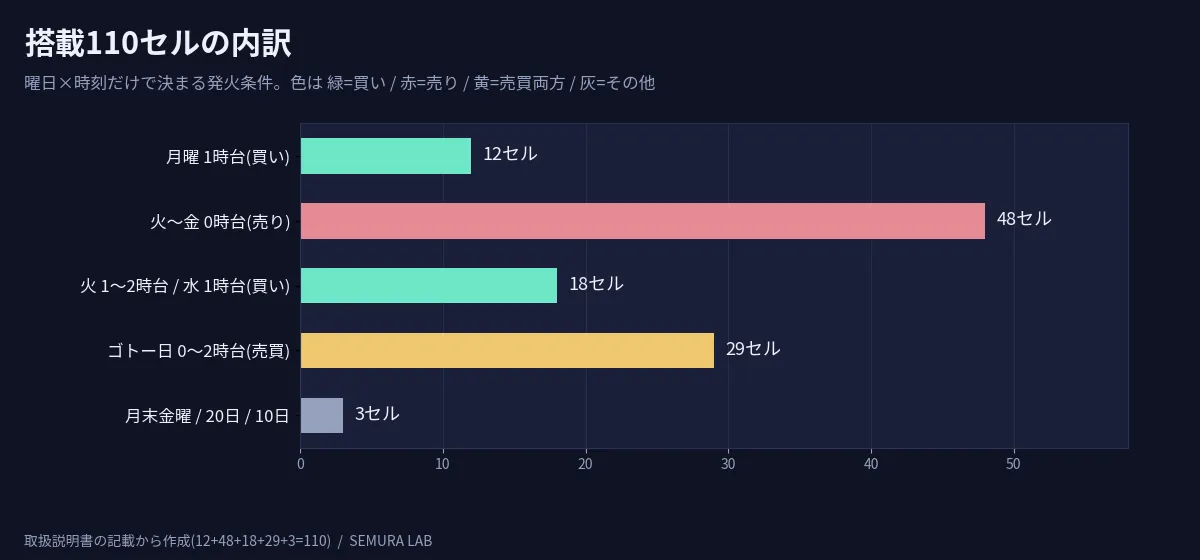
The firing conditions (cells) are defined by either “Day × Time × Minute” or “Specific Date × Time × Minute.” Immediately after a 1-minute candle closes for the applicable cell, a market order is entered at the opening price of the next candle. The breakdown is as shown above, with the 0:00 hour on Tuesday to Friday (selling) being the most frequent at 48 cells. Goto-day is designated on the 5th, 10th, 15th, 20th, 25th, and the last business day of the month, and future information is not included since it is determined by the calendar alone.
 【Image:fig18_trade_flow.png】
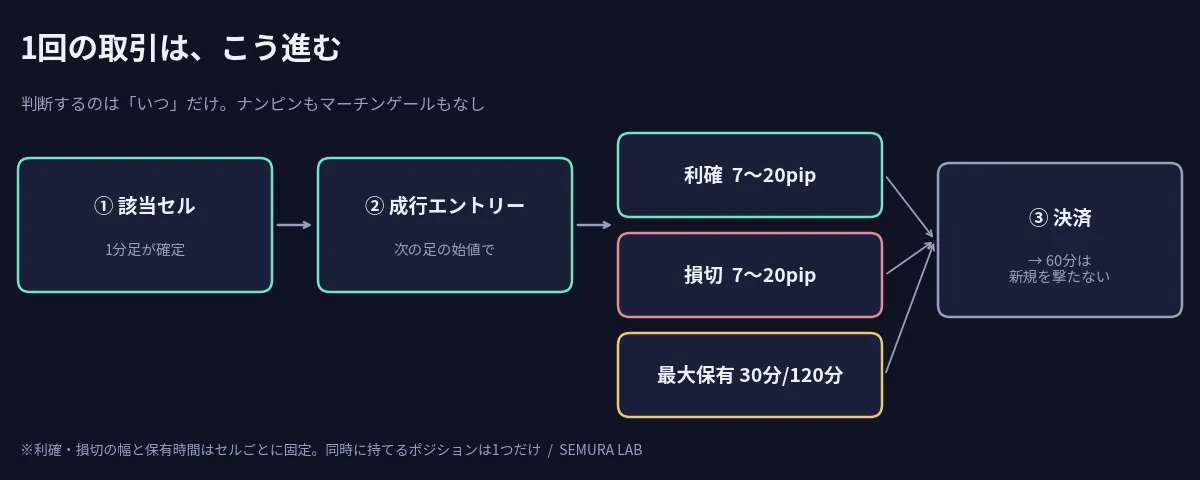
Settlements occur when taking profit, stop loss, or reaching the maximum holding time. Only one position can be held at a time; after settlement, no new trades for 60 minutes, and no averaging down or martingale strategies are used. The expected annual trading count is about 300 trades.
3. Actual Performance (after deducting transaction costs)
The verification was conducted using MT4's Strategy Tester, covering approximately ten years from January 4, 2016 to December 30, 2025.