

Daylight Saving Time comes in two stages: Europe on October 25, and the United States on November 1; confirm with EA's time settings
Around this time every year, the EAs that are time-based, and my own rule such as “stop trading before the 21:30 indicator,” shift by about a week. This is because the dates for changing to winter time differ by one week between Europe and the United States.
In 2026, Europe will switch to winter time on Sunday, October 25, and the United States on Sunday, November 1. From Monday, October 26 to Friday, October 30, only Europe will be on winter time. During this week, the FOMC (October 27–28) and the Bank of Japan Monetary Policy Meeting (October 29–30) are also scheduled. I prepared a quick reference table showing what shifts how and checked it against my GOLD 1-minute chart.
First, the conclusion
- When viewed in Japan time, many U.S. indicators (the NY 8:30 a.m. release) are up to Friday, October 30, and remain at 21:30. It will change to 22:30 from the week of Monday, November 2. In Europe, the morning in London (8:00) will advance to 17:00 a week earlier, starting the week of October 26.21:30 remains the same12:30 a.m. the next day? (Note: The text says 22:30; kept as 22:30) It will change to 22:30 from the week of Monday, November 2. Europe’s morning (London 8:00) becomes 17:00 starting the week of October 26.
- The same is true for GOLD’s 1-minute chart (for autumns 2014–2025, 12 times). The 1-minute movement around 21:30 is 2.9 times the average of the surrounding 60 minutes for the one-week offset. After the U.S. switches to winter time, the 2-week period drops to 1.0x, and instead 22:30 becomes 3.4x.2.9 times.
- For brokers whose server time shifts to the U.S. time zone (New York +7), the U.S. time frame moves with the server's clock, while only Europe’s time zone will be one hour behind for this week.Only Europe’s time zone will be one hour late for this one weekEA that uses “server time from X to Y” may drift from its intended hours during this week.
Quick reference table for three periods (Japan time)
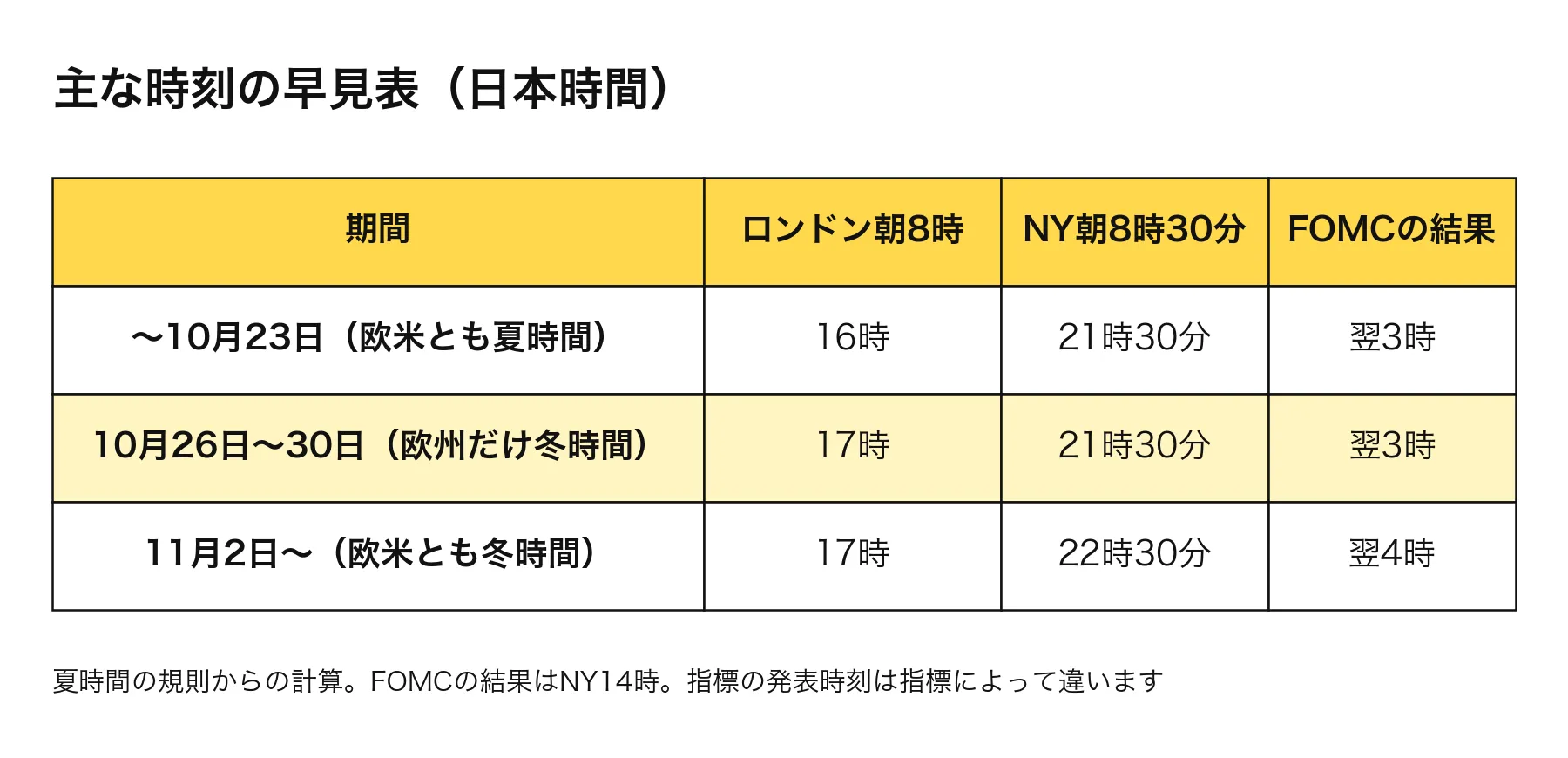
The reason for the shifts is that the switch rules differ by country. Europe returns to winter time on the last Sunday in October, and the United States on the first Sunday in November. Since the last Sunday in October and the first Sunday in November are always 7 days apart, the autumn shift is exactly one week each year (2027 will be October 31 and November 7). Japan has no daylight saving time, so when viewed in Japan time, the European time zone and the U.S. time zone are sequentially delayed by 1 hour each.
Verified with GOLD’s 1-minute chart
Using my XAUUSD (MetaQuotes-Demo 1-minute chart), I examined the 12 autumns from 2014–2025, and averaged the magnitude of price moves per minute (absolute difference between closing prices) by minute in Japan time. I compared how many times larger the 1-minute move at exactly 21:30 and exactly 22:30 were, relative to the surrounding 60 minutes, across the three periods.
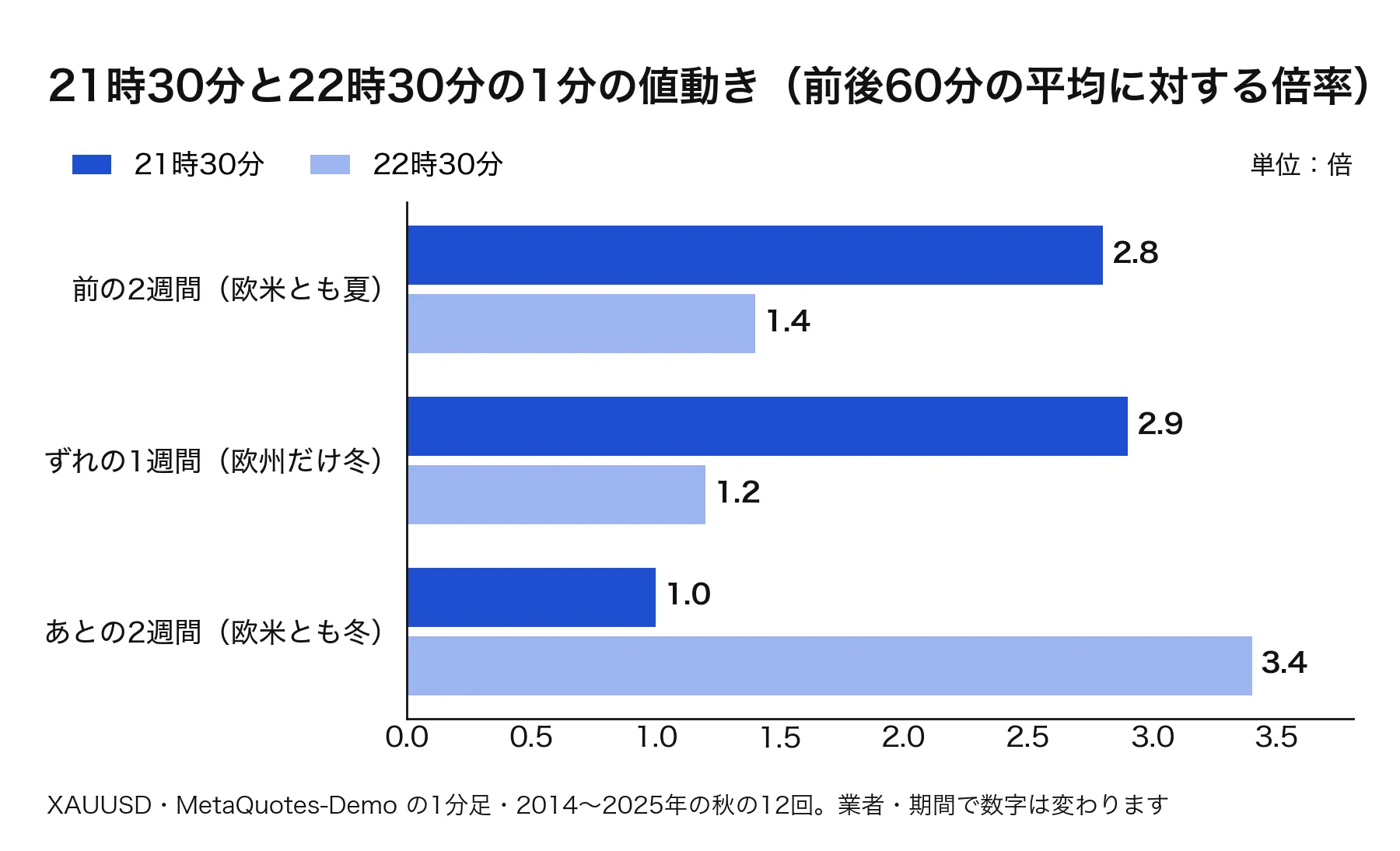
The peak of the offset week appeared at the same time as summer’s 21:30. Since U.S. indicators come out on U.S. time, the numbers show that even if Europe switches earlier, it does not affect the moves. When the U.S. switches, the peak moves to 22:30, and 21:30 becomes a 1-minute move of similar magnitude to before.
On the other hand, the European morning (London 8:00) peak was not clearly discernible with this method. Since GOLD’s most volatile times are around the dollar indicators, the European morning difference tends to be less evident.
Plans included in this one week
- FOMC is October 27–28. The results come out at 2:00 p.m. Eastern Time on the 28th, and the U.S. is still on daylight time, so in Japan time it will be29th (Thu) 3:00. The next one on December 8–9 will have the U.S. in winter time, so Japan time will be the 10th (Thu) 4:00.
- The Bank of Japan’s Monetary Policy Meeting is October 29–30 (with the Outlook Report). The timing of the announcement is not fixed.
If you base your own rule on “what time in Japan time,” rewrite it for this week using the quick reference table above to avoid confusion.
After this, I’ve included six steps to verify your EA’s time settings against server time, and a checklist (accessible via registration).