

[The True Story Behind the Australian Dollar's Rebound] AUD/USD 0.6966 and AUD/JPY 109.99 Reached — Why did buying resume after a sharp drop from the Australian employment shock (−379,300)? The limits of short-covering and the battle at 0.6978
On Friday, October 16, 2026, the Australian dollar (AUD) rebounded sharply after the previous day's shock in Australian employment data caused a plunge.
As of the time of writing,AUD/USD was around 0.69666to be bought back,AUD/JPY also surged to around 109.99 yenand approached the 110 yen level.
“Even though Australian employment fell by about 40,000, why is the AUD being bought so aggressively?”
“Is this a sign that the downtrend has ended and a genuine uptrend has begun?”
“Or is it merely a short-cover rally (buying back selling positions), a prime opportunity to sell on the rebound?”
In short, the current AUD rebound is highly plausibly a short-cover driven corrective rally based on “oversold conditions + defense of key technical support (0.6910).”
Domestic Australian fundamentals still face strong headwinds, and it is extremely risky to hastily conclude that a durable uptrend has begun.
From a practical trading perspective, this article will dissect the depth of Australia’s employment data, the dollar’s decline and commodities rally, CFTC speculative positioning, and the AUD/USD’s challenge at the “0.6978” watershed.
Chapter 1: The three major factors that triggered this AUD sharp rebound
“Three forces”
Against the backdrop of macro conditions and supply-demand distortions, three tailwinds supported the rebound despite Australia’s negative news.
【Three forces behind this rebound】
① Defense of technical bedrock:
The sharply fallen AUD/USD found support around the major support line “0.6910,” triggering a mechanically retraced, double-bottom-like rebound.
② Brief pause in the broad dollar strength (dollar index weakness):
Due to credit concerns around US AI-related stocks and a cautious stance by Fed officials, the dollar index (DXY) fell to around 101.77. Downward pressure on the dollar eased temporarily against the dollar.
③ Support for commodity currencies (rebound in commodities):
Prices for resources such as oil and gold remained firm, and the ASX 200 rose about 1.0%, aiding a short-term risk-on recovery.
What’s important is that this rebound did not stem from an improved Australian economy or a better RBA rate-hike path.
It was simply a technical, self-sustaining rebound driven by a unwinding of overextended short positions.
Chapter 2: The reality of the fundamentals —
AUD still faces strong headwinds
Objectively examining the fundamentals, the AUD environment has not decisively shifted to bullish territory.
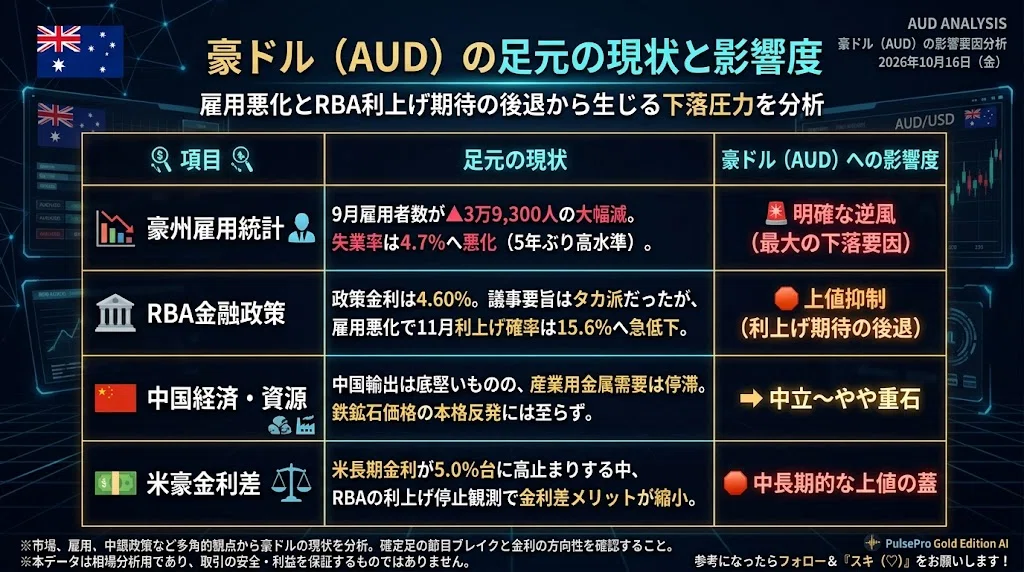
Weak employment is constraining the RBA
The minutes of the RBA September meeting released on October 13 showed vigilance toward inflation upside risks and the option for additional rate hikes if needed.
However, the immediate impact of the “September employment drop of 39,300” was strong.
Full-time employment rose by 44,000, but part-time employment fell by 73,700, and the unemployment rate rose to 4.7%. The market priced in November rate hike odds dropping to about 15.6% instantly.
With rate hike expectations fading, the environment for mid- to long-term money to bid up Australian rates on yield differentials is not solidly in place.
Chapter 3: The distortion of supply and demand —“Short positions
about 100,000 contracts” are fueling the rebound
A decisive piece of evidence that this rebound is a short-cover rally comes from futures market positioning data.
According to the Commodity Futures Trading Commission (CFTC) data for AUD futures, net shorts reached about 98,600 contracts..
【Mechanism of the short-cover in the market】
The mood turned bearish after the Australian employment shock,
shorts piled up to an extreme point,
the 0.6910 level could not be breached,
sellers were forced to realize profits and buy back to limit losses,
the accumulated “98,000 shorts” then transformed into strong upward pressure,
despite deteriorating fundamentals, the rate rebounded sharply upward,
and the price moved up in a self-sustaining fashion.
Because selling positions were so skewed, the strong rebound after bad news ended up larger; once this buyback cycle completes, if there are no new buyers, the market will slow again.
Chapter 4: Technical analysis — AUD/USD and
the key defense line for AUD/JPY
Here is the analysis of the breakout points in practical charts.
【AUD/USD resistance & support levels】
0.7030–0.7040: 100-day moving average, barrier against a medium-term downtrend ↑
0.7000: psychological barrier ↑
★ 0.6978–0.6989: 【the greatest watershed; center line of the 20-day Bollinger Band & retracement high】
↑ around 0.69666: short-cover ongoing
――――――
Current level: 0.6962: near-term resistance on the rebound
――――――
【Support levels】
★ 0.6940: short-term support line (if broken, rebound momentum weakens) ↓
★ 0.6910–0.6920: 【current rebound starting point & absolute defense support】 ↓
0.6850: long-term consolidation lower bound (breaking this could confirm a medium- to long-term downtrend)
Conditions for continued rebound:
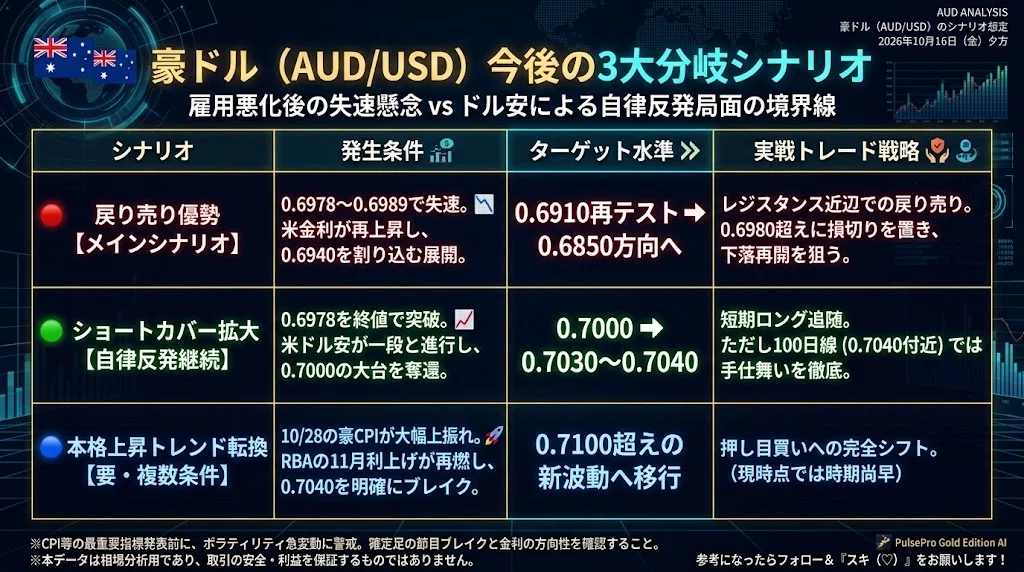
Clear daily close above 0.6978–0.6989,which, if surpassed, would further expand the short-cover and target a test of 0.7000.
Conditions for a pullback in the rebound:
Price is capped near 0.6978,and falls below 0.6940. In that case, the rebound would end as a mere correction, and there would be a higher risk of a further decline toward 0.6850 from a test of 0.6910.
Chapter 5: AUD/JPY at 109.99 yen —
Don’t be fooled by the illusion of a yen weakness
The rapid rise of AUD/JPY toward 110 yen requires a calm, careful breakdown.
【Dissecting the drivers of AUD/JPY ascent】
AUD/JPY rise =
“Independent AUD strength against the dollar” + “USD/JPY strength (yen weakness)”
In a scenario where AUD/JPY is rising while USD/JPY remains high around the 158 yen area, it is often the case that the yen is broadly weaker rather than the AUD being exceptionally bought.
Also, Japanese authorities have stated by Minister of Finance Suzuki that they are watching with high vigilance, and there is risk of intervention as USD/JPY approaches the upper 158s to around 159.
If the Bank of Japan and other policymakers intervene or if US stock prices slump again causing USD/JPY to fall sharply,AUD/JPY could be hit by a yen carry unwind and risk-off AUD selling, potentially falling faster than AUD/USD..
Chapter 6: Three major scenarios for AUD outlook
Three branching scenarios that will determine your future strategy.
Chapter 7: Important upcoming schedule and roadmap
Roadmap
For a genuine trend confirmation in AUD, monitor the following events closely.
【AUD monitoring schedule (Japan time)】
・10/16 (Fri) Tonight:
Whether there is an autonomous rebound in the dollar index and US yields by the US market close
・10/21 (Wed):
?? Aust. Deputy Governor L. Housser speech (first official comments after worsening employment)
・10/22 (Thu) 07:00:
?? Australia October PMI (manufacturing & services flash)
・10/27–28:
?? US FOMC policy statement
・10/28 (Wed) 09:30:
?? Australia Q3 CPI (Consumer Price Index) ???【the biggest showdown】
・11/03 (Tue) 12:30:
?? RBA monetary policy meeting (policy interest rate announcement)
In particular Australia CPI Oct 28will be the ultimate test of whether inflation persistence outpaces the employment weakness this time. If prices stay strong, rate hike expectations will revive and the rebound will gain momentum; if prices slow, AUD selling will accelerate.
Summary: Final investment verdict
In one sentence, the current movement is a position adjustment driven by technical defense rather than fundamentals improving: a short-cover rally without fundamental improvement.
The fact that 0.6910–0.6920 is holding is noteworthy.
However, until the 0.6978–0.6989 rebound resistance band is decisively broken, the medium- to long-term downtrend remains intact.
When US dollar weakness pauses, whether AUD can hold price independently will reveal the truth.
Rather than jumping in with “it’s rising, so buy,” observe price action near 0.6978 and determine whether selling pressure resumes, or if the rally continues, with a cool, clear assessment.
If this is at least somewhat helpful, please follow and press the heart icon at the bottom of the screen for updates!

TrendPulse Pro free trial:https://www.gogojungle.co.jp/tools/indicators/86532?via=users
TrendPulse Pro AI free trial:https://www.gogojungle.co.jp/tools/indicators/86529?via=users
QuickScalp AI free trial:https://www.gogojungle.co.jp/tools/indicators/86523?via=users
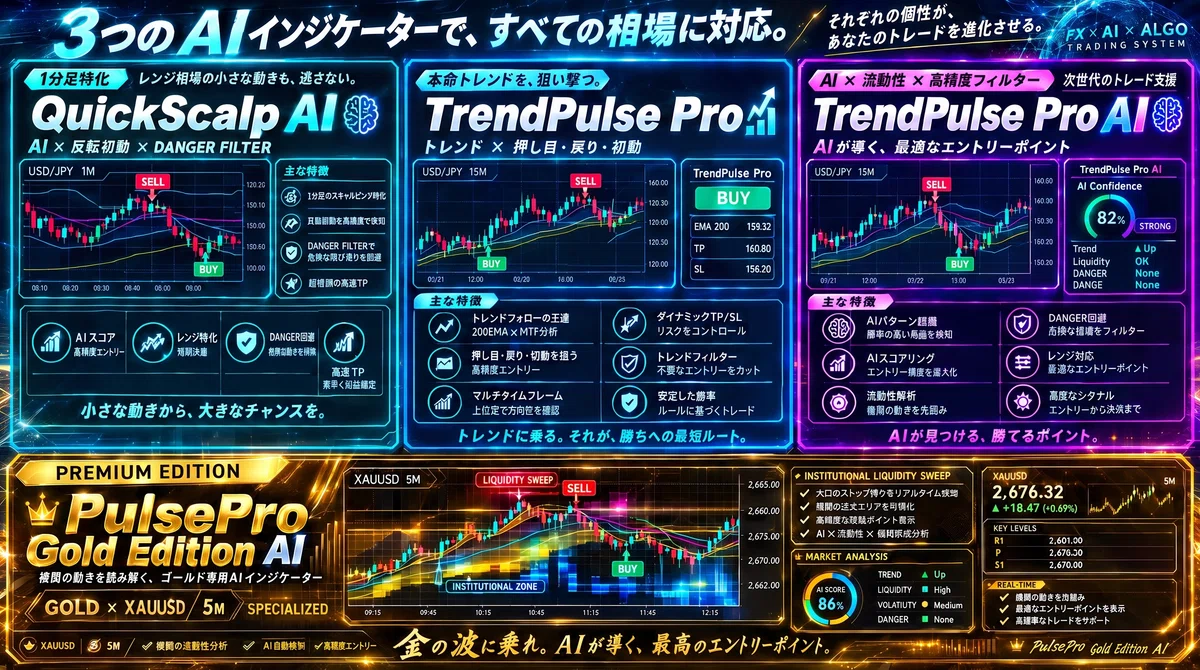
Eliminating emotion and capturing the market with clear evidence and rules—our unique indicators.
Details of functions and design logic are published on each product page
? [GogoJungle product pages]