

I tried 60 popular publicly available TradingView strategies with domestic costs included, and the pass rate was 0
I tried 60 popular public strategies on TradingView, and none passed.
TradingView is a service where you can look at charts and test trading methods created by others for free. The popular methods have many “likes.” I verified whether that popularity also promises profits after costs.
Decided first, then tested
If you pick good ones after seeing the results, you’ll end up picking something that happened to be successful by luck. So I decided the candidates and the criteria in advance.
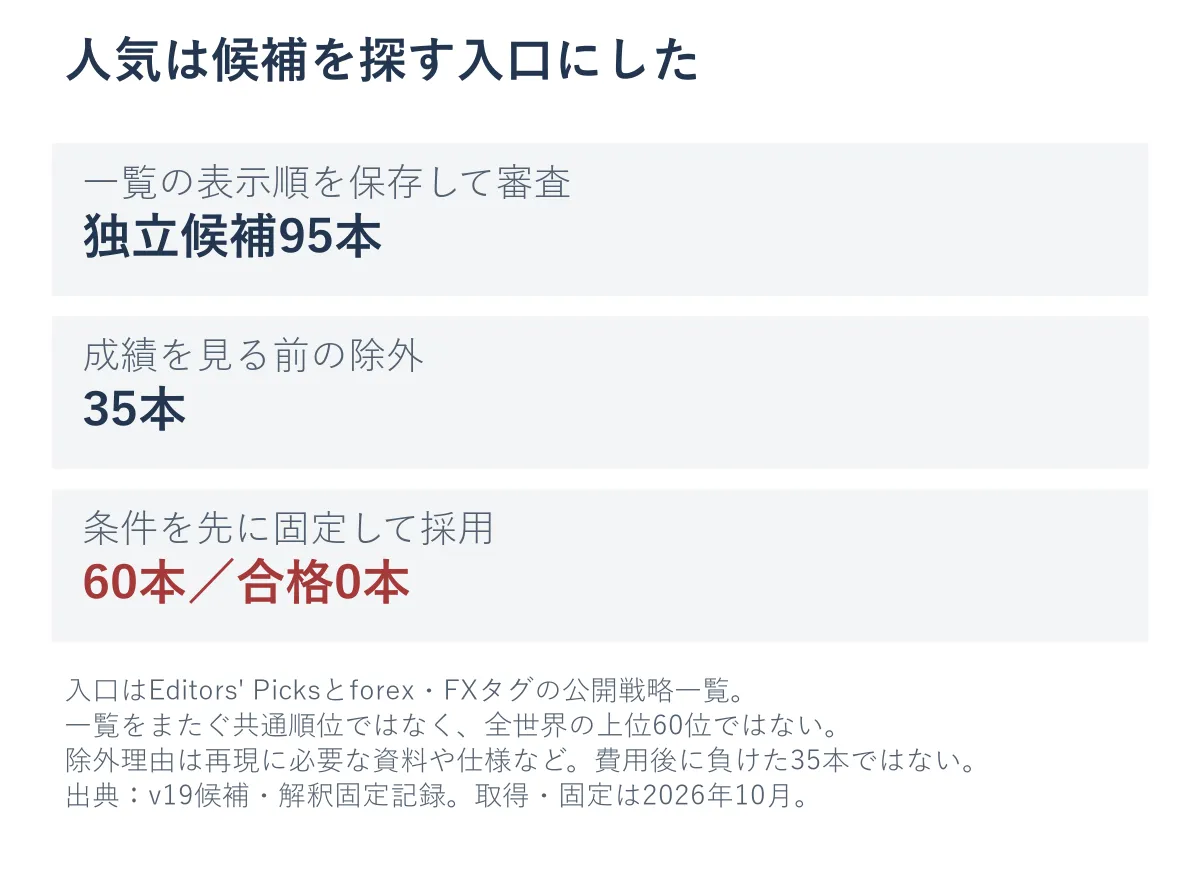
What I want you to see in this figure is the middle “35.” The ones ruled out were for reasons such as lacking the materials needed for replication. They were not excluded because they lost when tested.
Among the remaining 60, I included the costs of domestic FX companies. The spread between buy and sell, unfavorable slippage at order time, and the rollover costs when holding a position.
Popularity is similar to the line at a ramen shop. The length of the line is not a certificate of taste.
The middle performance is almost “break-even”
Performance was compared by “total profits ÷ total losses.” Above 1 means profit, below 1 means loss.
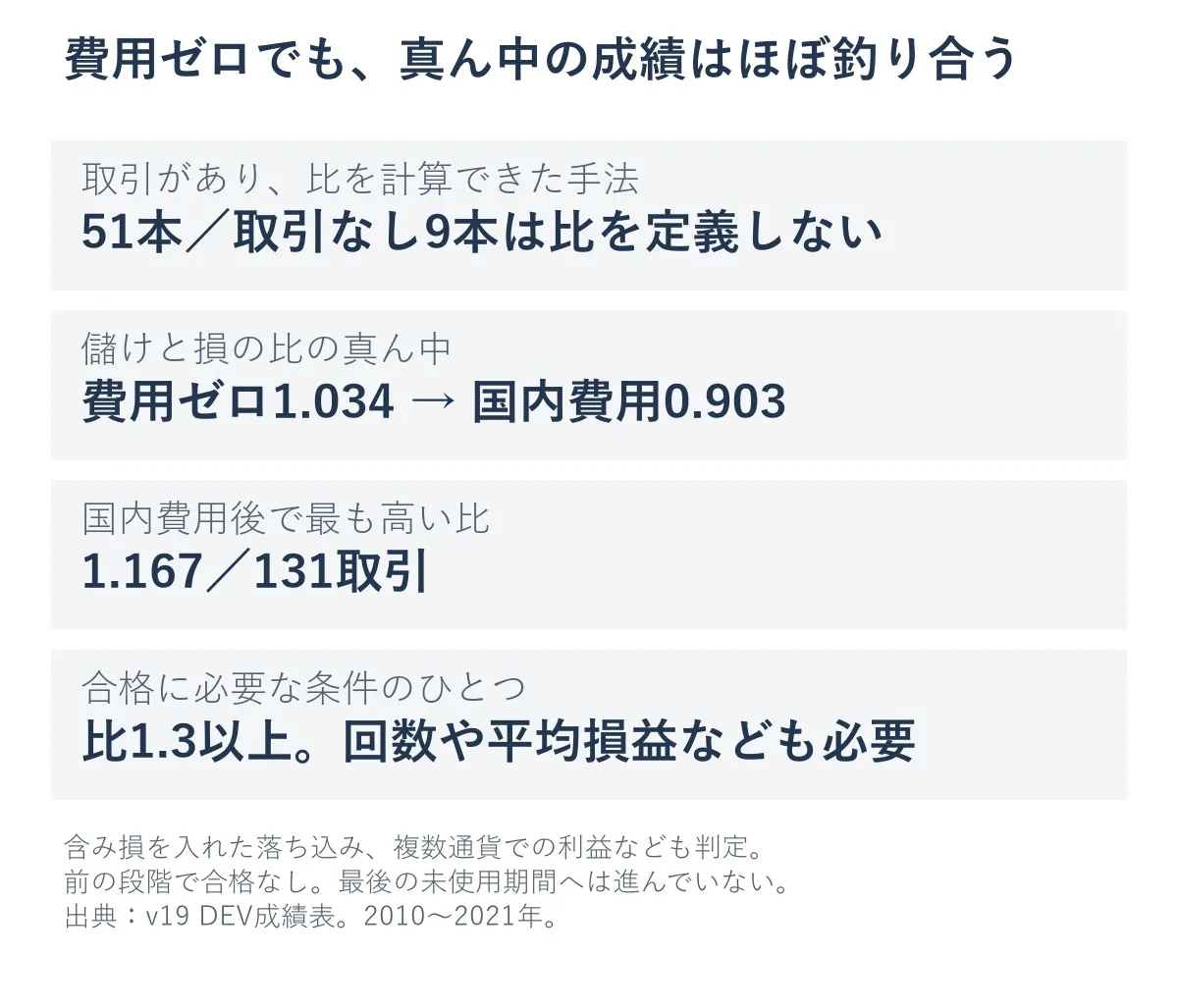
What I want you to see in this figure is the difference before and after costs. Even with zero costs, the middle value is 1.034, almost break-even. When domestic costs are included, it drops to 0.903.
Even the best method, with costs included, is 1.167. To pass, you needed above 1.3, and there were conditions such as the number of trades and average profit/loss.
The number of likes cannot cover trading costs.
Popularity is an entrance
From here, this is my personal view.
Investigating popular methods in itself is not a waste. It helps you understand what kinds of thinking are favored and serves as an entry point to test on your own.
However, I don’t want popularity to be misused as “proof that you can win after costs.” Even so, I will not adjust the passing criteria based on popularity.
When choosing a method, first check whether the performance table includes the cost conditions and the number of trades alongside it.
What isn’t clear in this article and cautions
・The candidates were gathered from TradingView’s Editors' Picks and the public methods list under the forex/FX tags. They are not ranked by global popularity or the author’s ability.
・It is not a complete recreation of the author’s capital management, and costs are assumed fixed.
・The period uses prices from 2010–2021, and the results are from testing methods published later at earlier prices. The final confirmation period was not advanced.
Sources
・My verification records (Public strategies study v19: fixed candidates and interpretations, performance table. Acquisition and fixation of candidates as of October 2026)
The results for all 60 strategies and the yearly/currency weaknesses of the top methods are summarized in the e-book “TradingView Popular Strategies: 60 Full Verification Reports.”
https://www.gogojungle.co.jp/tools/ebooks/87979
This article is a record of verification and information provision, and does not recommend specific trading or promise profits. Please make investment decisions on your own.