
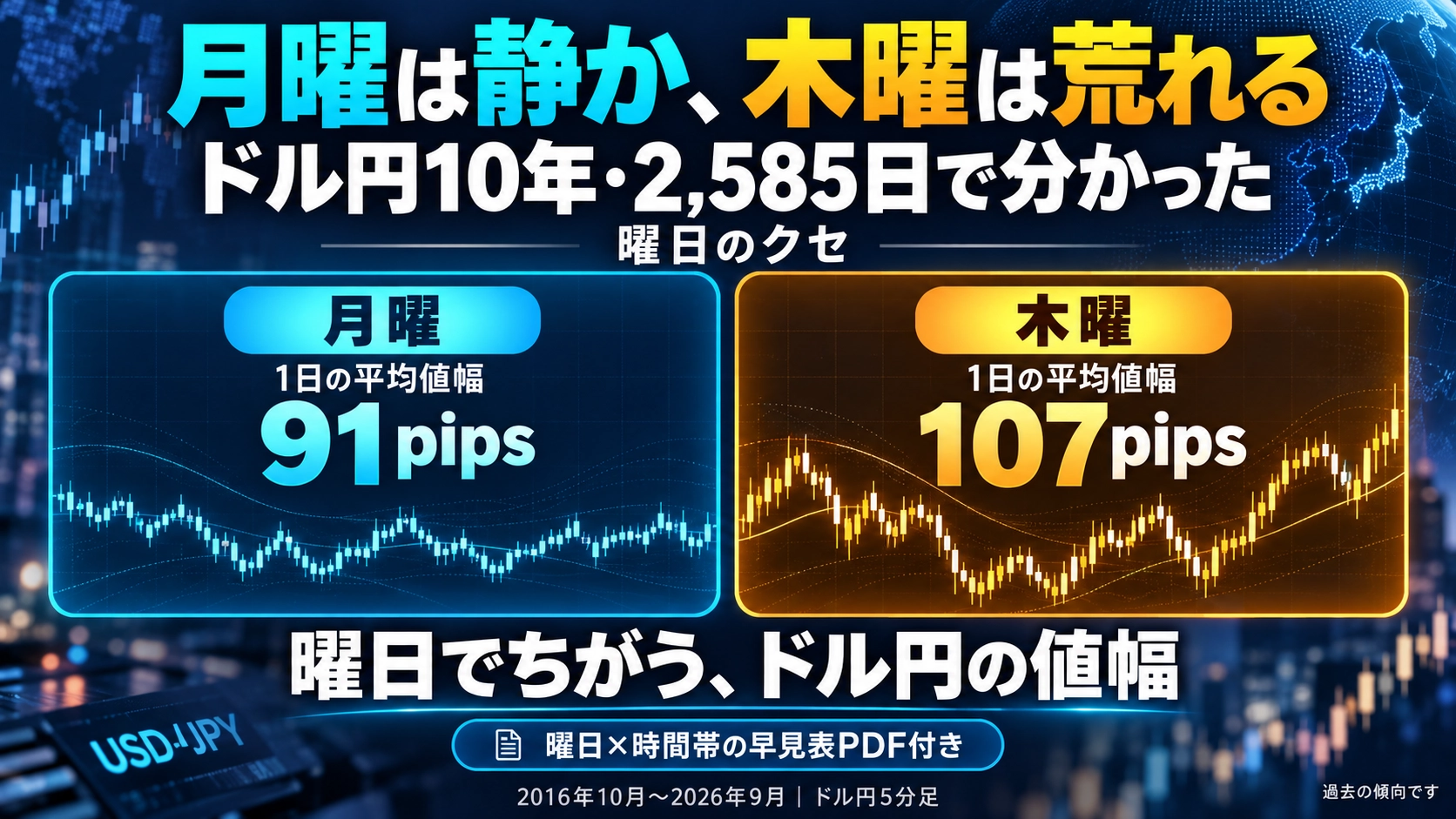
Monday is quiet, Thursday is rough|Dollar-Yen 10 years, 2,585 days reveal the “weekday habit”
[New Product Introduction]
I released the MT5 indicator "Omakase Horizontal Line Pro" that notifies you on your smartphone when your foot hits the horizontal line (this is a product I sell).
https://www.gogojungle.co.jp/tools/indicators/88552
Even when entering with the same stop-loss width, on Mondays it didn’t arrive, and on Thursdays it hit the stop loss immediately.
Haven’t you had that kind of experience?
USD/JPY, and the daily movement range varies by day.
I counted 10 years of USD/JPY 5-minute bars (October 2016 to September 2026, on weekdays 2,585 days).
Terminology used in this article
- Range: the difference between the day's high and low (1 pip = 0.01 yen)
- Daily window: from 7:00 a.m. to 6:59 a.m. the next day Japan time (dividing at the close of the NY market)
Mondays are quiet, Thursdays are volatile
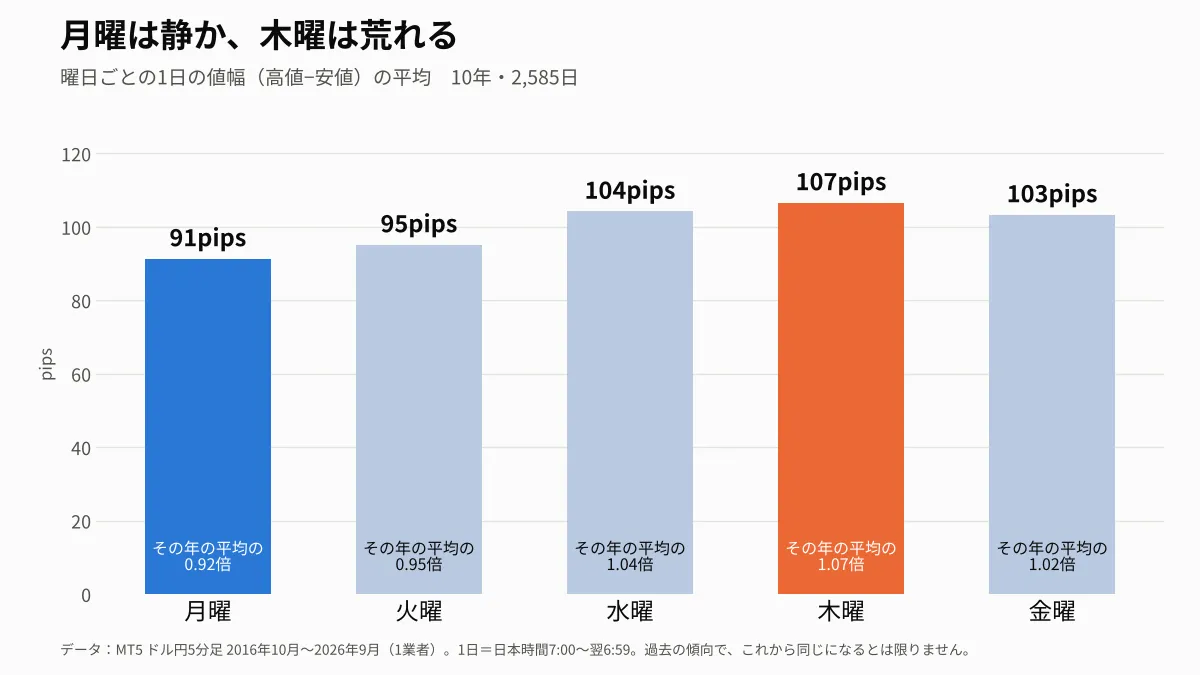
Monday: 91 pips
Thursday: 107 pips
Tuesday 95 pips, Wednesday 104 pips, Friday 103 pips.
Between Monday and Thursday, there is about a 1.2x difference in daily range.
Even when dividing by year, Mondays are quiet in 9 out of 10 years, while Thursdays are active in 9 out of 10 years. It doesn’t seem to be skewed by a particular year.
I use a browser app that announces times by voice, “FX Voice Reminder,” to read out the times to watch (this is a product I sell).
▶ See FX Voice Reminder (no installation required)
The daily difference is about 1.2x, but when looking only at the 21:00 hour in daylight saving time, the Monday-Thursday difference widens to about 1.6x.
In the continuation,
- A printable “Day of the Week × Time Zone Quick Reference” (PDF, 2 pages)
- On Mondays, 60% end up “upwards”, i.e., the rise/fall by day of week
- Why Thursdays nights move a lot (there is a fixed time every week)
- Based on these results, how I adjust my view of price range by day of week
is included.