
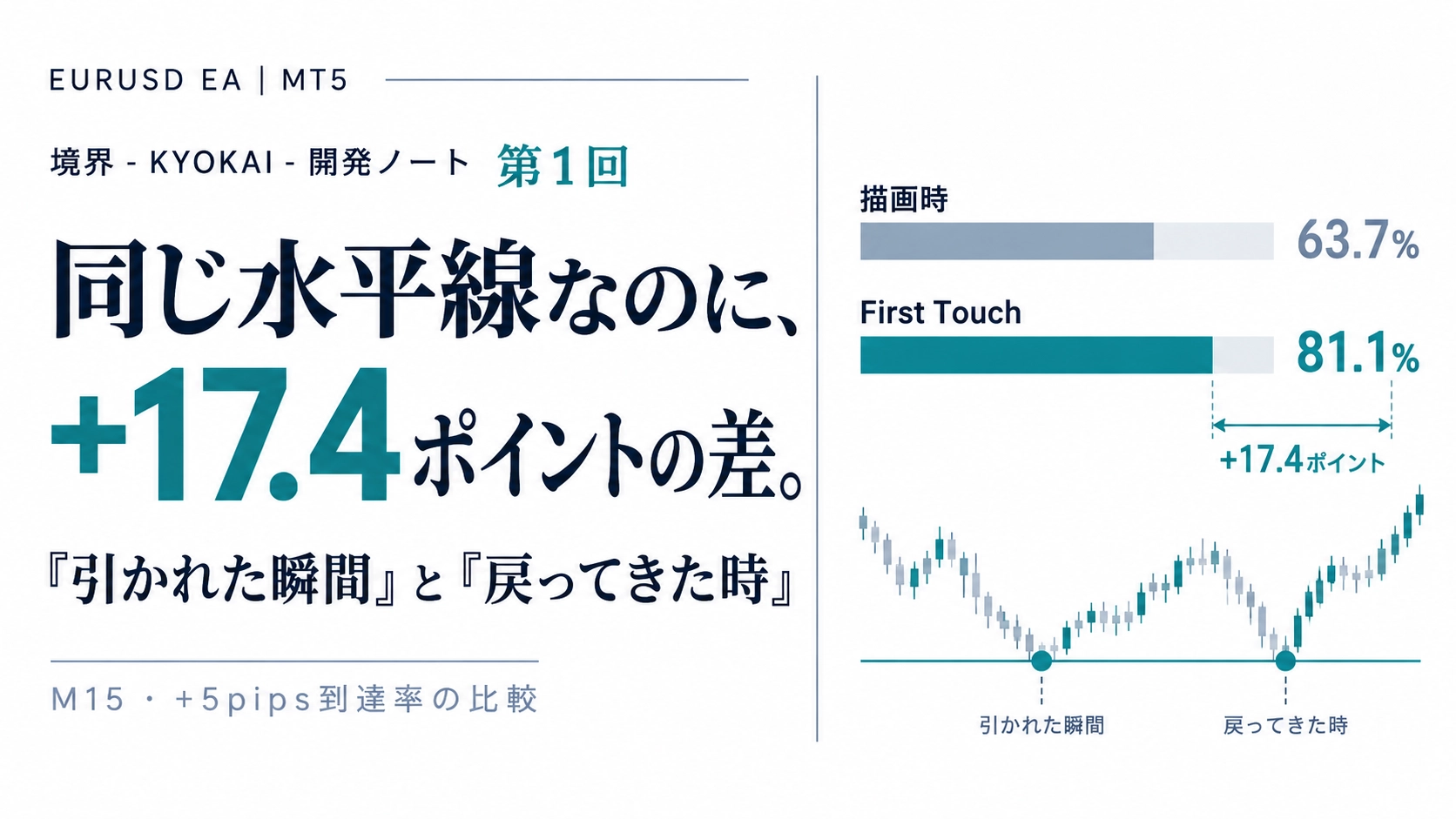
The horizontal line responds more when it comes back than at the moment it is drawn—EA development's first discovery
An EA for EURUSD, "Boundary - KYOKAI -", is completed. What I tried, what didn’t work, and what I kept. Here is the verification process.
» Product page for EA "Boundary - KYOKAI -" here
When it touches the horizontal line, it reverses. That hypothesis was half correct.
The starting point was discretionary counter-trend trading
The trigger was my own discretionary method: when price reached a strong resistance/support, I would counter-trade for 30 seconds to 1 minute.
Could this be turned into an EA? The first thing I made was an indicator that drew a horizontal line on M15 bars and checked for touch (the precursor to the later "Boundary").
First, “measure” before trading
Rather than jumping to an EA, I logged the price action after touch to CSV and aggregated it. Here are the early EURUSD (real-time) results.
| Subject | Cases | Proportion that reversed after 1 minute |
|---|---|---|
| All Touches | 130 | 47.6% |
| Only the first touch | 70 | 53.7% |
Note: these are from a small initial dataset.
If you sum all touches, it’s almost a coin toss. However, when narrowing to only the first touch, it rose a bit. The difference isn’t large, but it was enough to conclude that there was value in exploring the first touch as a clue.
That is the preface. Ahead, there was one result that surprised me the most.
Compared “the moment of draw” and “the return when it came back”
Next, I compared cases where the Pivot line was confirmed at the moment of entry versus when the price moved away once and then touched back at the first touch (First Touch). I used only cases where both could be compared on the same pivot.
| M5・At drawing 1,073 |
61.9% | |
| M5・First Touch | 78.0% | |
| M15・At drawing 397 |
63.7% | |
| M15・First Touch | 81.1% |
Comparison of reaching +5 pips. Basically, the analysis is for EURUSD.
| Timeframe | Number of comparable cases | Median time from drawing to pullback |
|---|---|---|
| M5 | 1,073 | Approximately 1 hour 25 minutes |
| M15 | 397 | Approximately 3 hours 55 minutes |
In both timeframes, the First Touch that came back later wasabout 16–17 points higher.
It wasn’t that the new line attracted reactions. It was that after moving away once, price reacted more readily when it returned to that boundary. This is where “First Touch after line formation” becomes the core of the boundary later.
Impressions at M5 and M15 at this point
The count was higher for M5, and the First Touch reaction was slightly better for M15. The subsequent live trading verification would be unified on M15 from here on.
What this number alone cannot tell
These numbers measure the “+5 pips moved” ratio. They are not the performance of actual buy/sell with TP/SL. In reality, when you take what looked good in the diagnosis and apply it to live trades, the story changes. For currencies with higher win rates, the results could be worse; adding conditions could weaken performance; extending TP could lower the PF, and so on. In the next sections, I will describe these failures in order.
Summary
- Overall reversal rate for all touches is about 48%, roughly a coin toss
- Narrowing to the first touch improved things slightly
- The First Touch that returned had about 16–17 points higher +5 pips reach than the moment of drawing
- But this is a diagnostic value, not a trading performance
The EA that was developed after this verification
Boundary - KYOKAI -
EURUSD-only EA that targets the First Touch of the horizontal line with a counter-trend strategy.
Through various trials including the ones described here, it has taken its present form.
| Subject | EURUSD-only • M15 |
| Entry | First Touch counter-trend on horizontal lines (R1, R2, S1, S2) |
| Filtering | Bollinger Bands, ADX, higher-timeframe filter |
| Exit | SL linked to H4 ATR and trailing |
Next:Touch alone was not enough. What remained after adding BB and ADX, and what disappeared after adding RSI and Stochastic.
※These are results from past verifications and do not guarantee future performance.