
The rule that cannot be kept becomes a habit you want to protect.
“Just a little, maybe I can get something.”
Looking back on failures at this period, what stood at the entrance was such a small desire.
First week of August 2026. Checking the history of Fintokei’s Challenge Account (demo account), the daily profit and loss on the 4th was −169,859 yen, and on the 6th it was −102,237 yen.
In the two days of sharp decline, −272,096 yen. Including other days, the weekly total was −272,038 yen.
About 270,000 yen in the red.
It wasn’t about aiming for the usual profit in the usual conditions.
I wanted to secure at least a little profit.
With that kind of feeling, a position I held moved in the opposite direction from what I had expected.
“Ah, no… this is definitely bad stuff…”
The intervals between repeats became longer, but I thought, should I do it again…
No, “should I do it again…?”
That kind of feeling crossed my mind.
Still, I tried to help the position I had by averaging down (adding to a losing position).
At first, I wanted profit.
Later, I wanted to save the position I had taken.
Looking back, that switch is scary.
Although I entered after watching the market, before I knew it, my next actions were determined by my position’s own circumstances.
Lack of resolve.
I should anticipate the worst price movement and build a position accordingly.
This is one of my usual trading rules.
But actually, this isn’t such a difficult thing to do.
However, that only applies when it’s “my usual trading.”
In my normal trading, there is always a price at which I will lock in the loss.
Once I’ve come this far, I retract my reading. I enter with the intention of accepting that loss.
The “resolve” I’m talking about here refers to that kind of preparation.
Rather, if you can’t decide in that situation, it isn’t even trading.
Yet sometimes I skip that preparation and enter with a feeling like, “I might get a little,”
Outside of my usual trading, I end up taking on a position on my own.
This is something I want to note as my personal first failure.
Not knowing UT doesn’t explain it.
Before using what I know, my hands were already moving.

The reason for the impatience will not disappear from now on.
Why do I enter in such a way.
Looking back, there are various reasons that come to mind.
This week I haven’t made a profit.
I missed opportunities at work.
I exhausted my willpower at a new workplace.
I missed the chance by a few minutes.
In my past full-time era, there was a sense of urgency that I must make a profit or life wouldn’t be livable.
There are probably more such reasons, but I think these kinds of reasons will not disappear in the future either.
From now on, there will surely be times like, “Ah, I haven’t traded this week yet…”
As I work while moonlighting, there will always be countless chances I can’t be there for.
If I change jobs, there will be days when I exhaust my willpower again.
I’ll inevitably be late because I can’t hold it in when I have to use the restroom, when the intercom rings, or when an important message comes in.
Those things won’t disappear either.
If I try to face the market only after eliminating all reasons for impatience, it’s not clear when that would be.
Nevertheless, as I began changing my actions after August’s failures, a strange sense emerged.
“Ah, I won’t have to do this anymore.”
That sense gradually grew into something close to certainty.
The reasons to rush didn’t disappear, nor did a life where I don’t miss opportunities.
So why did I feel that way?
That’s why I decided to talk with AI to dig into it.
First, what I had been skipping at the entry point when I failed.
What I had been skipping was the extra step of looking at higher timeframes.
For example, the 1-minute chart is rising strongly.
“No, at some point there will be a pullback.”
When I thought that, I would judge based only on the short-term shape in front of me, without checking where the peak sits on the higher timeframe.
The visible pattern has some reason behind it.
But I wasn’t looking at the situation in which that pattern was placed.
What’s happening on the 1-hour chart?
From August 10 onward, I decided for myself.
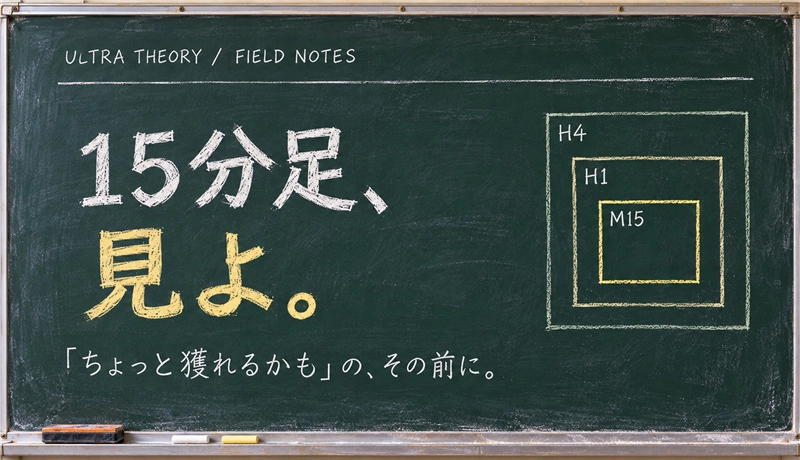
I will not enter based solely on chart patterns below the 15-minute chart.
If there are movements on the 1-minute or 4-minute charts that catch my eye, I first go look at the 15-minute chart.
I don’t end the discussion with just the 15-minute shape; I check what’s going on in the higher timeframes.
Up to here, I think this is a common reflection story.
I messed up big, so I decided on rules. Next, I will follow them.
But if that’s all, it could still be a story of, “I decided, yet did it again.”
What was interesting in this reflection was not the decisions themselves, butthe reason why going to check afterward was no longer a burden.
“Ah, only here.”
When I look at the 1-minute or 4-minute charts, I still feel, “Huh?”
That feeling hasn’t disappeared entirely.
But at that moment, that failure once again crosses my mind.
There was the same entry point in the failures I had repeated before.
“If I enter now by thinking, ‘I might get a little profit,’ I’ll end up with what happened before again.”
Too risky. Let me check the 15-minute chart.
Something like that happened.
And then I actually went to check it.
“Ah, that’s still so far on the 15-minute chart.”
“Ah, the 15-minute chart has just turned toward that direction.”
What had seemed good when viewed only on the short-term now appears weak when placed back into a larger wave.
That’s right. It’s still in this story.
Then, there’s no need to enter based on the current impulse.
“Well, fine.”
I’ve been able to accept that.
The feeling wasn’t that I forcibly resisted a trade I wanted to make, but different.
After checking, I no longer felt drawn to that trade.
And what remained was the small relief of, “I’m glad I checked the 15-minute chart.”
Even if money doesn’t increase, the feeling of “glad I checked” remains.
In this moment, I did not enter.
Obviously, that postponement didn’t directly increase profits in the account.
Still, something a little good happened inside me.
I feel like looking only at short-term charts makes me want to enter.
I check the higher timeframe.
I reconsider whether I should adopt the current idea or pass.
And I think, “I’m glad I checked.”
For me, accumulating this experience bit by bit was a big factor.
“It’s good I didn’t enter” isn’t about realizing afterward that “if I had entered, I would have surely lost.”
I realized my own lack of basis at that moment and stopped taking positions on impulse.
That’s what felt “good” about it.
The act of checking brought something back in the moment.
Therefore, when I next feel “Huh?” on a short-term chart, it becomes easier to look at the 15-minute chart.
In the beginning, I had a strong urge not to repeat my failures.
Then, the sense of, “If I look, I can judge for myself,” was added.
That small sense of accomplishment became my reward.

Once I look at the 15-minute chart, I want to see the 1-hour chart as well.
The change didn’t end there.
When I check the 15-minute chart, I think now:
What is this movement in the 15-minute chart saying within the context of the 1-hour chart?
Seeing the 1-hour chart, I also want to check the 4-hour chart.
I move the movements that caught my eye on the 1-minute or 4-minute back to the 15-minute chart.
That 15-minute chart is then moved back into the 1-hour chart.
And connected to the background of the 4-hour chart.
Rather than viewing each chart as separate, I trace where the movement I’m looking at now sits within a larger movement.
For me, the fractal connection of timeframes began to have meaning in actual judgment through this flow.
The phrase “let’s look at the higher timeframes” is known.
But knowing it and linking the current movement to its background have a距离 between them.
I think I filled that distance with checks, one by one.
I always have the daily chart on a secondary screen as well.
However, I don’t automatically rotate through all timeframes every time until I remember the big background.
Increasing the number of confirmations wasn’t the goal.
I want to know what story I’m in now and what I intend to do about it.
The meaning of following the rules changed.
Looking back this far, only now did I put it into words.
It’s not that I can read the market because I started following the rules.
The joy of being able to read the market started forcing me to follow the rules.
Of course, deciding to “check” in the beginning was necessary.
It’s not that nothing changed just by deciding.
However, there was another reason that the action continued.
When I checked, the connections became visible.
When the connections are visible, I can reconsider whether to take the current impulse or pass.
Because that makes me happy, I check again.
Rules and understanding supported each other within that.
And with this change, one more realization settled in my gut.
I have a method to accumulate profits.
I can also use it in actual trading.
Still, I got a little impatient. I missed a chance. I still haven’t made a profit this week.
From that feeling, I started a strange trade whose basis I couldn’t even identify.
Moreover, I tried to save that position and ended up widening the damage.
Why do I have to blow away all the precious profits I’ve built up for such a worthless trade?
It feels such a waste.
Entering with my own basis and accepting the predetermined loss is part of my usual trading.
What hurt was that stepping away from that method and letting impulsive thoughts ruin the accumulation I’ve built.
There is a proper way to do it, and I have the power to implement it.
As that sense grew, it felt even more wasteful to emit profits in trades unrelated to that method.
That’s why, when I felt the urge to enter on a short-term chart, returning to the 15-minute chart became an important step for me.
From now, am I trading in line with my usual method?
Or am I just thinking, “I just want to take a little now.”
If I return to the background, I can reconsider that."}
The joy of confirming and making my own judgments.
And the desire not to lose what I’ve piled up by strange trades.
Both supported me to check again next time as well.
When I said, “It’s precious, so I fell for it” I meant that in that sense.
About two months after that.
From August 10, 2026, to October 9.
Cumulative net P/L in the demo account became +375,189 yen.
Even including the roughly 270,000-yen loss recorded in the first week of August, the trading history since August 3 examined this time shows +103,151 yen.
Of course, there were days with losses over 70,000 yen, and there were unnecessary trades.
There were days when I subconsciously entered after glancing at the short-term chart and later realized the mistake.
Not everything is perfect.
Nevertheless, during this period I didn’t repeat actions that started from a mere impulse to save a position and lead to a large loss, as I had done before.
This was a very big change for me now.
What I really want to convey in this story isn’t the amount of profit itself.
The difference between the judgment to accumulate profits and the judgment to destroy it in an instant.
That the difference has become much clearer than before.
And,the fact that I could recognize that difference for myself was what changed my next actions.
It’s not that I’m saying anyone who studies UT will achieve the same results.
I myself will continue to face the market and keep checking whether this change is real.
But, at least for me now, there is one good sign.
And I can explain where that sign came from this way.
This is the most important thing I wanted to convey in this reflection.

Beyond “Wait properly.”
This experience also connects to what I value in UT TRADE GYM.
Link market events and create a state where I know what I’m doing now.
For example, before ending with “let’s wait,” confirm what you can see now and what is missing.
Connect the reasons you intended to enter to preceding events and the background of higher timeframes.
Then you can explain your judgment or review it.
Make that process a place to practice.
Aim to be able to say the same answer as the teacher, but more importantly, to ask yourself questions, observe, verify, and adjust.
Aim to complete verification on your own.
“Follow the rules.”
Of course, you can be taught that.
But if, by following those rules, the person can experience what becomes visible,
“I’m glad I checked.”
“I see why I should wait.”
If you can discover those moments yourself,
the rules may cease to be something you are forced to follow by someone else.
In this reflection, I strongly felt that possibility.
For me, the beginning of change was almost quietly.
I look at the 1-minute chart and think, “I might get a little.”
Then I look at the 15-minute chart.
“Ah, it’s still within this story.”
Understanding that, I can return and say, “Okay, I’ll pass.”
A small success that won’t be recorded in that day’s account.
But that “glad I looked” created the person who keeps looking next time.