
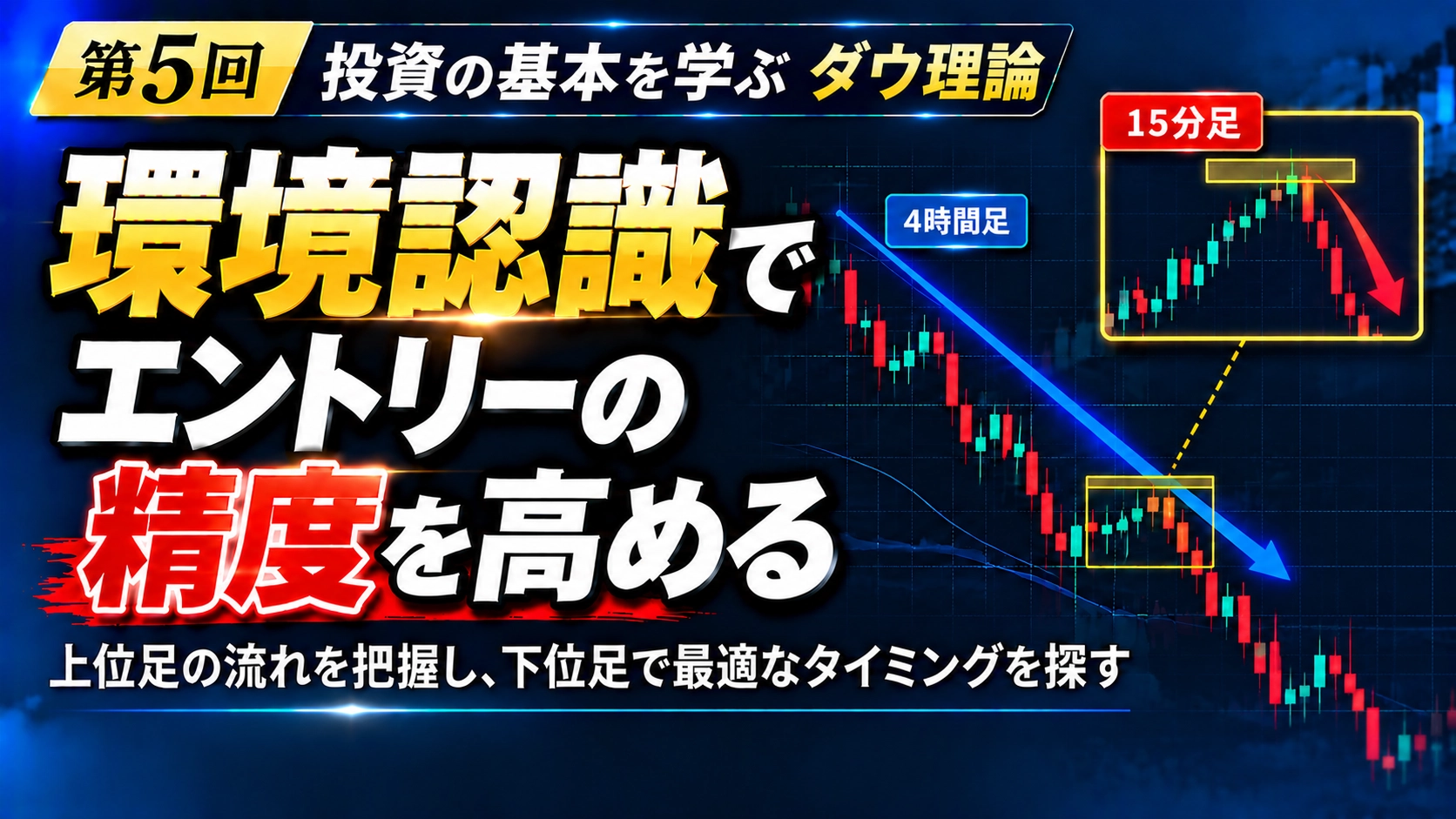
Learn the basics of investing Dow Theory Episode 5
I longed after breaking the high with a 15-minute chart, but it immediately retraced and I hit the stop. Have you ever had that experience?
The theme of the 5th in the Dow Theory series is “environment recognition.” I will explain how to view the market to reduce such stop-outs.
What I realized after many stops
When I first started trading, I watched only the 5-minute and 15-minute charts, bought when the high broke, and sold when the low broke, thinking I was following Dow Theory.
However, no matter how many entries I made, I kept getting stopped out. I couldn’t understand why I kept losing despite following the rules.
One day, when I looked back at a losing moment on the 4-hour chart, I finally realized: what I thought was a breakout of the high was actually a downturn in the 4-hour chart partway through a downtrend.
The reason I was losing wasn’t the method,it was that I wasn’t looking at the overall marketthat way. Since then, I always check the higher timeframe before entering, and my stop-outs decreased significantly.
What is environment recognition
Environment recognition means understanding “what state the current market is in” before entering. Just as you decide what to wear after checking the weather forecast, you decide “buy, sell, or do nothing” after knowing the market state.
The market direction is judged according to Dow Theory as covered in previous installments.
・Highs and lows both rising → uptrend
・Highs and lows both falling → downtrend
・Neither applies → range
Look from higher timeframes first
What’s important in environment recognition is looking at multiple timeframes. Start from the larger timeframe and go in order.
・Daily and 4-hour: confirm the main trend (direction)
・1-hour: see where price is within that trend
・15-minute and 5-minute: look for entry timing
The basic idea is to align timing on small timeframes with the direction of the larger trend.
If you only look at lower timeframes, you’ll get fooled by false moves
In a diagram of the stop losses I described, this is what happens.
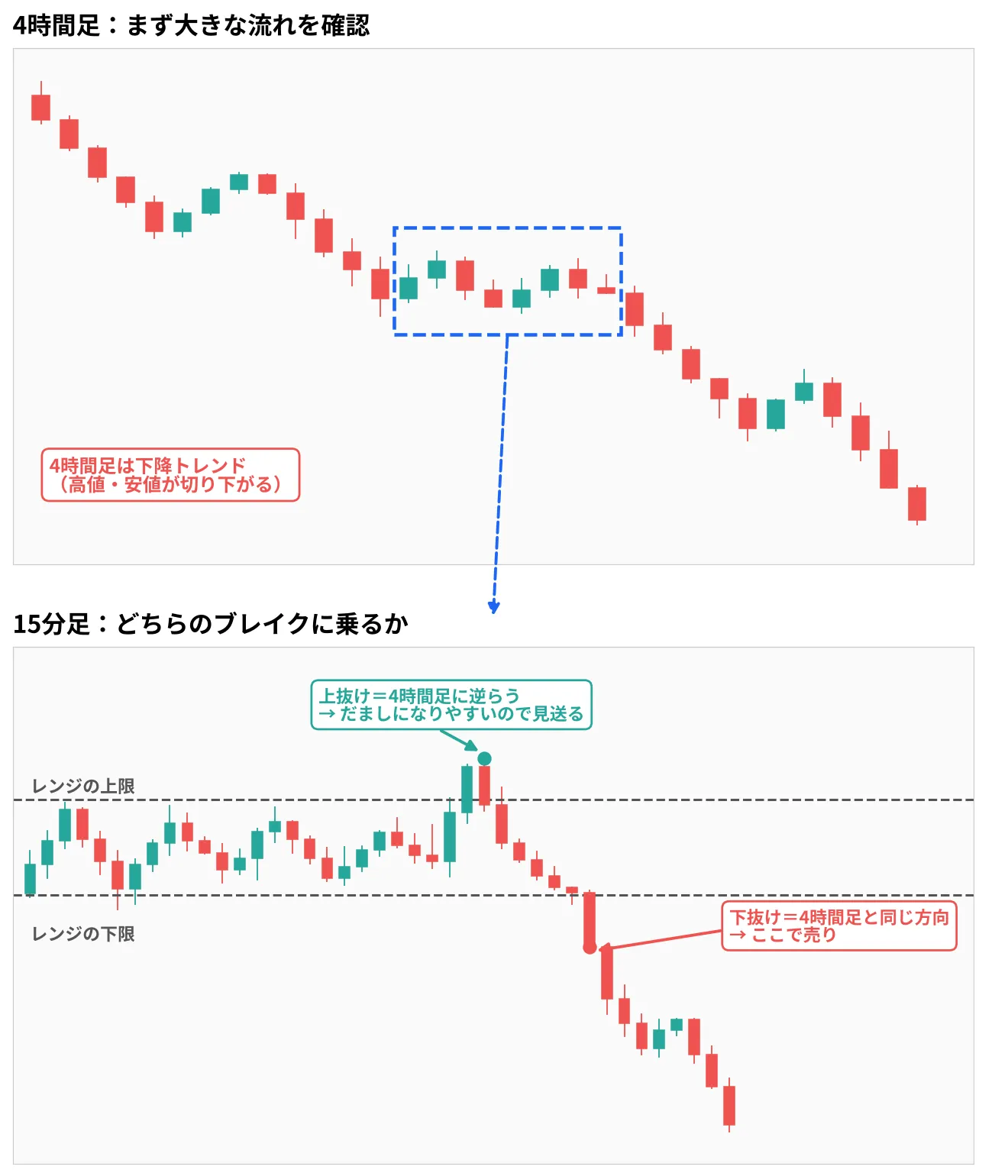
When the 4-hour chart is in a downtrend, a break above on the 15-minute range goes against the larger flow, so momentum doesn’t sustain and it tends to reverse. You enter as per the signal, but move in the opposite direction, which isa “false signal”.
How to avoid false signals
① Avoid breaks against higher timeframe direction
If the 4-hour chart is in a downtrend, skip the 15-minute break above, and only target breaks below in the same direction as the 4-hour chart.
② Mark higher timeframe pullback highs and pullback lows
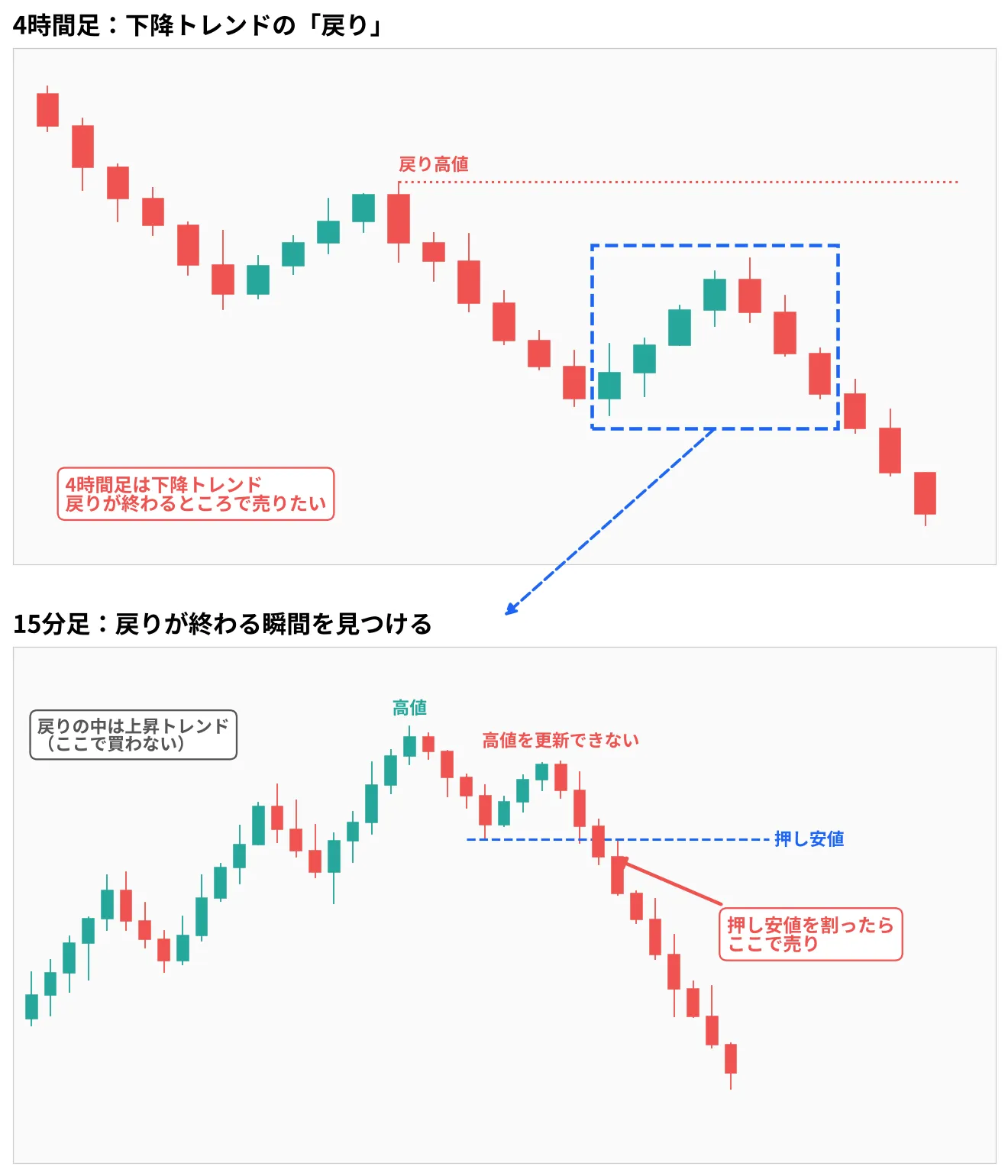
In a downtrend, the pullback high; in an uptrend, the pullback low. These are the points that determine whether the trend will continue.
③ Wait until the higher and lower timeframe directions align
When the 4-hour is down and the 15-minute is up, don’t enter. If the 15-minute can’t push to a new high and breaks a pullback low, that’s a sign the higher timeframe direction has aligned. Selling then becomes less prone to false signals.
Plan a scenario before entering
With this in mind, decide a scenario in advance: “If this happens, I will do that.”
Example: When the 4-hour is in a downtrend
・If price rises toward just before the pullback high, wait for scenario ③ and consider selling
・If price breaks above the pullback high, the downtrend may be ending, so stop selling
What’s important is not to be right about the forecast, but to have a predetermined next action regardless of the movementin which direction it goesso you can act accordingly.
“Tenda Trade Assist” to make the 4-hour flow easier to check
In my creation “Tenda Trade Assist,” there is a function that displays the 4-hour SMA (default 200, period adjustable) on charts of any timeframe.
While watching the entry timing on the 5-minute or 15-minute charts, you can see the 4-hour flow on the same chart, reducing the chance of overlooking higher-timeframe movement.
Furthermore, when the filter is ON, if price is above the SMA you automatically enter long, and if below you enter short, preventing entries against the higher-timeframe flow (default OFF).
▼Details of Tenda Trade Assist here
https://www.gogojungle.co.jp/tools/indicators/86695
Even with automated trading (EA), environment recognition matters
There is no EA that wins in all market conditions. Counter-trend EAs struggle with strong trends, and trend-following EAs struggle in ranges.
My EA also includes a mechanism to check the 4-hour flow. When I tested removing this mechanism, the results deteriorated so much that the account would have broken down. Whether discretionary or automated, environment recognition greatly affects results.
When using an EA, understanding whether the current market is favorable or unfavorable for your EA makes it easier to decide whether to keep running or pause temporarily.
Summary
・Environment recognition means understanding the market state before entering
・Look at the higher timeframe for direction and align timing on the lower timeframe
・Breaks against the higher timeframe direction are prone to false signals
・Decide in advance at what point you will change your mind as a scenario
Before your entry method, first observe the market state. Adopting this habit can significantly reduce wasted trades.
Next time: Fractal structure
If you look at one wave on the 4-hour chart on the 15-minute chart, you’ll see similar rising and falling waves within it. This market mechanism, where “small waves exist within large waves,” is called a fractal structure.
Knowing this reveals why higher timeframes are prioritized and where a major trend reversal begins. See you next time as well.