
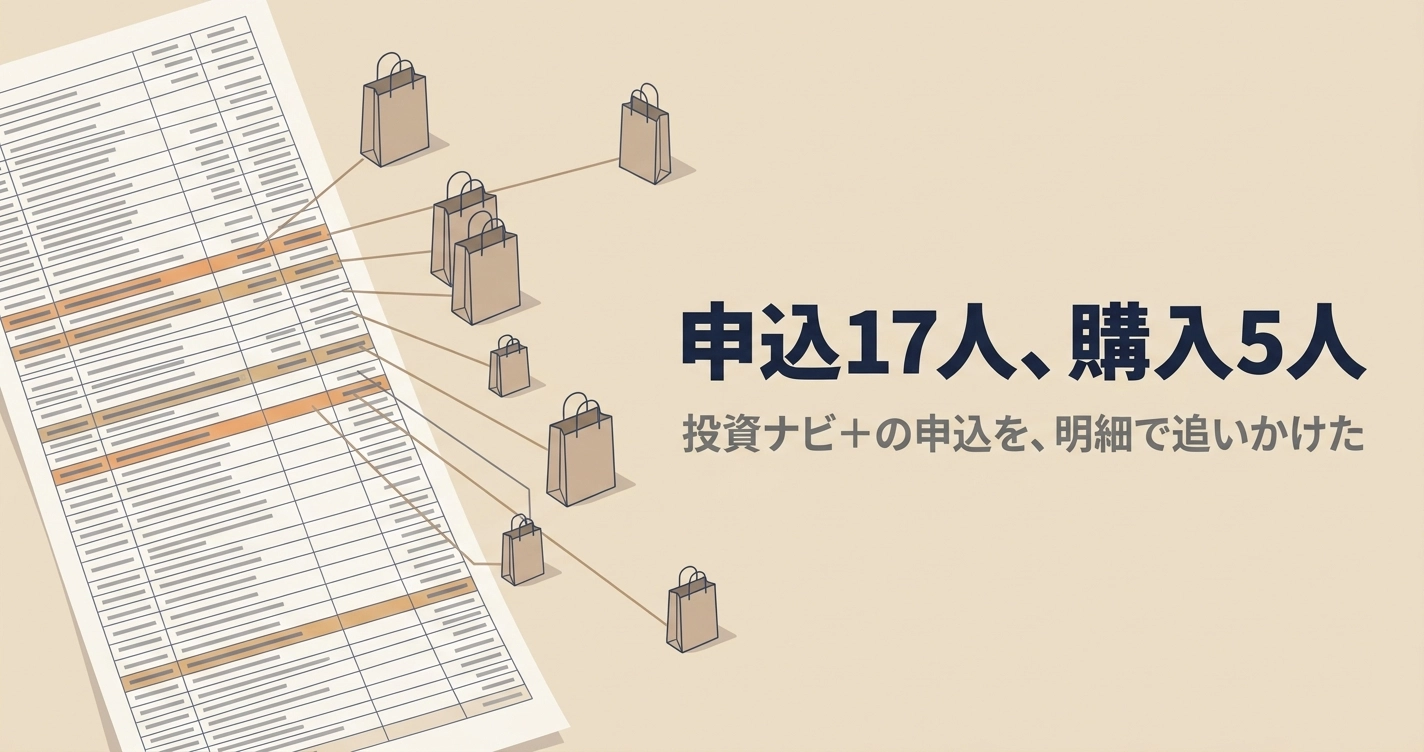
From the free application of Investment Navi+, how many people purchased — counting applications and purchases by linking them in the receipt details
17 people Free application (April–September) | 5 people · 13 items Purchases after application | 32 minutes From application to buying 5 items in total |
I am lab.aiueo, creating MT4/MT5 indicators and selling them on GogoJungle.
In June, I published an introduction article for SMC-Signal on Investment Navigator.
The latter half of the article had a “Read more” link, and reading required a free application.
Applications leave themselves as purchases without amounts in the receipt on GogoJungle. The receipt also indicates whether the person later bought something.
Today, I will write the results of linking applications and purchases from the receipts from April to September.
First, the numbers only
- Applications: 17 cases (17 people). 13 cases in June, 3 in July, 1 in September
- People who bought something after applying: 5 people (about 30% of 17)
- The number of items purchased by those 5 people: 13 items
Whether an application directly caused a purchase cannot be determined from the receipt. What can be known is that the applicant and the buyer later turned out to be the same person.
Still, among 58 people who bought items from June 5 to September 29, 5 people and 80 items were from those who had applied.
This is a record of how to read receipts for those selling indicators or those planning to attract readers with articles.
1Time from application to first purchase
For the 5 people who bought after applying, the time from application to the first purchase is listed.
- 32 minutes later
- 4 hours 20 minutes later
- 11 hours 53 minutes later
- 5 days and 13 hours later
- 84 days later
Three of the five bought within half a day of applying.
It appears that readers continued to the sales page after reading the article. However, the receipts do not show from which page they bought, so this is speculation.
The person who bought after 84 days purchased SMC-Radar and SMC-Compass in September, and GD-Deck a week later. At the time of the June application, GD-Deck did not exist.
2After 32 minutes from application, five items were purchased together
An application was made at 23:59 on June 16, and the next day at 00:31, five items were purchased together.
- SMC-Signal
- SMC-Radar
- SMC-Compass
- CP-POL
- CP-POW
Furthermore, four weeks later, when the MT5 version of CP-POL was released, they bought again.
The article about the application was an introduction to SMC-Signal. Still, the buyer did not only buy SMC-Signal.
Even with a single product introduction article, readers may look at other products by the creator. This one case suggests as much.
3Applications stopped in July
Applications by month were 13 in June, 3 in July, and 1 in September. After July 13, there were no more applications to the SMC-Signal article. The September 1 application was for another article.
From receipts, it can be read that applications gathered immediately after the article was published and then stopped after about a month.
Right after publishing, it catches attention; as new articles are added, it becomes harder to catch. This aligns with the movement of the numbers, though this is an inference that cannot be confirmed by receipts alone.
If you want to keep gathering applications, you have to keep publishing articles.
4A method to count by linking applications and purchases in receipts
Using GogoJungle receipt receipts (CSV). Here is my procedure.
- Download receipts for a period (I used April 1–September 29)
- Pick rows where the \"Product ID\" matches the article. This is an application. The selling price and revenue are shown as “-”
- Record the \"Download Member ID\" of the application row
- For the same member ID, look for rows after the application date that have revenue
- If found, count the time from application to purchase and the number of items
There are two caveats.
- If someone bought before the application, they are counted separately. In this case, one person bought the day before the application and was not included among the five
- We cannot see outside the period of the receipt. Those who bought after September 30 are not yet counted
Member IDs and nicknames are used only for aggregation and are not shown in articles.
A script version of the steps
As the receipt rows increase, manual searching becomes difficult. I turned it into a Python script. It outputs only time and item counts, without exposing the member IDs on the screen.
"""Count the applications and subsequent purchases in GogoJungle receipt CSVs for article applications"""
import csv
import sys
from datetime import datetime

path, *articles = sys.argv[1:]          # e.g.: python leads.py receipts.csv 80800
rows = [r for r in csv.DictReader(open(path, encoding="utf-8-sig")) if r.get("商品ID")]


def when(r):
    return datetime.strptime(r["販売日時"], "%Y/%m/%d %H:%M")


def paid(r):
    return r["収入"] not in ("", "-", "0円")


# First application time per member ID
first = {}
for r in rows:
    if r["商品ID"] in articles:
        m = r["ダウンロード会員ID"]
        first[m] = min(first.get(m, when(r)), when(r))

buyers = 0
for m, t0 in sorted(first.items(), key=lambda x: x[1]):
    after = sorted(when(r) for r in rows
                   if r["ダウンロード会員ID"] == m and paid(r) and when(r) >= t0)
    if after:
        buyers += 1
        print(f"申込 {t0:%m/%d %H:%M} → 最初の購入まで {after[0] - t0}({len(after)}本)")
print(f"申込 {len(first)}人のうち、申込のあとに買った人 {buyers}人")
Usage is simply passing the receipt CSV and the article product IDs. If there are multiple articles, pass their IDs in order.
python leads.py output_dev_xxxxxx_20260401_20260929.csv 80800 85372Results from my receipts.
申込 06/05 21:17 → 最初の購入まで 5 days, 12:53:00(2本)
申込 06/08 23:27 → 最初の購入まで 11:53:00(1本)
申込 06/15 16:28 → 最初の購入まで 4:20:00(1本)
申込 06/16 23:59 → 最初の購入まで 0:32:00(6本)
申込 06/27 18:21 → 最初の購入まで 84 days, 7:59:00(3本)
申込 17人のうち、申込のあとに買った人 5人
If someone bought before the application, they will not appear unless there is a purchase after the application. People who bought both before and after the application are only counted for the later purchase.
5How note and Investment Navigator are currently separated
Currently separated as follows.
- note: daily serialization. Writing about the creator. Paid content covers only the practical part of selling indicators
- Investment Navigator: publish the same article in full for free. From September 25, the form requiring no application
If you stop requiring applications, receipt rows for applications will disappear. In that case, linking applications to purchases in receipts will no longer be possible as in this article.
In return, the number of people who read the article to the end should increase since there is no application step. There are not yet enough numbers to compare which leads to purchases.
From October, I will write again when the daily articles have accumulated data on how they tied to sales.
This article is my own sales record. It does not disclose information that could identify purchasers. The structure of GogoJungle and Investment Navigator Plus may change, so please check the latest guidance. The indicators I 소개 are tools to assist market analysis and do not guarantee profits. Please make investment decisions at your own risk.
Thank you for reading to the end.