
What you must know, or things get bad!? The 2% Rule and Bankruptcy Probability [Capital Management and Position Management Part #2]
Hello! This is SAKU!
In the previous article (【Very Important】What is the Risk-Reward Ratio? 【Money Management and Position Sizing Part #1】), we learned about the risk-reward ratio that is indispensable in money management!
This time, to turn that into concrete numbers and establish money management rules, let's study the “2% Rule” and “Probability of Ruin”
What the 2% Rule Is
The 2% Rule states that the risk per trade (maximum acceptable loss) should be kept within 2% of your capital.
For example, with capital of 1,000,000 yen, the loss tolerance per trade should be kept within 20,000 yen (1,000,000 × 2%).
However, this is only a guideline, and individual tolerance varies, so many people set loss tolerance per trade to about 1–5% of capital.
(As a beginner, going above 3% might be taking on too much risk.)
This means thatit is advisable to recalculate after each trade.
Example) If 2% is the loss tolerance
・Trade with 1,000,000 yen capital and 10,000 units
→Maximum loss tolerance is 20,000 yen (2% of capital, 200 pips)
→With a 20,000 yen stop loss, remaining capital is 980,000 yen
→For the next trade, the maximum loss tolerance is 980,000 × 2% = 19,600 yen (for 10,000 units, 196 pips)
Similarly, if there is a profit, calculate based on the increased capital using the same percentage.
You can set the same percentage for a certain period or a fixed amount, and tailor it to what works for you.
Lot Size and Pips (Calculating the Appropriate Lot)
Rather than fixing the take-profit and stop-loss to the same number of pips every time, adjust your lot size according to the current take-profit target and stop-loss in pips.
Example) If you set maximum loss to 2% of capital 1,000,000 yen
・ Stop-loss at 25 pips, take-profit at 50 pips (risk-reward 1:2)
→ Since the maximum loss tolerance is 20,000 yen, enter with 80,000 units (8 lots)
20,000 yen ÷ 2,500 yen (stops 25 pips, 10,000 units = 2,500 yen) = 80,000 units
If you were fixed at 10,000 units (10 lots) each time,
2,500 yen × 10 lots = 25,000 yen stop loss, which is 25,000 yen ÷ 1,000,000 yen capital × 100 = 2.5% risk, exceeding the set 2% risk.
Thus,adjust the lot size so that the loss remains within the set loss tolerance according to the price move to stop-loss. This is how you should proceed!
Also, as with profit amounts, profits do not necessarily scale with win rate and trading skill.
The same 10 pips can yield very different profits depending on whether you trade 1,000,000 units or 10,000 units.
If you take 10 pips, the profit of someone trading 1,000,000 units is 100,000 yen, whereas someone trading 10,000 units would make 1,000 yen.
If you focus on the amount, the former looks more profitable, but the trading content is the same.
Focus on win rate and risk-reward ratio, keep capital protected, and trade without being swayed by amounts!
What is the Probability of Ruin in the Valsalà Model
The probability of ruin in the Valssa model is defined asthe probability of ruin given repeated trading rules and the relationship between win rate and risk-reward ratio.
From the Balsara probability of ruin table below,if the risk-reward is 1:2 or better,
even with a win rate of 50%, ruin is hardly likely.This is evident.
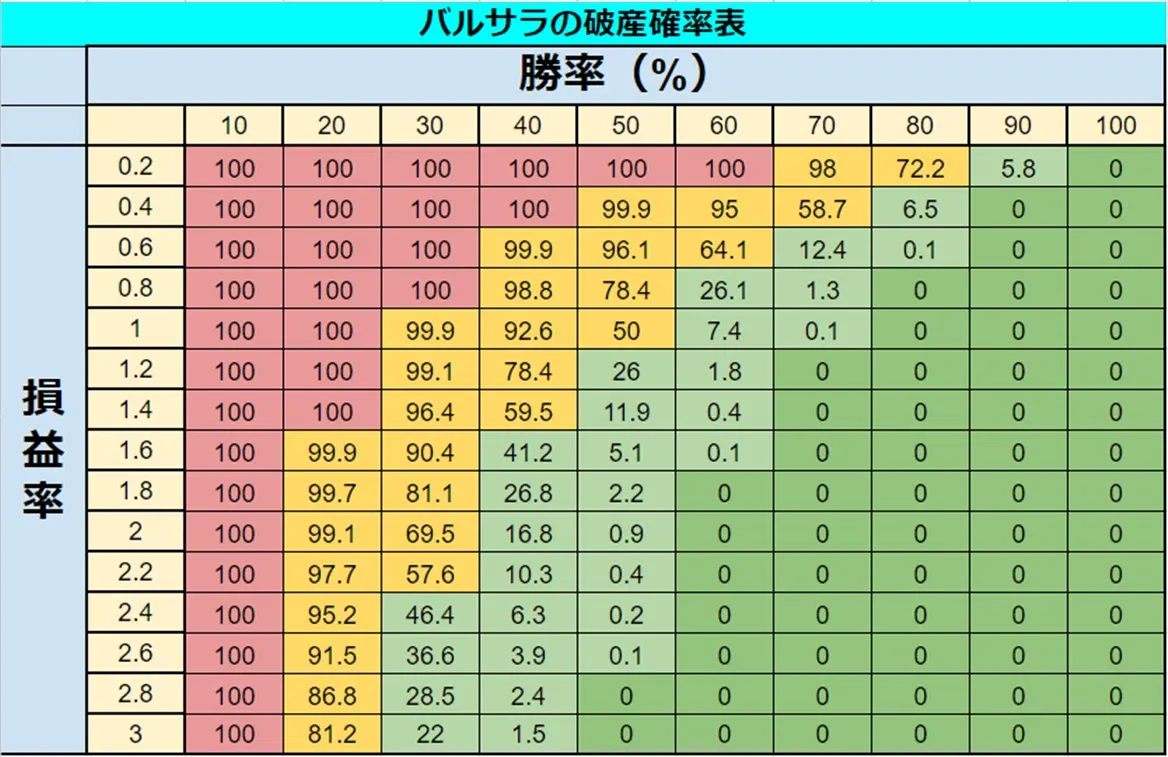
Conversely, even with a win rate of 60%, if the reward relative to risk is 0.2, ruin occurs 100% of the time! (;´Д`)
If you already have a trading rule, backtest your win rate and risk-reward ratio over a period to assess the probability of ruin!
If the probability of ruin for that trading rule is high, improvements may be needed!
Capital Management Is Extremely Important!
In the previous and current articles we’ve learned about money management, and this is enormously important when trading! (Previous article →【Very Important】What is the Risk-Reward Ratio? 【Money Management and Position Sizing Part #1】)
If you want to protect your precious funds while making a profit,you can't rely solely on technical analysis!I will repeat this until my mouth is sore.
Please study money management as well!
Calculations may be tedious and time-consuming, but if you want to win, commit to money management—it is unavoidable!
There is a huge difference between trading by feel when you haven’t studied money management and trading with an ingrained understanding of it.
Having only aggressive offense without defense won’t work.
As you can see from the Valssa probability of ruin table, even with an 80% win rate, if the risk-reward ratio is poor, ruin is highly likely. Also sharpen your defense.
Not only entry rulesbut alsomoney management rules
Even if the numbers don’t immediately show up, as long as you don’t exit, the results will come later.
That’s all for now!
Calculating allowable loss, risk-reward, and appropriate lot size may take time at first, but as you practice per trade, it will become natural!
If you’re not at a level where you can do at least this much naturally, you’re not ready for real trading.
Next time, we’ll study position management!
Next article is here ↓
Are you clipping losses with grounds for the money management and position management? 【Part #3】
For those who want even more practical money management, click here! ↓
【Limited Time Release!】 MMS Trading Encyclopedia—Spot the “structural traps” that individual investors fall into and the market microstructure analysis that reveals the footprints of big players— (There is also a free trial version)
→MTF Multitime Frame Analysis Essentials (There is also a free trial version)