

[Beginner] Tips for GOLD scalping: Why you keep winning but your money doesn’t stay
First, from the results of CALDO 1.1.50 on October 7
First, we will introduce the results of “CALDO GOLD AI Ver.1.1.50” on October 7, 2026.
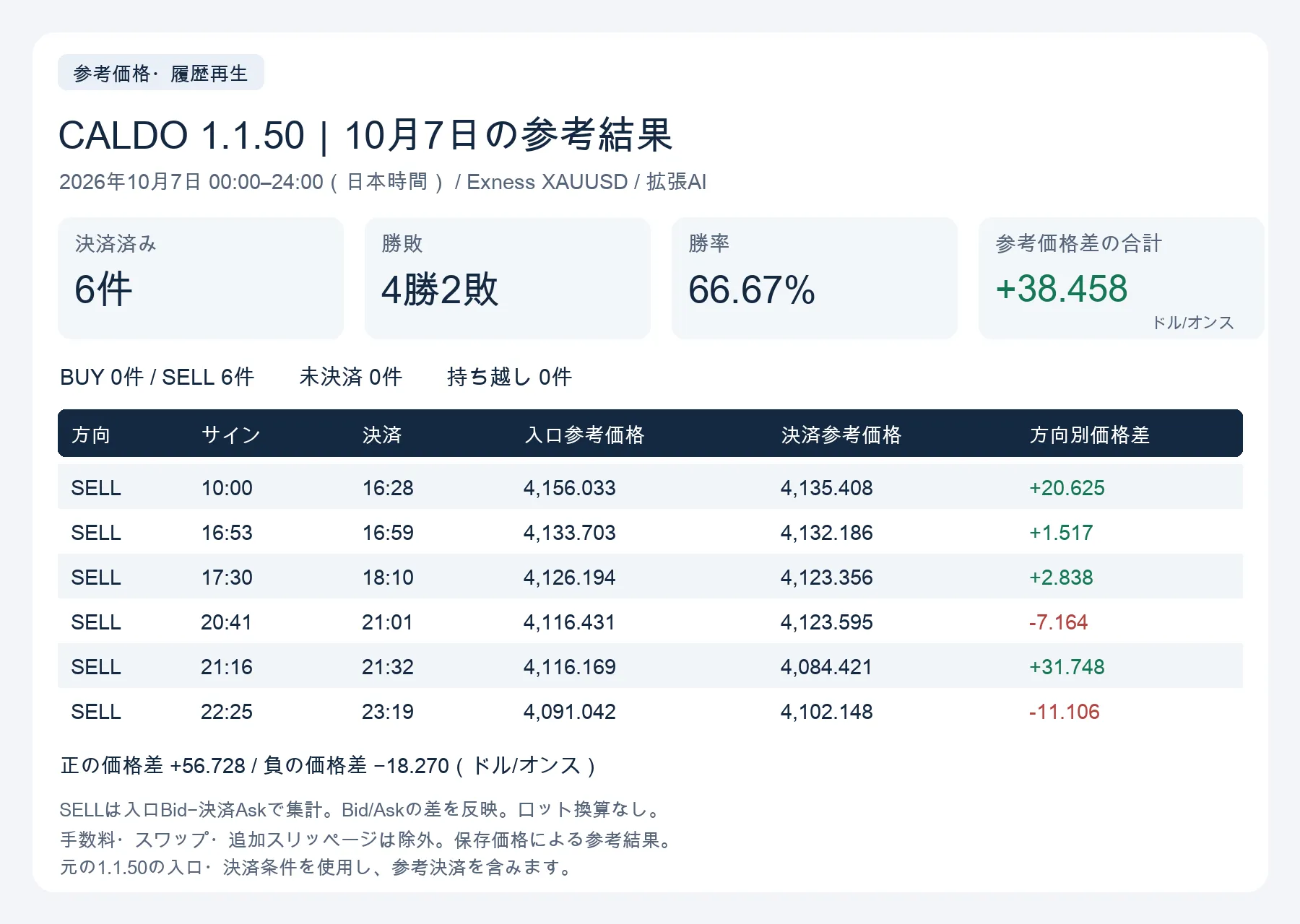
What is being published this time isa reference result that reproduces CALDO 1.1.50's initial setting "Expanded AI" using Exness saved prices. The aggregation target is signals generated from 00:00 to 24:00 on October 7, 2026 (Japan time).
| Confirmation items | Reference results for October 7 |
|---|---|
| Number of signals | 6 cases (all SELL) |
| Settled within the day | 6 cases |
| Wins/Losses | 4 wins, 2 losses |
| Win rate | 66.67% |
| Total positive reference price difference | +56.728 dollars/ounce |
| Total negative reference price difference | −18.270 dollars/ounce |
| Net reference price difference | +38.458 dollars/ounce |
| Unsettled at end of day | 0 cases |
Breakdown of 6 signals and settlements
All times are in Japan time. The reference price difference for SELL is calculated as “entry Bid − settlement Ask.”
| Signal time | Settlement time | Entry reference price | Settlement reference price | Reference price difference |
|---|---|---|---|---|
| 10:00 | 16:28 | 4,156.033 | 4,135.408 | +20.625 |
| 16:53 | 16:59 | 4,133.703 | 4,132.186 | +1.517 |
| 17:30 | 18:10 | 4,126.194 | 4,123.356 | +2.838 |
| 20:41 | 21:01 | 4,116.431 | 4,123.595 | −7.164 |
| 21:16 | 21:32 | 4,116.169 | 4,084.421 | +31.748 |
| 22:25 | 23:19 | 4,091.042 | 4,102.148 | −11.106 |
※ The units for price and price difference are dollars/ounce. The reference price difference is the sum of each signal’s value and has not been converted to lots or account currency. It reflects Bid/Ask differences, but does not include fees, swaps, or additional slippage. It is a playback of history according to the original 1.1.50 entry and settlement conditions and includes reference settlements. It does not represent actual order/filled account profit or loss, nor forward results run on the same day for 1.1.50.
On this day, there were 4 wins and 2 losses, and the total positive reference price difference exceeded the total negative difference. However, some signals took several hours from entry to settlement. The overall results for this day cannot be treated as scalping performance that finishes in a few minutes.
When looking at the results, please pay attention not only to “how many times you won,” but also to how much you lost on losing trades and how much remained in the end.
Also, results calculated from reference prices and actual orders/settlements should be treated separately. It is not guaranteed that you can trade at the displayed prices. CALDO’s displayed prices are reference values and may differ from actual execution prices.GogoJungle
From here, for those just starting scalping, we organize the basics of trading and actions that lead to failures.
The theme this time is not “selling/buying quickly” but “deciding the entry conditions and exit conditions in advance.”
Scalping is not a method to earn by making many trades
Scalping is a trading style that typically involves buying and selling within seconds to minutes, aiming for small price moves. However, having a short holding time and being able to make profits easily are not the same thing.OANDA Securities
“Buy because it rose a little”
“Sell because it started to fall”
“I cut losses, so I’ll make up for it in the next trade”
Imagine trades like this.
In each situation, the reasons to buy and to sell change, and loss-cut criteria become vague, making it impossible to compare good trades with bad ones.
What you should aim for first is not increasing the number of trades.
A trade you can explain: why you entered and where you planned to exit
Fail example: 80% win rate still results in losses
The following is a hypothetical example for explanation. It is not CALDO’s actual results. Each trade’s profit or loss is after deducting trading costs.
| Trade result | Count | Profit/Loss per trade | Total |
|---|---|---|---|
| Winning trades | 8 trades | +500 yen | +4,000 yen |
| Losing trades | 2 trades | −2,500 yen | −5,000 yen |
| Total | 10 trades | — | −1,000 yen |
Even if you win 8 out of 10, you end up negative in total.
“If there’s a small profit, I take it quickly. But if there’s an unrealized loss, I wait for it to recover.”
If profits and losses are biased like this, a few losses can wipe out accumulated gains.
Rather than just increasing win rate, look at the amounts of profit and loss as a pair.
This is the key point to remember first.
From here, what to change in actual trading
When told “don’t jump in” and “stick to your stop loss,” what exactly should you check?
From here on,explain how to narrow entry methods, why conditions change with chasing buys, and how to decide stop losses and trade sizes, along with fail examples. At the end, a pre-trade checklist is provided.
The remainder can be read with a free access application.