
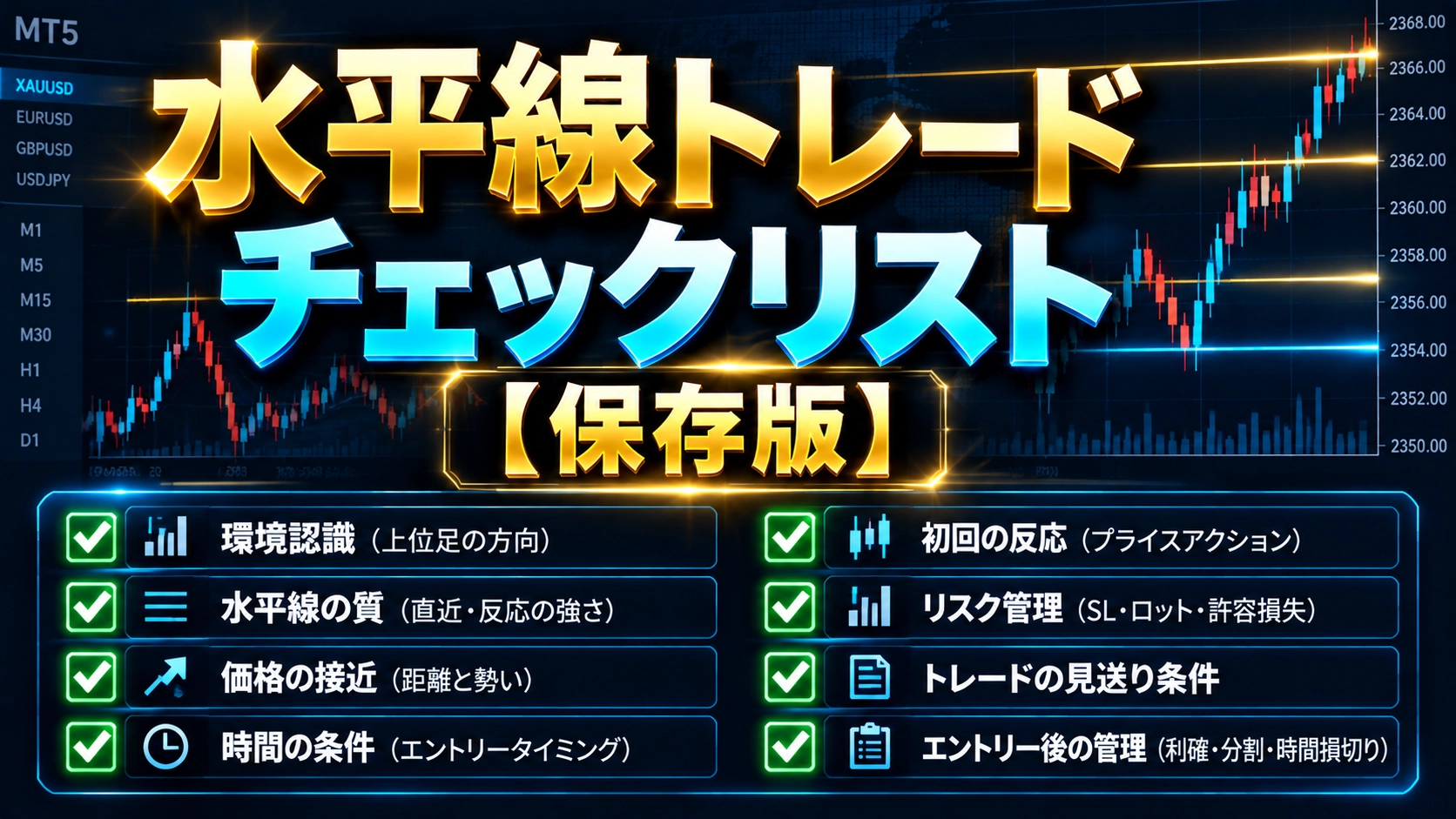
[Episode 6] A Checklist That Uses Horizontal Lines as "Judgment Material" (Final)
From Episode 1 to Episode 5, we have organized the essence of horizontal line trading as follows.
- Which number contact is that line making? (state of the line)
- How is the price approaching it? (the process of approaching)
- Are we not starting confirmation only after it has been “touched”? (timing)
- Does the approach have “momentum”? How much do the conditions overlap? (quality assessment)
- What should we look at before considering the “apparent win rate”? (proper validation)
In this final installment of the series, we will distill the content into a form that can be used as-is in actual trading sites.“Confirmation Checklist”as a concrete takeaway.
This is not a chapter adding new difficult theories. It is a practical session that reorganizes the thought process so you can execute it in front of the chart without hesitation.
Horizontal lines can be drawn on a chart by anyone.
The real difficulty lies in deciding what to observe and what to deprioritize (ignore) after drawing them.
Because having too many rules (checkpoints) makes it hard to follow in the field, we have narrowed the blocks to be consciously observed to a minimum of five.
❌ Three things you must not do when you open a chart
Before looking at the list, please first reflect on whether you have already done the following actions as a self-check.
- Continuously drawing lines to unlimited high and low levels that you are curious about
- Panicfully jumping in merely by watching the moment of touching the line
- Deciding that “this line will definitely reverse” based on past impressions or win rate
To prevent these, make it a habit to go through the next “5 check blocks” before trading, even for a short time.
Now, I will lay out the practical set that can be used in real trading sites: the ‘Horizontal Line Confirmation Checklists (A–E)’.
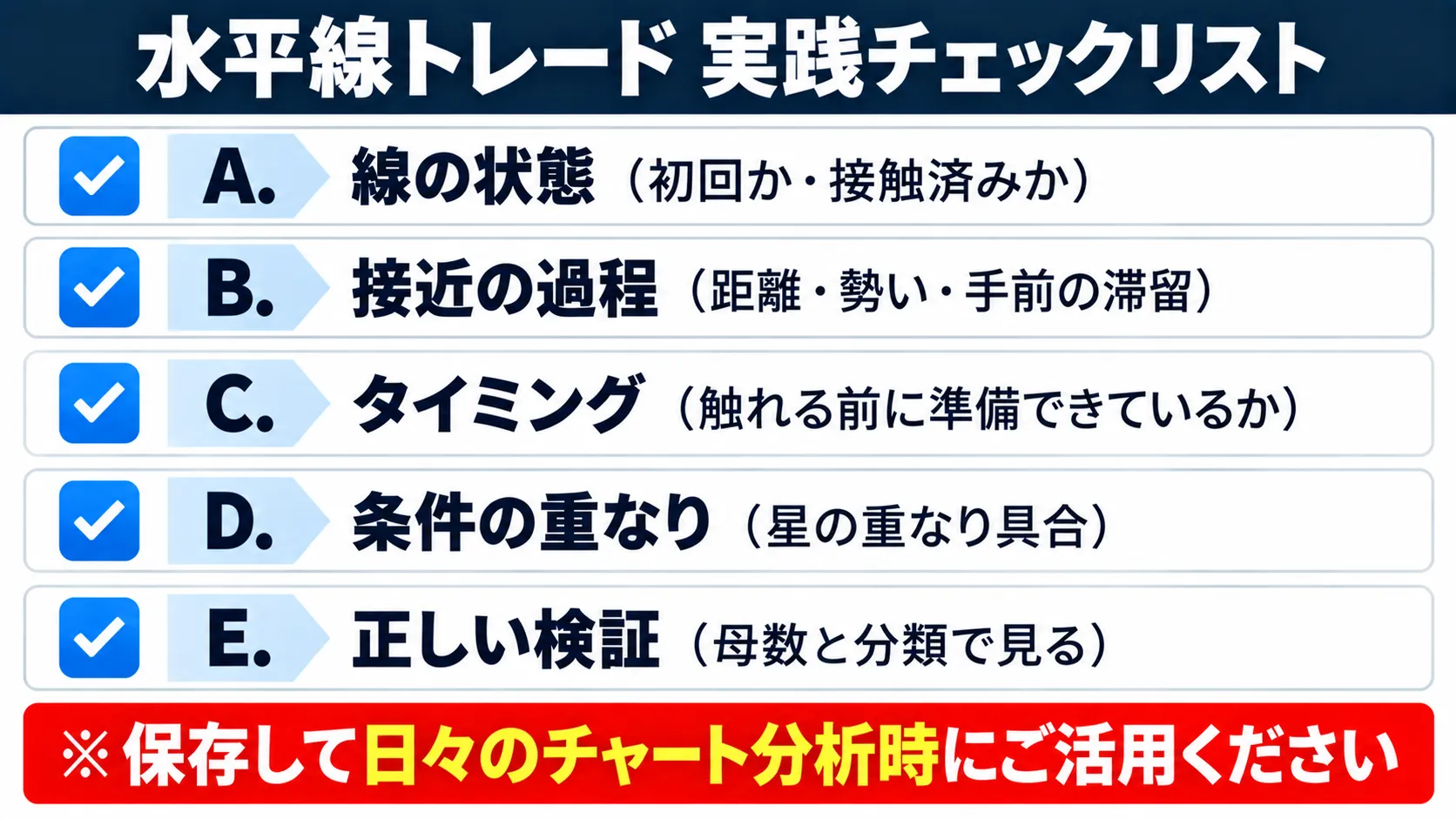
? Horizontal Line Trading — Practical Checklists (A–E)
You do not need to perfectly fill in all items every time.
In your mind, you can realize, for example, “Today’s trade missed the B perspective” as a checklist to become aware of your blind spots.Please use it as such.
[Block A] Line State (Episode 1)
- □ In the current time frame, have you narrowed down the lines you should watch (are you drawing too many equivalent lines)?
- □ Is that line a “first-time nearly untouched candidate” or has it already “touched”?
- □ For a line that has touched, is there still a basis to aim for it again under the same conditions?
[Block B] Process of Getting Close (Episode 2)
- □ Is the distance to the line still far away or already right in front?
- □ Is there a clear momentum in the approach, or is it gradual?
- □ Before the line, is there a stall or consolidation (order fulfillment) happening?
[Block C] Timing (Episode 3)
- □ Are you starting judgments and confirmations after the price touches it?
- □ At the moment the approach is seen, decide whether the primary scenarios are rebound or breakout
- □ If you open the chart after seeing alerts/notifications, are you factoring in structural delays (one-wave completion)?
[Block D] Overlap of Conditions (Episode 4)
- □ Is this contact based on “basic conditions only,” or is there an overlap of conditions such as momentum and environment?
- □ Are you treating less overlapped contacts with the same priority as highly overlapped precise ones?
[Block E] Review by Numbers (Episode 5)
- □ Before checking win rate, have you confirmed the denominator “sample size”?
- □ Rather than the overall average, have you looked at tendencies classified by初回/勢いあり (first time / momentum present) etc.?
- □ Is the verification time aligned with your actual holding time and settlement rules?
- □ Instead of win rate alone, have you evaluated the shape of losses when you lose (how you lose) as a set?
Just going through this A–E sequence will help you break away from hit-or-miss trading and enable you to make grounded, consistent judgments.
Even in manual trading, simply keeping this thought process in your head should dramatically reduce the number of times you panic after contact.
To apply this checklist in actual trading
On the other hand,when monitoring multiple currency pairs or looking at charts while working on other tasks, it is practically difficult to manually notice the approaching stage and keep organizing the overlaps of A–D in your head.
A system that visually displays the state on the chart in stages or that picks up real-time notifications for the approaching or watching stages will be preciselya powerful auxiliary tool to implement this thought process in the field without breaking it.
The “TENRYU LEVELS FX” I developedis a discretionary support indicator designed to execute the thought process we've explained in this series directly on MT5..
Main features of ‘TENRYU LEVELS FX’
- Automatic organization of horizontal lines (R1/R2/S1/S2)
- Approach → Watch → formal ruling at first touch
- Visualization of condition overlaps with ★ / ★★ / ★★★
- Public release of verification data clearly separated by all items and by conditions
This is not a magical tool that decides entries for readers,but a partner to execute without breaking the order of confirmation in tradingas it was developed.
※This tool assists decision-making and does not guarantee future profits or win rates. Please understand this in advance.
※If you are looking for a GOLD (Commodity) specific ‘TENRYU LEVELS’ or a bundled FX version, please see the guidance on the product page above.
In closing
Across all six installments, the message I wanted to convey most clearly can be summarized in one sentence.
Horizontal lines are not just something you “draw” on a chart; they are something you observe in context of how many times you approached, how you approached, and when you check them.
A simple two-way view of whether you touched or did not touch a line provides too little information from the chart. By adding the qualities of proximity and proper validation segmentation, the density of trading decision material for the same single horizontal line becomes dramatically higher.
Thank you for reading to the end!
I hope this checklist will be of some help in organizing your daily trading judgments.