
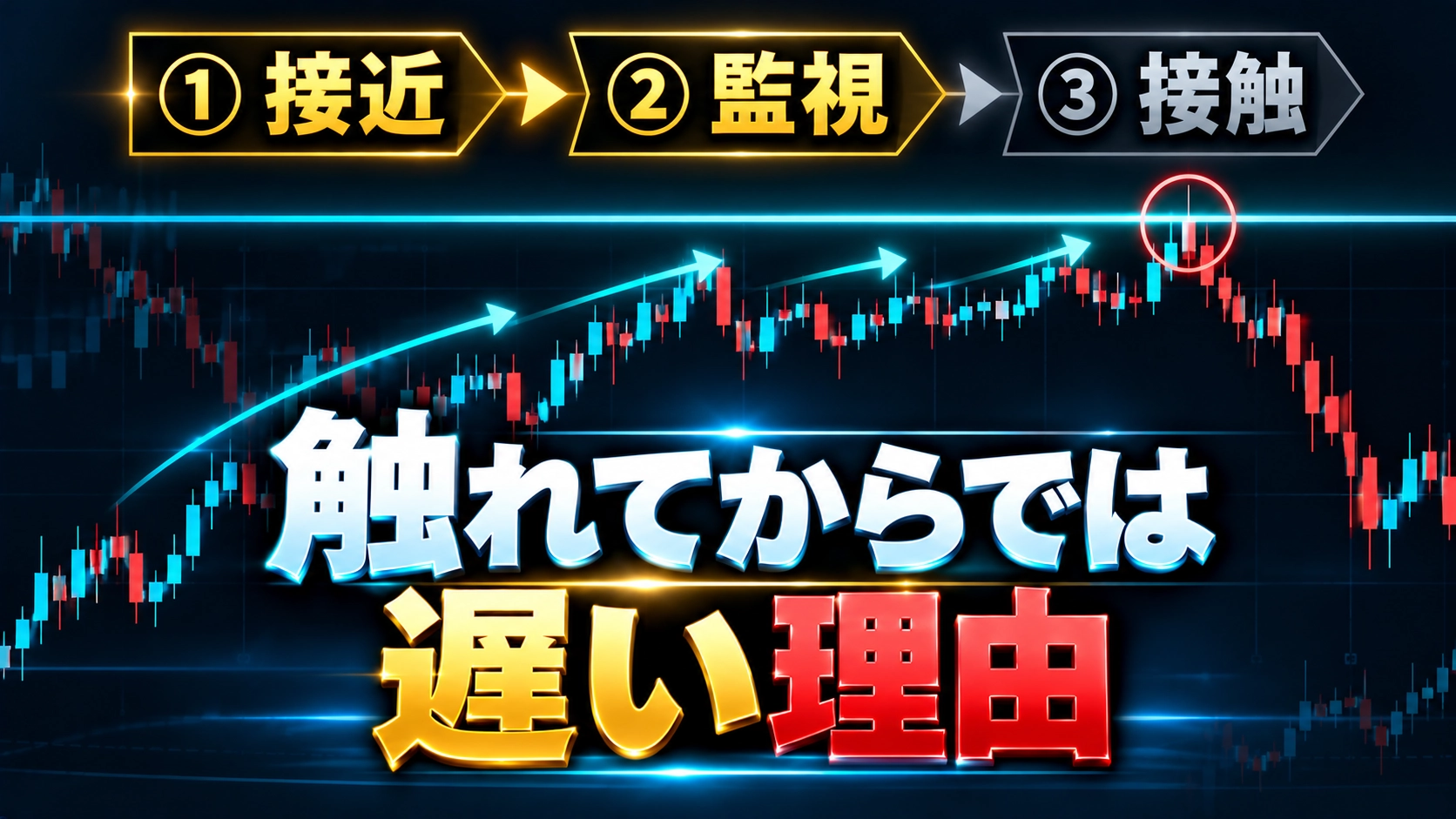
[Episode 3] Why short-term horizontal trend trading isn't enough if you wait for a “touch” before acting
The first part talked about “which number contact this is” and the second part about “how it is approaching.”
This time, it is about time (timing) in trading.
When aiming for reversals at a horizontal line or a breakout, especially on shorter timeframes, scalping, or day trading, you may have experienced something like the following:
Touched the line
An alert or signal appeared
Noticed the alert and opened the chart
By then, one wave (the reversal) had already completed…
This is the same whether you trade manually or use indicator signals, andif you design “to view after the event is confirmed (completed),” it tends to lag structurally in short-term trading.
The reason is not that our judgments are slow or that we lack perseverance. It lies in the fact that the “order of confirmation (timing)” is too far back.
Two reasons why “acting after touching” is slow
① The time from reaching the line to reacting is too short
In short timeframes, the speed from line reach to reversal (or breakout) can be extremely fast.
The sequence of “reach → reaction → price moving away” can finish before we even notice the alert and open the chart.
② Alerts and signals only tell you about past events
Common alerts and arrow signals typically inform you of a past fact such as “conditions met” or “touched.”
While it’s useful to be informed about what happened,if you start preparing only after you receive the report, by the time you finish preparing, the situation may have already changed.
Therefore, in short-term horizontal-trend trading, you should not only
“judge after touching”
“open the chart after a signal is issued”
but alsoprepare in advance during the period before touch (approaching stage)to determine the outcome, which can be a deciding factor.
The “distance, momentum, and initial stalling” discussed in Part 2 are precisely the preparation materials for that.
If the approaching process is visible in advance, you can have a scenario ready for what to do when touched at that moment, eliminating the need to start from scratch after reaching the line.
So how should we apply this “preparation in the approaching stage” to actual trading procedures (practical trading)?
In fact, you don’t need to think about it as something difficult.
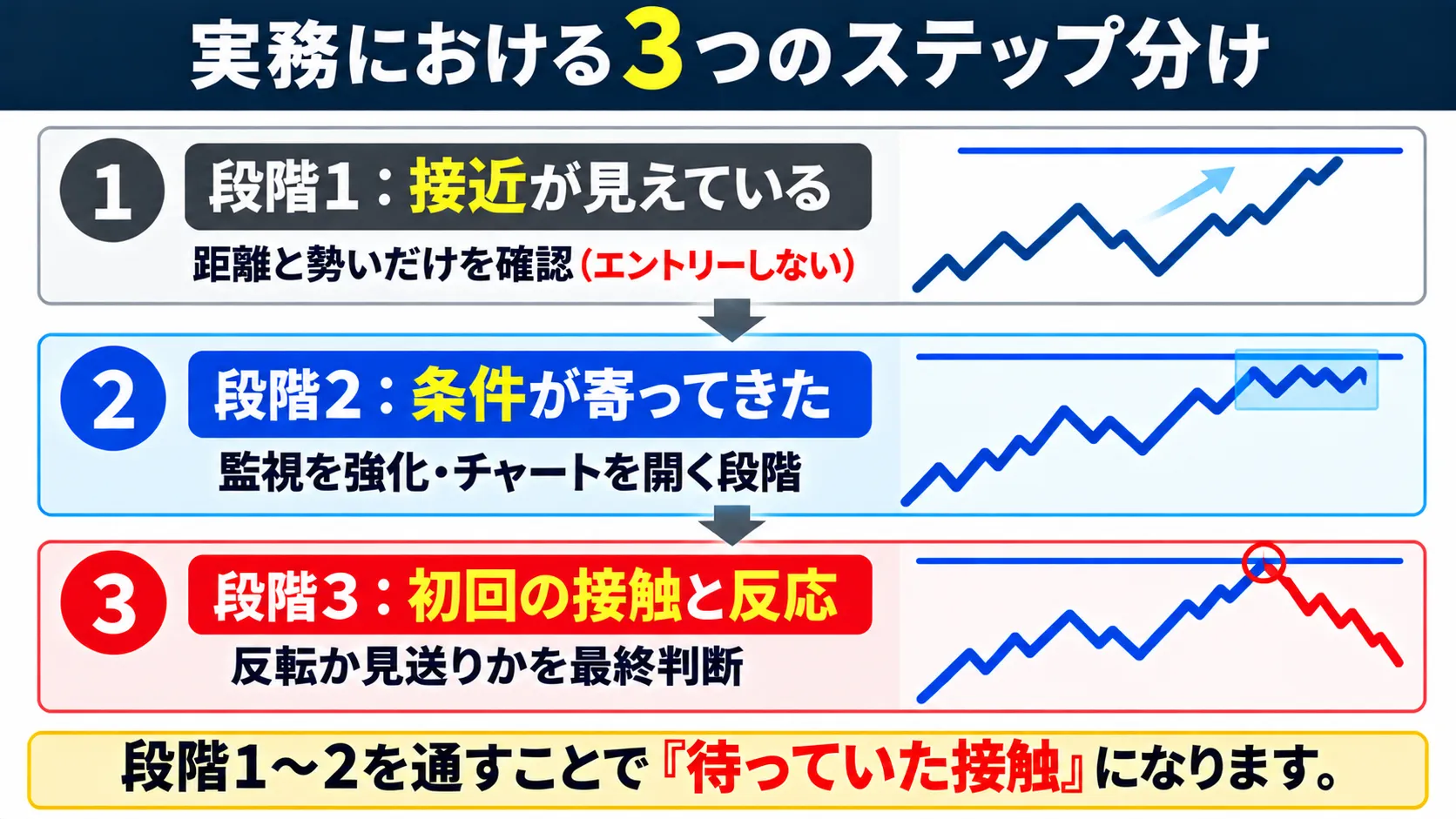
What I consciously apply in practice is a “three-stage step division” to avoid making trading overly complex.
Stage 1: Approaching is visible (preparation)
Prices approaching an important line that hasn’t been touched yet.
Here, we don’t consider entries at all. We simply check the distance to the line and whether there is momentum, and mentally brace for what’s to come.
Stage 2: The approaching conditions arrive (monitoring intensifies)
In addition to approaching, you see strong momentum or front-side consolidation, so it is no longer merely a distant approach.
At this point, it becomes meaningful to “watch the chart closely” and “increase monitoring of alerts.” It is not yet the stage of entering because it hasn’t touched yet.
Stage 3: Initial contact and its immediate reaction (judgment and execution)
What happened after the line was first touched and how the price reacted.
Only here do you make the final decision on whether to enter aiming for a reversal or to pass this time.
The important point isnever start trading at Stage 3.
If you have gone through Stage 1–2 even once, a touch at Stage 3 becomes not a sudden panic event but a pre-awaited, expected contact.
To make this approach practically operable
This three-stage process can be practiced in manual discretionary trading as well.
By narrowing down the horizontal lines to watch and glancing at the chart as you approach, you can drastically reduce the number of times you panic-enter after touching and fail.
However, on the other hand,when monitoring multiple currency pairs or juggling other tasks such as work or housework, it becomes realistically difficult to notice manually at Stage 1 (approach).
In the end, you end up relying on notifications after the price has reached the area, and you repeat the same delay.
If there were a system that allows you to notice during the approaching stage without stress, it would make Stage 1–2 preparation more feasible—in real terms.
That is precisely why I developed a horizontal-line indicator for MT5—this is the main motivation.
It automatically draws lines, clearly separates “approach” and “monitoring” states, and makes a final judgment at the first touch.
Not by watching the arrow after touching, but by being able to track in real time the “pre-touch state” on the chart and in notifications.
The concrete form of this is
“TENRYU LEVELS FX”.
APPROACH (Approaching):Detect approaching of horizontal lines (R1/R2/S1/S2)
WATCH (Monitoring):Visualize and notify when conditions are approaching
TOUCH (Judgment):Treat the initial touch reaction as the official signal
It is not just a tool to “jump in when a signal appears,”but an indicator that supports the trading process itself of “preparing the scenario from the approaching stage.”.
※This tool is to assist and improve judgment and does not guarantee future profit or win rate.
※When using on a short timeframe and “opening the chart after seeing the alert,” there may still be inevitable delays depending on market conditions. Please understand this in advance.
Summarizing the contents from Part 1 to Part 3 yields the following:
What number contact is that line on? (line freshness)
How is the price approaching? (approach process)
Has that confirmation started only after it touched? (timing)
Drawing horizontal lines on a chart is easy.
What is truly important is the mindset shift from chasing reactions afterward to preparing during the approach.
Next time, even for the same horizontal line, how should you change your entry decision between an approach with momentum and one without?
I will write about the overlapping conditions and how to organize them specifically.