
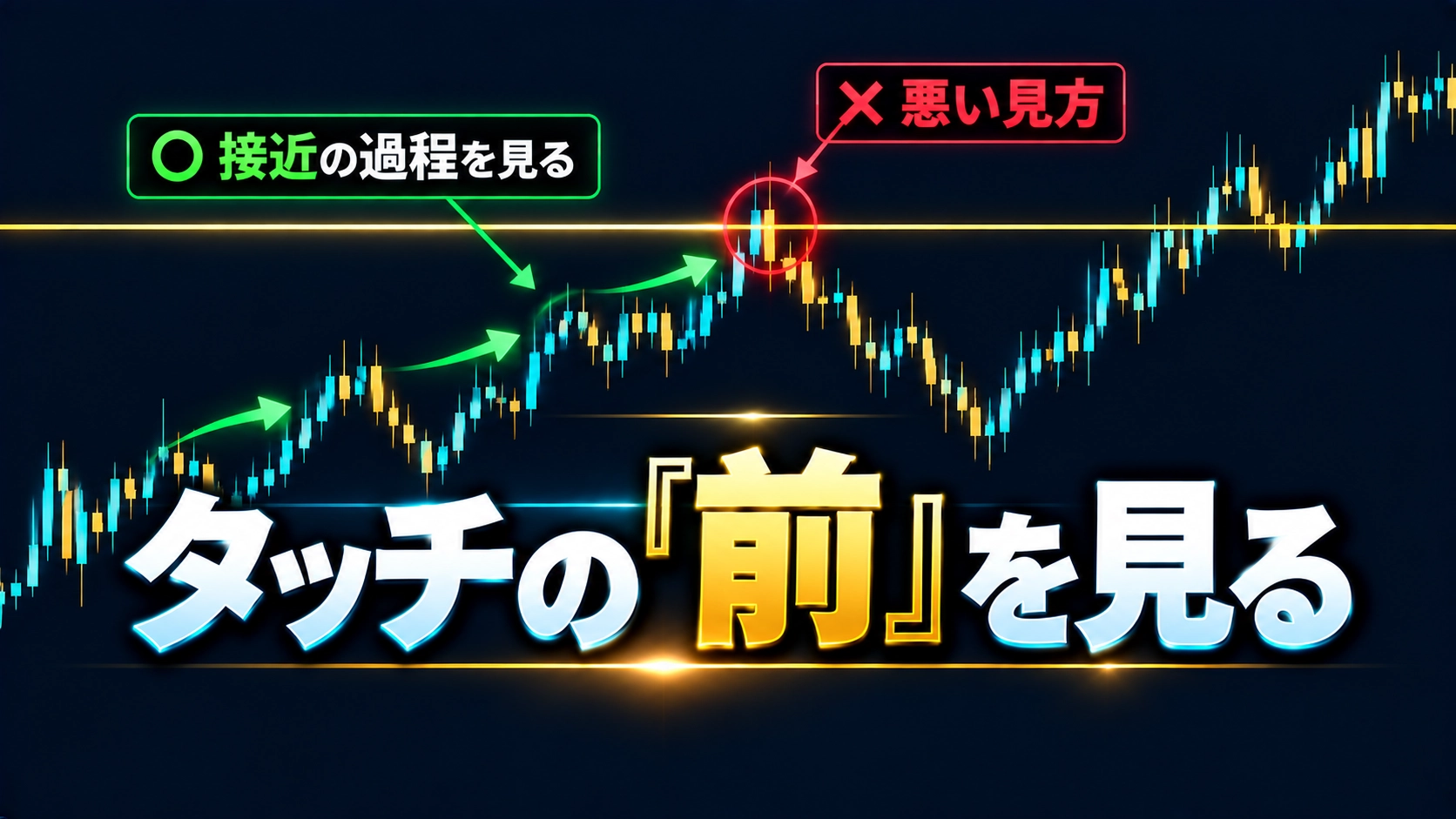
[Episode 2] Are you only looking at the moment the horizon “touches”?
Last time, I wrote that it’s better to distinguish “which number contact this line is” rather than how many lines to draw.
For an untouched line and a line that has already been touched many times, the meaning is different even for the same horizontal line. The first step was to separate them.
This time, we go further.
The most common mistake in horizontal line trading isto only look at whether it touched the line (the moment of contact).
When you look at the chart, your eyes inevitably go to the moment of contact.
“Candle wicks overlapped with the line,” “the wick touched it,” “did it reverse there or not.” When reflecting back, that single impression tends to remain strong.
However, the real market drama (offense and defense) starts long before touching the line.It begins long before the touch.
Is it approaching straight and with momentum?
After pausing once, is it approaching again gradually?
Is it bouncing back and forth near the line (consolidation) several times before reaching it?
Even for the same “touch,” if the process to reach it differs, the reaction after touching will change completely.
At least for me, while I’m only cutting and looking at the moment of arrival, I cannot logically explain later “why I entered there” or “why I got out this time.”
What tends to happen if you only look at the moment of arrival?
There are two main reasons.
① You are already seeing it as late
Especially in short-term timeframes or in highly volatile markets, once the line is touched, an alert may ring, and by the time you open the chart, a wave (price action) may already be finished. When you check on a smartphone notification or during some other task, the price may have already reversed from the line or broken through with vigor.
② You think “touch = event complete”
Reaching the line is just a fact, but whether it’s the first time, a strong, rapid approach, or it arrived after expending energy beforehand cannot be determined from a single candlestick at the moment of touch.
If you oversimplify “touch = entry,” you throw away important chart clues (hints) that could be obtained.
That doesn’t mean you should analyze every approach with complex multi-time-frame analysis.
What’s important is to develop a habit of watching how price approaches before deciding whether it touched,and to observe this just one step at a time.
So, what exactly should we look for in the process of approaching the line?
Actually, the points to check are not complicated. I focus on the following three.
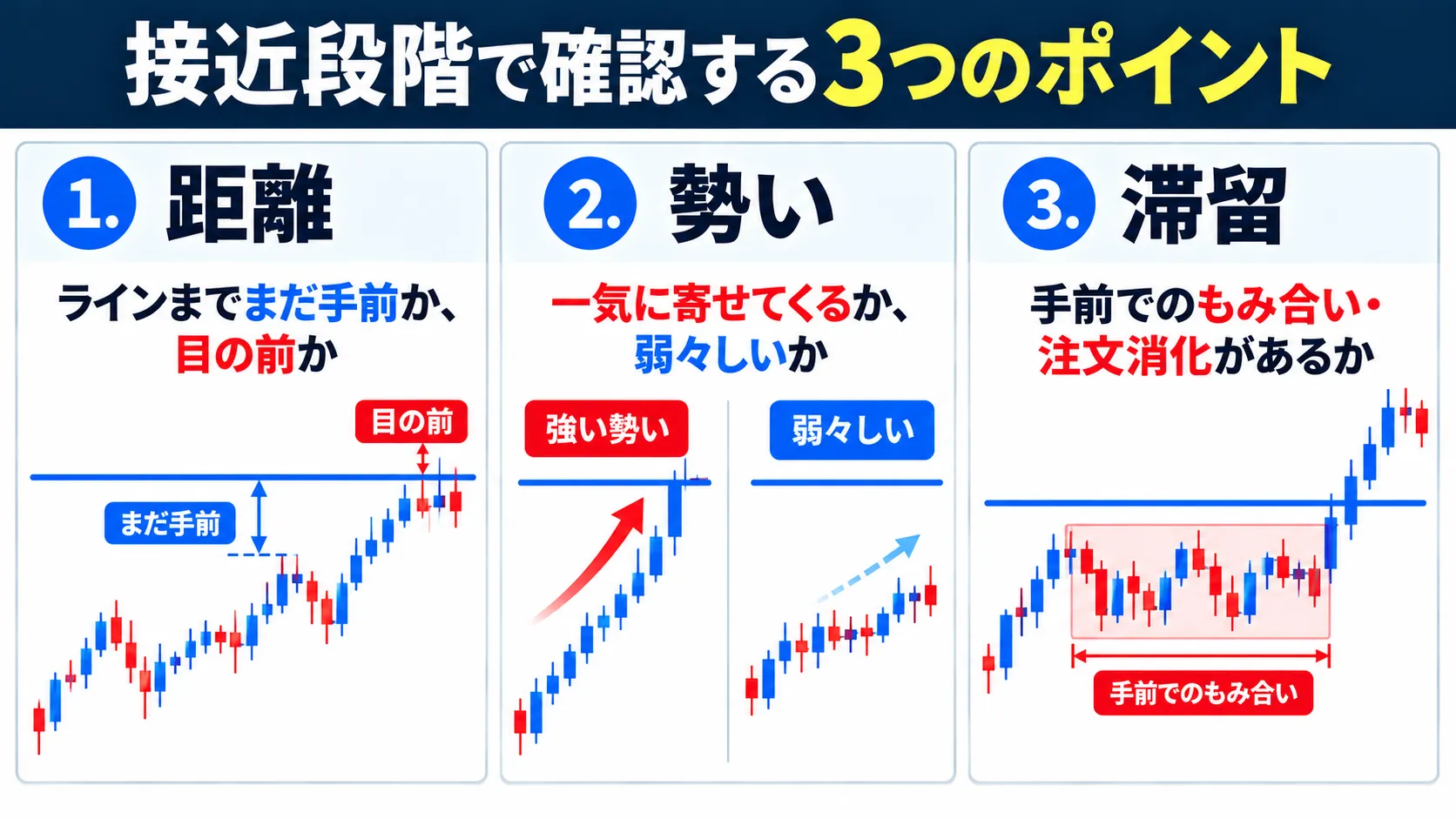
When I observe the approaching process, I keep it simple with these three points to avoid doubt.
1. Distance to the line
“Is it still quite far away?” “Is it already in front of my eyes?”
“Almost touching” vs. “still approaching” have completely different implications for trade preparation (scenario construction).
2. The momentum of approaching
Did it approach quickly in a short time, or did it gradually approach over time?
A fast approach may break through in one go, or it may strongly reverse on the first touch. What’s important here is not trying to predict which way it will turn, butto correctly recognize that it’s a momentum-driven approach and to prepare accordingly.
3. Stalling near the line (defense and offense symptoms before the line)
If it stalls up and down near the line, the battle (order fulfillment) around that line may already have begun. On the other hand, if it reaches almost straight to the line without much stall, there may still be strong energetic rebound typical of the first touch.
You don’t need to quantify these three every time with difficult scores.
When you open the chart, you only need to be able to describe in one sentence which of the following is most prominent right now: “distance, momentum, or stall near the line.”
Just by adding this check after drawing the line, you can move away from the aimless trading of “buying/selling simply because there was a touch,” and make decisions based on reasons.
.
If you combine the previous discussion of “which number contact” with this time’s “process of approaching,” your view of how to read horizontal lines updates as follows.
Is the line a “first candidate” or “already touched”? (state of the line)
How is the price approaching now? (process of approaching)
Are you fixated only on the moment of arrival? (objective view)
If you insert this check after drawing the line, you can escape from aimless trades of “buying/selling just because the price touched a line” and make decisions with solid justification.
Next time, I will write about why in short-time frame trading you cannot be timely enough if you move after the signal or touch, and discuss “how to prepare for entry from the approaching stage.” and .