

[Episode 1] The horizon is not about “how many lines to draw” but about “which contact number it is”
Many traders use horizontal lines.
Support and resistance. Easily noticed highs and lows. Round numbers.
Although people draw them differently, the idea of “placing a line on the chart where the price is likely to react” is common.
However, as you become more proficient with horizontal lines, everyone will inevitably hit the same wall at least once.
“There are too many lines; I don’t know where to wait.”
Recent highs, a bit earlier highs, weekly granularity levels, daily granularity levels, round numbers… If you draw all the points you’re curious about, the chart becomes cluttered with horizontal lines in no time. And the more lines there are, the slower your entry decisions become.
When I was trading with discretion, I fell into exactly the same state.
The more I drew, the more it felt like I could breathe easier, but as a result my judgment slowed.
Looking back now, it wasn’t that I increased the number of lines, but that I hadn’t decided what to look at.
In fact, the reason for confusion with horizontal lines isn’t only “how to draw them (where).”
What truly deserves attention is that even if the lines are the same,
a line that has never clearly reacted (uncontacted)
a line that has been touched and held many times (contacted)
the meaning of the price movement that line represents is completely different.
We are often taught that “a line that has stopped price many times is a strong line.”
However, the more a line has effectively acted, the more something is happening behind the scenes, and it may already be absorbed by market participants.
So when we draw lines on a chart, which should we prioritize viewing?
In short, there is no need to decide which is "absolutely correct."
What matters isto clearly distinguish and be aware of "which number contact this line has had" at this moment.
Rather than how many lines you drew,
you should consider whether that one line is an “initial reaction candidate” or a “line already digested.”
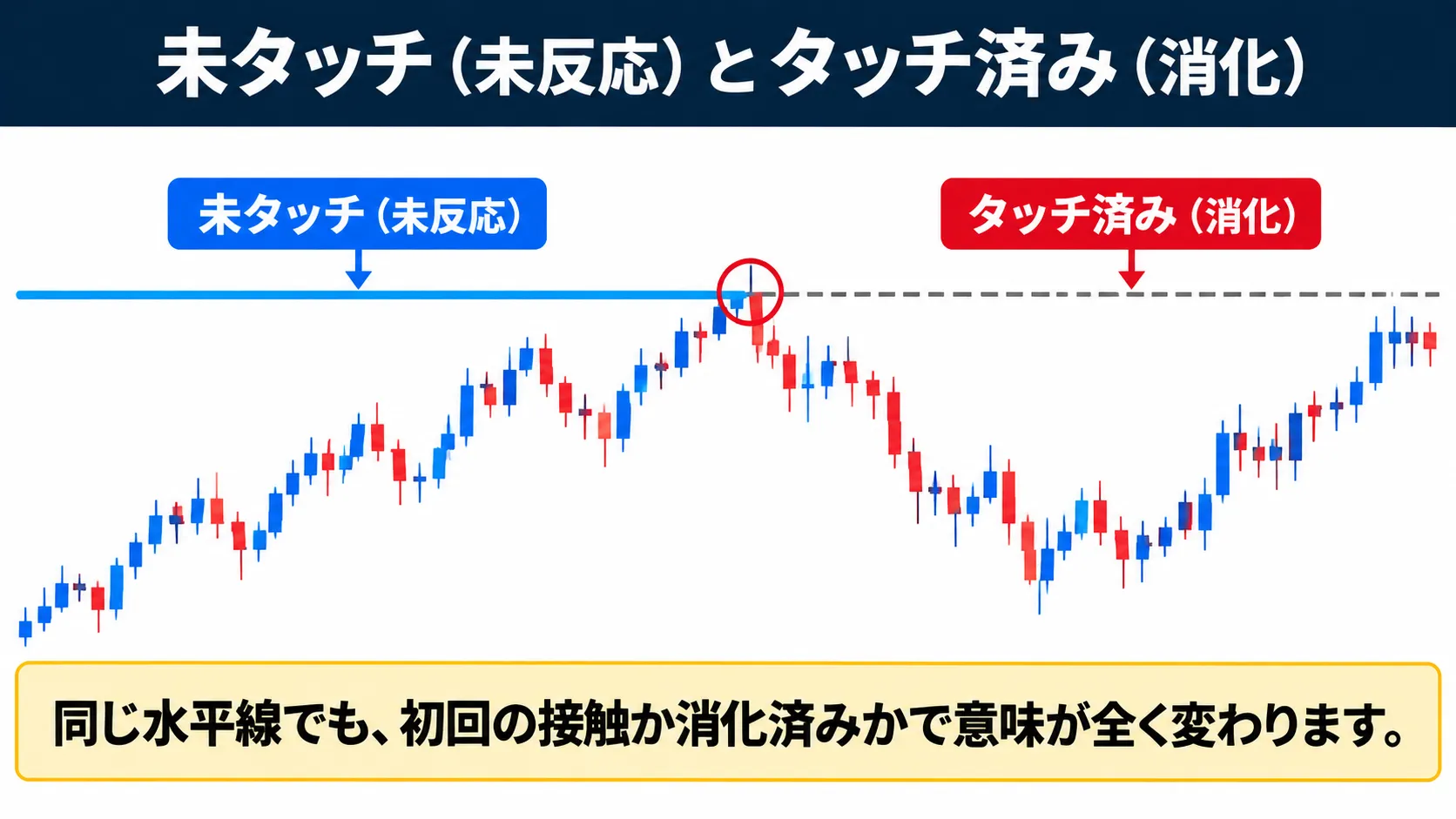
If this remains ambiguous, even with the same horizontal-line trading, the world you see will differ from person to person.
When using horizontal lines, I first organized three points in my head:
In the current time frame, can I narrow down the lines to watch (reduce the number)?
Is that line still a first reaction candidate, or has it already been touched (state awareness)?
Is the price only looking at the moment of arrival, or is it also watching the approach (observation of price movement)?
① is about “narrowing.” Narrow down the important candidates to a few and don’t treat all of them with equal weight.
② is the main topic this time.
The “initial reaction” to an uncontacted line and the “re-approach” to a contacted line look the same on the surface as a horizontal-line touch, but the internal battles differ. At least for me, I avoided treating these two under the same conditions haphazardly.
※ I will write in detail about the “approach process” in the next installment, but in short-term trading, there are many situations where information just before the touch is more important than the moment of touch itself.
One caution: “Prioritizing the first contact does not mean it will always reverse.”This is not a universal sacred rule.
On the contrary, it is closer to saying, “Because it is the first contact, observe carefully how the price reacts.”
Lines that have already moved up and down many times have, each time, buyers and sellers changing positions, and the order book may have been digested. On the other hand, lines that have not yet clearly reacted may be places where large orders will confront price for the first time.
Instead of deciding “which is stronger,” observe the reaction after distinguishing how many times the price has touched it. That way, whether you win or lose, you’ll retain learning about “why it happened” on the chart.
Drawing lines on the chart is not difficult in itself.
The real difficulty lies in not giving all drawn lines the same weight.
If you use horizontal lines, before you increase their number heedfully, ask yourself:
“How many times has this line been touched so far?”
That is the only message I want to convey in the first instance.
Next time, I will write about what tends to happen when you only look at the moment the line is reached.
I will discuss how to read the market pressure from the approach process.