

[Very Important] What is the Risk-Reward Ratio? [Capital Management / Position Management Part #1]
Hello! This is SAKU!
This time, I will detour from a discussion on technical analysis and split into several parts to talk about money management and position management.
First of all,Very, very important!
In previous articles as well,the article about turning a small amount of capital into 1 million yen with high leveragewas touched on, but in FX, you cannot win merely with chart-reading skills.
Let’s also make sure to thoroughly learn about money management!
About Money Management and Position Management
Money management and position management are essential skills to protect your funds and grow profits.
As for profits, you can only leave it to the market’s direction; you cannot control it, sothe only thing you can control in the market is the amount of loss.
No matter how high your win rate is, if this part is sloppy, you will have a hard time sustaining wins month after month.
First, what you should know in money management,the risk-reward ratio—let’s look at it!
What is the Risk-Reward Ratio?
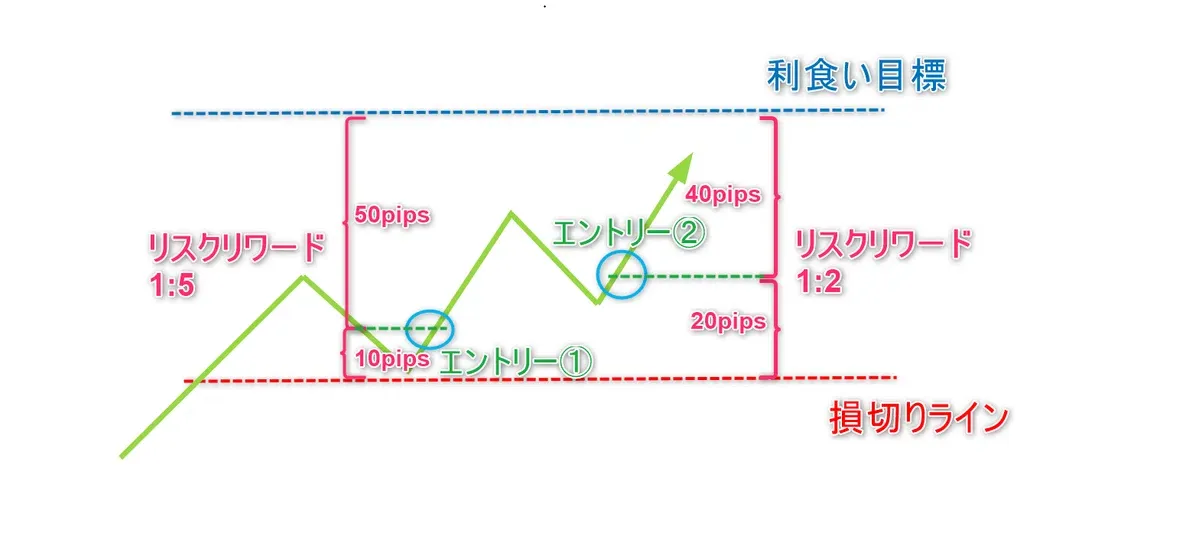
The risk-reward ratiois the ratio of loss (risk) to profit (reward). It can also be thought of as the ratio between the stop-loss distance and the take-profit target.
Generally, it is said that trades should have a risk-reward ratio of at least 1:2.
Example) Stop loss 25 pips: expected profit 50 pips = 1:2 risk-reward ratio
Of course, if profits later extend, the risk-reward ratio becomes more favorable.
In the above example, if you ultimately take 100 pips, the risk-reward ratio becomes 25:100 = 1:4.
Regarding the risk-reward ratio,always be mindful before you enter.If it is 1:1 or less, you should not enter.
Loss is small, profit is large—this is the principle. If the risk-reward is poor, you will slowly blow up.
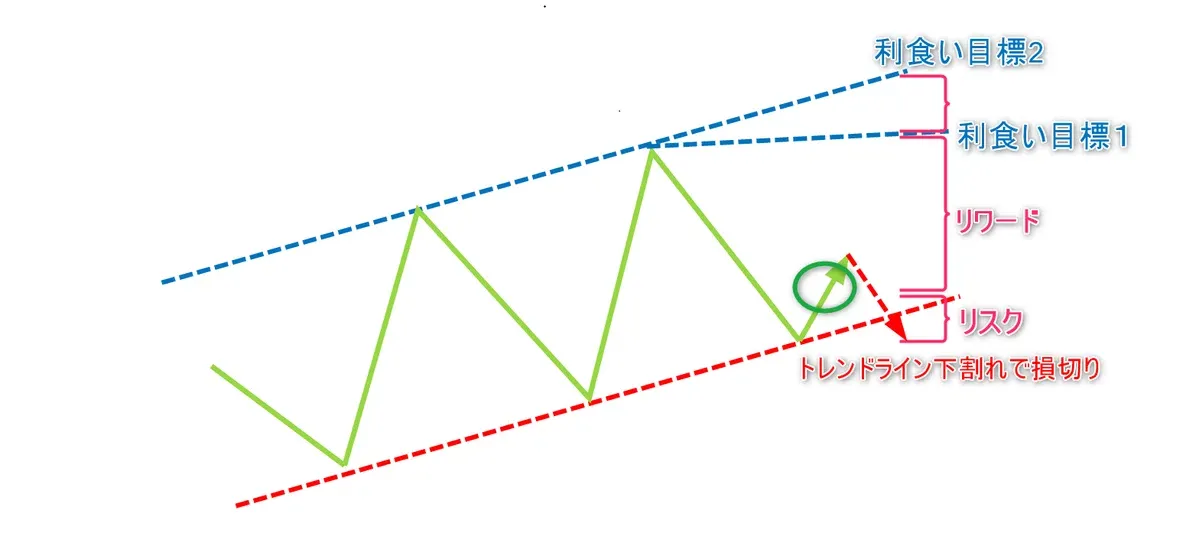
If you entered at the green circled area in the figure, the range from the trend line break to the stop-loss becomes the risk, and the first take-profit target (the previous high) becomes the reward for the moment.
If you set the take-profit target to reach the channel line, the reward increases accordingly, and the risk-reward ratio becomes higher.
Caution for Small Loss, Large Profit!
What to be careful about here isnot to set the risk-reward ratio according to your convenience.
For example, if the stop-loss line is 10 pips away, and you decide the take-profit target should be 20 pips to make it 1:2, I do not recommend this..
Conversely, if the take-profit target is 20 pips away, so you set the stop-loss at 10 pips to make it 1:2, I also do not recommend this..
Both are not based on analysis-driven risk-reward, but rather on your convenience to set the ratio.
So what should you do?Based on the analysis, if the risk-reward is what it should be, then enter when a good opportunity arises.
Or, if the risk-reward is poor, then skip it—this kind of judgment is desirable.
We said the principle is small losses, big profits, butultimately it depends on the market; trade when the market flow suggests you can achieve small losses and big profits.
A good entry, in my view, is not an entry where profits immediately rise after entering, but an entry at a place that is easy to exit (to escape).I believe so.
The Relationship Between Win Rate and Risk-Reward
For example, compare Mr. A with a 100% win rate (invincible) and Mr. B with a 50% win rate.
Assume both start with 1 million yen and make 10 trades.
Here, Mr. A’s risk-reward ratio is 1:1, and Mr. B’s is 1:4, and the loss per trade is 20 pips for both trades.
Mr. A does not lose; obviously 10 straight wins.
Mr. A 10 trades 10 wins 0 losses
Losses 0 pips Profit 200 pips
Result: +200 pips
Mr. B wins and loses alternately, about half and half.
Mr. B 10 trades 5 wins 5 losses
Loss 100 pips (20 pips × 5 losses) Profit 400 pips (20 pips × 4 × 5 wins)
Result: +300 pips (profit 400 - loss 100)
Despite Mr. B’s lower win rate, the final profit is higher, right?
This shows thatwin rate does not necessarily equal profit.
Of course, a higher win rate is preferable, but keep in mind that the risk-reward must be high as a prerequisite.
※ Some products boast high win rates, but if you worsen the risk-reward ratio—e.g., by setting an abnormally wide stop-loss—you can more easily increase win rate, so beware.
With a risk of 20 pips per trade and profits of a few pips, it will be easier to win, but the risk is too large.
Today, as the introduction to money management, I talked about the risk-reward ratio!
Always pay attention to the risk-reward ratio before you trade each time!
If you keep a trading journal and write the risk-reward ratio for each trade, you can later calculate your average risk-reward and assess its quality, so this is recommended!
Next article is here ↓
Isn’t it a disaster if you don’t know?! The 2% Rule and Bankruptcy Probability [Money Management and Position Management Part 2]
For more in-depth money management, learn more here! ↓

【Limited-time launch campaign!】→ MMS Trading Encyclopedia— A market microstructure analysis that reveals the "structural traps" and the footprints of big players that individual investors fall into (There is also a free sample edition)

→The Secrets of MTF Multi-Time-Frame Analysis (There is also a free sample edition)