
Do holidays morning drop? Do the mornings at the start of the month rise? Dollar-yen “Tokyo morning routine” count three rules in 1-minute bars over 11 years 9 months
Hello. I am the "Verification Sommelier" who lists indicators (EA is under review).
Last time, I counted for 11 years 9 months of 1-minute data whether the dollar/yen really falls after the Gov’t Market Rate on Gotō day.
This time, as a continuation, I count three patterns that are said to occur in the Tokyo morning at fixed dates and times using the same data: mornings of holidays, the first business day of the month, and the early morning after holidays.
Previous article:https://www.gogojungle.co.jp/finance/navi/articles/127721
Conclusion First
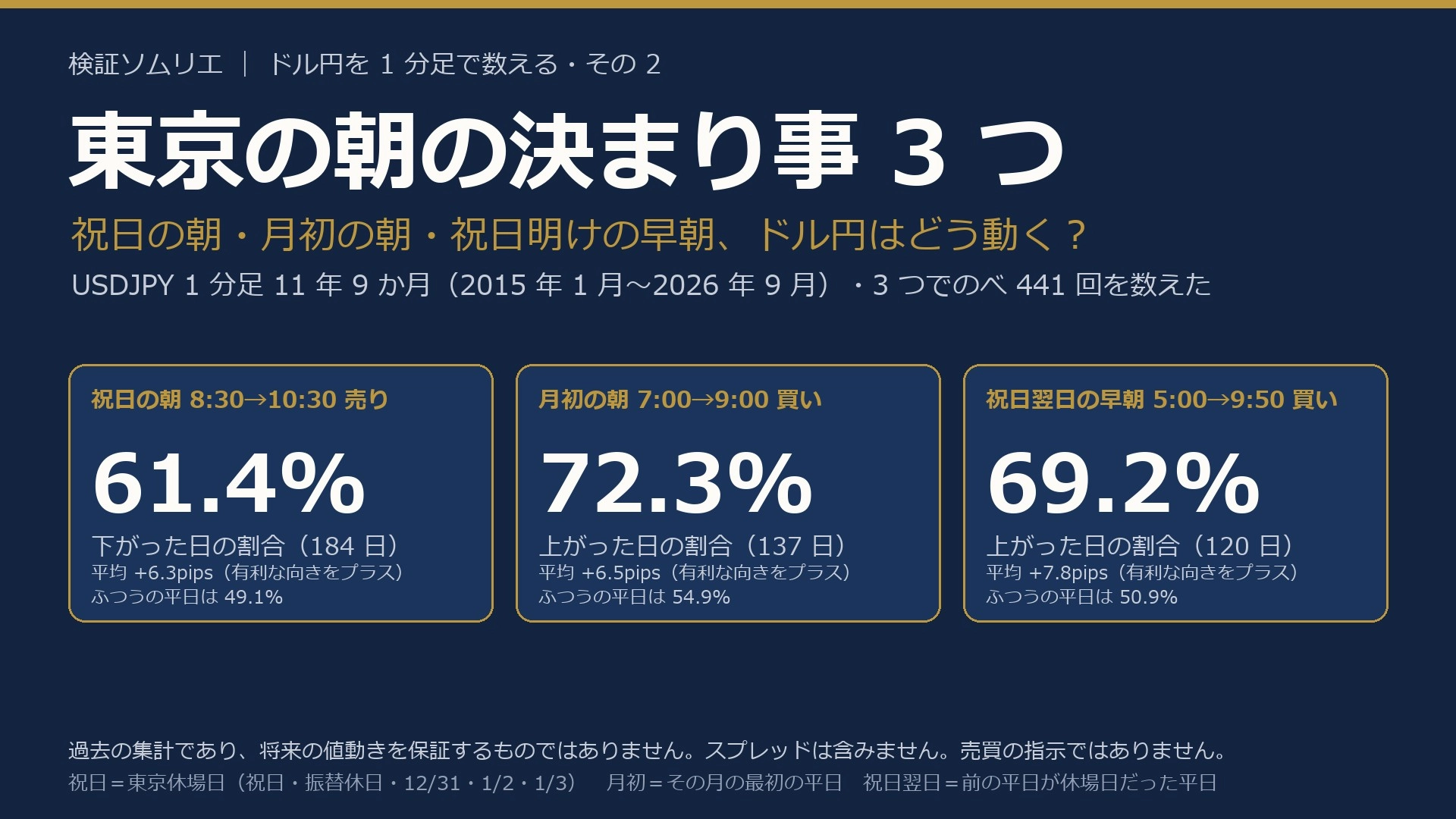
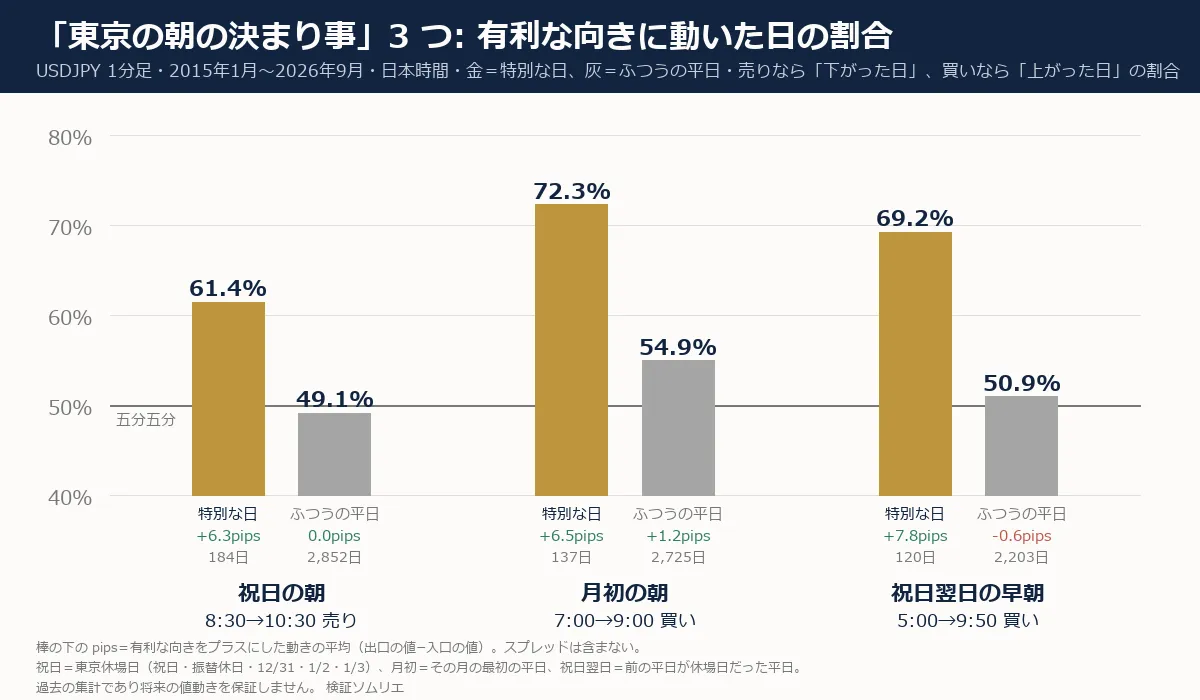
・Holidays (Tokyo market closed) from 8:30 to 10:30: days when it went down were 61.4% (184 days). On ordinary weekdays it was 49.1%, roughly a coin flip.
・The first business day of the month from 7:00 to 9:00: days it rose were 72.3% (137 days). On ordinary weekdays it was 54.9%.
・The morning of the day after a holiday from 5:00 to 9:50: days it rose were 69.2% (120 days). On ordinary weekdays it was 50.9%.
・If you combine all three as a simple 20-pip stop-loss trading, over 11 years 9 months there were 441 occurrences in total, with a win rate of 62.8%, total +2,483 pips, and a profit factor of 2.37 (excluding spread). After subtracting a cost of 1.0 pip, it remains 2.03.
・Even when recounted for only the period after fixing the time window (Jan 2025 to Sep 2026), all three still show bias (total 73 occurrences, profit factor 3.39).
・However, each pattern is small, occurring only 7–18 times per year, and some years are negative.
What is “Tokyo Morning Routine”
All are said to be explained by demand in Tokyo (actual currency trading by corporations and investors) clustering at those specific dates and times.
・Holiday mornings: Japanese holidays mean Tokyo market is closed and there is no fixing rate. When domestic importing companies’ dollar purchases don’t come in, dollar/yen tends to fall in the morning.
・First of the month mornings: At the start of the month, dollar buying gathers due to payments by importing companies and setting of investment trusts, so it tends to rise early in the morning.
・Morning after holidays: Demand that built up during the break emerges from the early morning after the holiday and tends to rise toward the fixing rate.
Whether this is true or not is not confirmed in this article. What is confirmed is only how biased it is when counted.
Method of Counting
・Data: MT5 USDJPY 1-minute chart, from Jan 1, 2015 to Sep 30, 2026 (11 years 9 months). Times are converted to Japan Standard Time.
・Holidays: Japanese holidays (including substitute holidays and national holidays) when the Tokyo market is closed, adding Dec 31, Jan 2, Jan 3 as “Tokyo closed days.” Do not count if they fall on weekends (market closed). Jan 1 has no market record, so it is excluded.
・First of the month: the first weekday of that month (in January, skipping Jan 1 to the next weekday). Even if Tokyo market is closed on Jan 2, it is counted as the first weekday of the month (same as EA/indicator).
・Day after a holiday: a weekday that is not a holiday and whose previous weekday was a Tokyo holiday. Mondays at 5:00 the market is not yet open (week starts at 6–7), so if Friday is a holiday it does not count.
・Time window: holidays 8:30→10:30, first of the month 7:00→9:00, day after a holiday 5:00→9:50. Compare the entry time with the exit time.
・Comparison benchmark “ordinary weekdays”: weekdays that are not Tokyo holidays and do not meet the above conditions. Count in the same time windows.
・Simple trading: open at entry time, close at exit time. If price moves 20 pips against, stop loss. Spreads are not subtracted (numbers with 1.0 pips and 2.0 pips are provided in notes).
・Profit factor = total gains ÷ total losses. Greater than 1 is positive; 2 indicates you earned twice as much as you lost.
・If two events coincide on the same day (e.g., Jan 2 where first of the month and holiday coincide, or a day where first of month and day after a holiday coincide, 9 days in total; 431 days, 441 occurrences cumulatively), count separately for each time window. Since the EA can hold only one position at a time, on such days only one side is counted.
・Judgments for holidays, first of the month, and the day after holidays follow the rules in the indicator “Gov’t Rate After Sign” and the EA “Gov’t Rate After Sign.”
Result 1: The Morning of Holidays (8:30→10:30)
・Holidays (184 days): days that fell, 61.4% down, average change −6.3 pips, median −3.6 pips (negative = decline).
・Ordinary weekdays (2,852 days): days that fell 49.1%, average 0.0 pips, median +0.4 pips.
・8:30 Sell, 10:30 Buyback and stop loss 20 pips: win rate 59.2%, average +6.0 pips per trade, total +1,108 pips, profit factor 2.48. Stops hit on 21 of 184 holiday days.
・By year, 9 of 12 years were positive. Losses occurred in 2015 (−9 pips), 2017 (−31 pips), 2021 (−5 pips). First half (2015–2020) had profit factor 1.75, second half (2021–2026 Sep) had 3.11.
・Of the 184 days, 80 were Mondays (due to the Happy Monday system and substitute holidays).
→ On ordinary weekdays, 8:30→10:30 is about 50/50, while on holidays 60% of days fell.